
Why one number can change the mortgage you are offered
Ask a room of Canadian homebuyers what credit score they need for a mortgage and you will hear confident, completely different answers: 600, 650, 680, 720. The reason for the confusion is that all of those numbers are real — they just belong to different doors. There is no single national pass mark for a mortgage in Canada. Instead, there is a ladder: a minimum set by the mortgage insurers, a higher practical floor set by the big banks and other prime lenders, a still higher level where the best pricing usually begins, and, below the insured minimum, a separate market of alternative and private lenders who price risk very differently.
Understanding which door you are actually walking through matters more than chasing an abstract idea of a “good” score. A buyer at 605 and a buyer at 685 can both be approved, but they will not necessarily be offered the same lenders, the same rates, or the same flexibility on the rest of the file. A buyer at 590 is not necessarily shut out of homeownership either — but the route changes, the down payment usually grows, and the cost of borrowing rises sharply. This guide works through the whole ladder using the rules that apply in 2026, explains what a credit score is actually made of, shows how lenders read the story behind the number, and sets out a practical six-to-twelve-month plan for improving a score before an application.
Two cautions before the numbers. First, a credit score is only one part of a mortgage decision. Lenders also test income, debts, employment, the property itself, and the federal stress test. A strong score cannot rescue a file that fails those tests, and a weaker score can sometimes be offset by a large down payment and clean recent behaviour. Second, the score you see in a free app is not always the exact score a lender pulls. Canada has two credit bureaus, Equifax and TransUnion, and lenders may use different scoring models built on bureau data. Treat your consumer score as a reliable compass, not as the lender’s exact instrument.

The 300-to-900 scale and what the bands mean
Credit scores in Canada run from 300 to 900, and a higher score is better, according to the Financial Consumer Agency of Canada. Equifax Canada, one of the two national bureaus, publishes bands that are widely used as a reference: 300 to 559 is rated poor, 560 to 659 is fair, 660 to 724 is good, 725 to 759 is very good, and 760 to 900 is excellent. TransUnion Canada, the other bureau, calculates its own score from its own data, so the same person can legitimately have two different scores on the same day — differences of 20 to 50 points between bureaus are common because not every lender reports to both bureaus and updates land at different times.
Those labels are helpful for everyday credit, but mortgage lending turns on narrower thresholds inside the bands. The most important are 600, 680, and 720. Six hundred is the insurers’ floor for an insured mortgage. Around 680 is where prime “A” lenders generally become comfortable. Around 720 and above is where borrowers typically qualify for a lender’s best pricing, assuming the rest of the file is strong. Notice what that means: a score in the mid-600s sits in Equifax’s “fair” to “good” range and may still leave a buyer short of a bank’s preferred range, while a score in the low 700s — still short of “excellent” — can be entirely sufficient for top mortgage pricing.
The insured minimum: 600, and why it exists
When a buyer puts down less than 20 percent, the mortgage must be insured against default. Canada’s three mortgage default insurers are CMHC, Sagen, and Canada Guaranty. CMHC states the rule plainly in its program materials: at least one borrower or guarantor must have a minimum credit score of 600. That rule is the foundation of the whole ladder, because it defines the smallest down payment route — as little as 5 percent down on the first $500,000 of the price, with 10 percent on the portion above that — for buyers whose scores clear it.
Insured mortgages also carry other conditions that interact with credit. The home must generally cost less than $1.5 million, the amortization is capped at 25 years for most buyers (30 years for eligible first-time buyers and new builds), and the borrower’s debt-service ratios must fit within limits — a gross debt service ratio of up to 39 percent and a total debt service ratio of up to 44 percent under CMHC’s standard guidelines. If you are new to how that insurance premium itself is calculated, our guide to CMHC mortgage insurance premiums, rules, and when you need it walks through the cost by loan-to-value band.
Below 600, the insured door closes. That does not end the conversation — alternative and private routes are covered below — but it changes the arithmetic fundamentally, because the buyer generally needs at least 20 percent down and will pay a higher rate. For a buyer close to the line, spending a few months lifting a score from the 580s to above 600 can be worth more than any rate negotiation that follows.
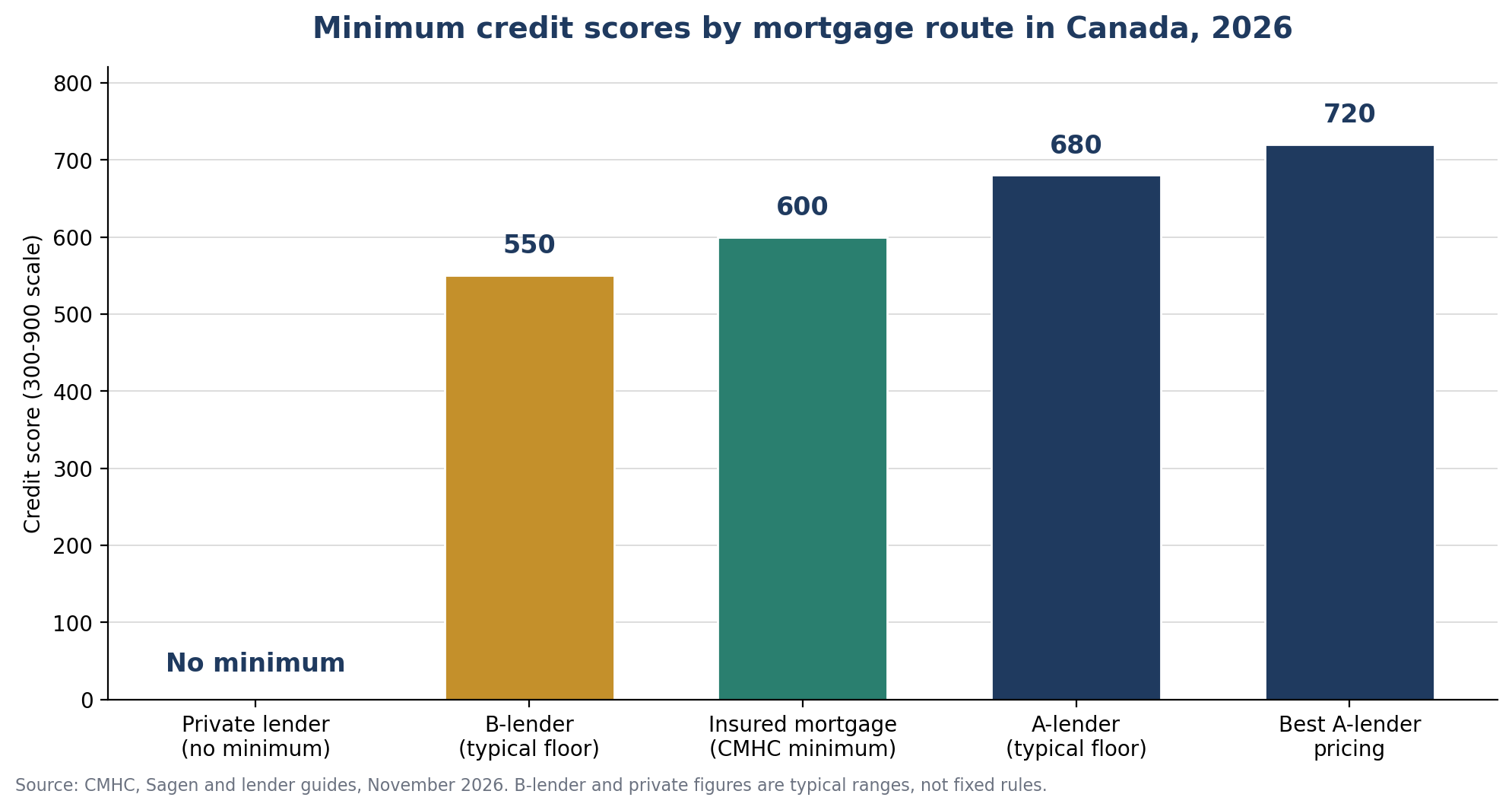
Minimum credit scores by mortgage route in Canada, 2026. Source: CMHC, Sagen and lender guides, November 2026.
The prime-lender reality: about 680, best pricing at 720 and up
The insurers’ 600 minimum is a floor for insurance, not a promise that a bank will approve the loan. Prime lenders — the major banks, large credit unions, and monoline lenders funded through prime channels — set their own, higher standards. In practice, roughly 680 is the common floor for comfortable A-lender approval, and 720 or higher is where best pricing is typically available. Between 600 and 679, an insured mortgage is possible, but the lender will usually want the rest of the file to be strong: stable, verifiable income, modest other debts, and a clean recent payment record with no fresh late payments.
Why do lenders hold a line well above the insurer’s minimum? Because the score is a summary of behaviour over years, and lenders read it as a forecast. A file with a score in the high 600s, two years of on-time payments, and low card balances tells a very different story from the same score produced by a recent missed payment and maxed-out cards that are still near their limits. Underwriters look at both the number and the pattern: how many accounts are past due, whether there are collections, judgments, or a bankruptcy or consumer proposal in the history, and how recent any problems are. Distance from trouble matters almost as much as the trouble itself.
Credit is also only one leg of the approval. Every insured borrower, and most uninsured borrowers at federally regulated lenders, must pass the mortgage stress test — qualifying at the greater of the contract rate plus two percentage points or 5.25 percent. A 780 score does not waive that test. Likewise, the down payment itself has its own rules about sources and seasoning, which our guide to down payment minimums, sources, and gifted down payments explains in full. Think of approval as a set of gates that all have to open: credit, income, debt ratios, down payment, and the property.
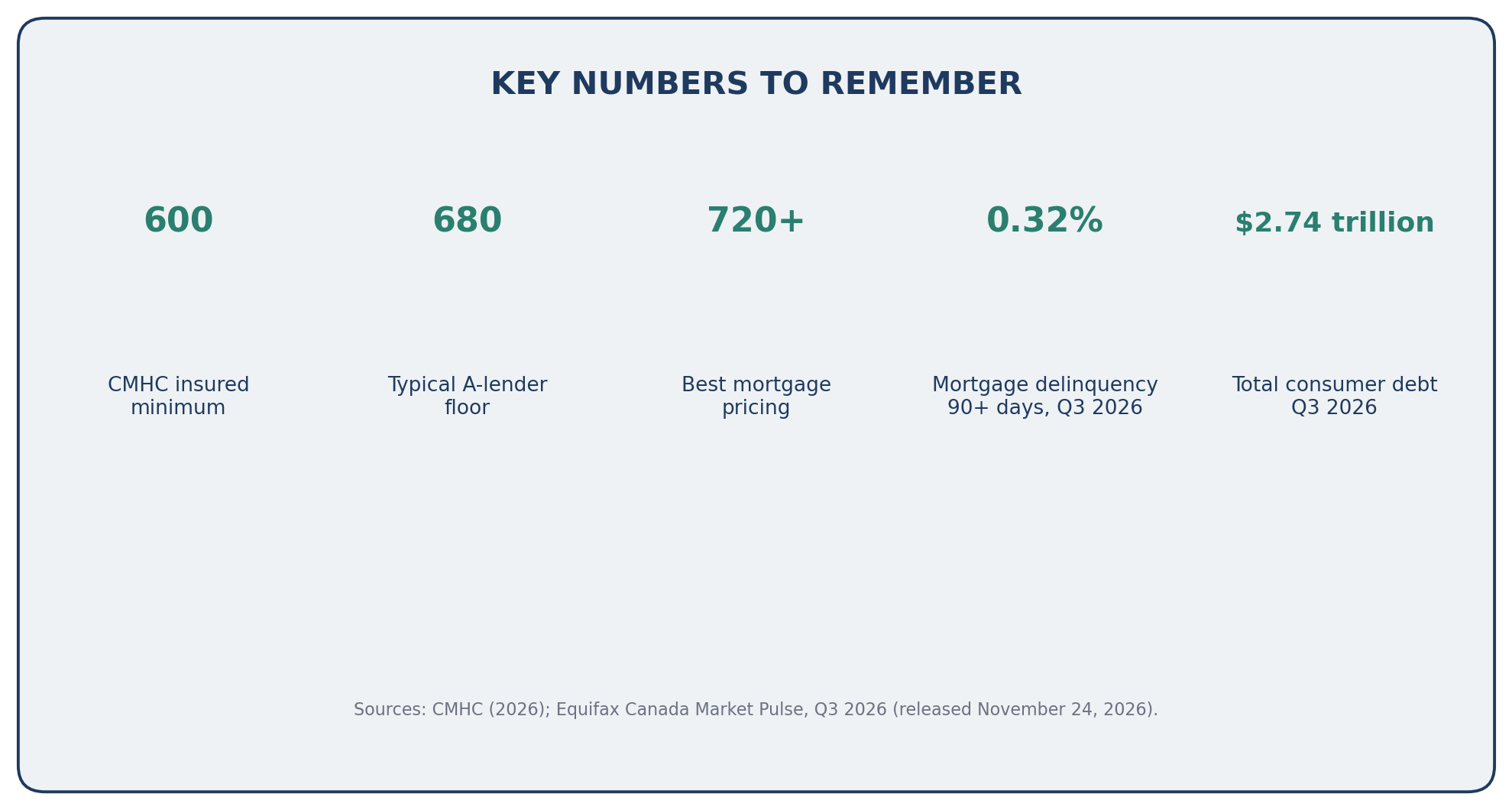
Key numbers to remember. Sources: CMHC (2026); Equifax Canada Market Pulse, Q3 2026.
What a credit score is actually made of
Equifax describes five factors that drive a Canadian credit score, and knowing the weights tells you where effort pays off fastest. Payment history is the largest factor at about 35 percent: whether bills, cards, loans, and lines of credit are paid on time, every time. Credit utilization is next at about 30 percent: how much of your available revolving credit you are using, with lower utilization generally helping the score. Length of credit history contributes about 15 percent, which is why closing your oldest card can be counterproductive. New credit — recent applications and newly opened accounts — accounts for about 10 percent, and credit mix, the variety of accounts handled responsibly, makes up the remaining 10 percent.
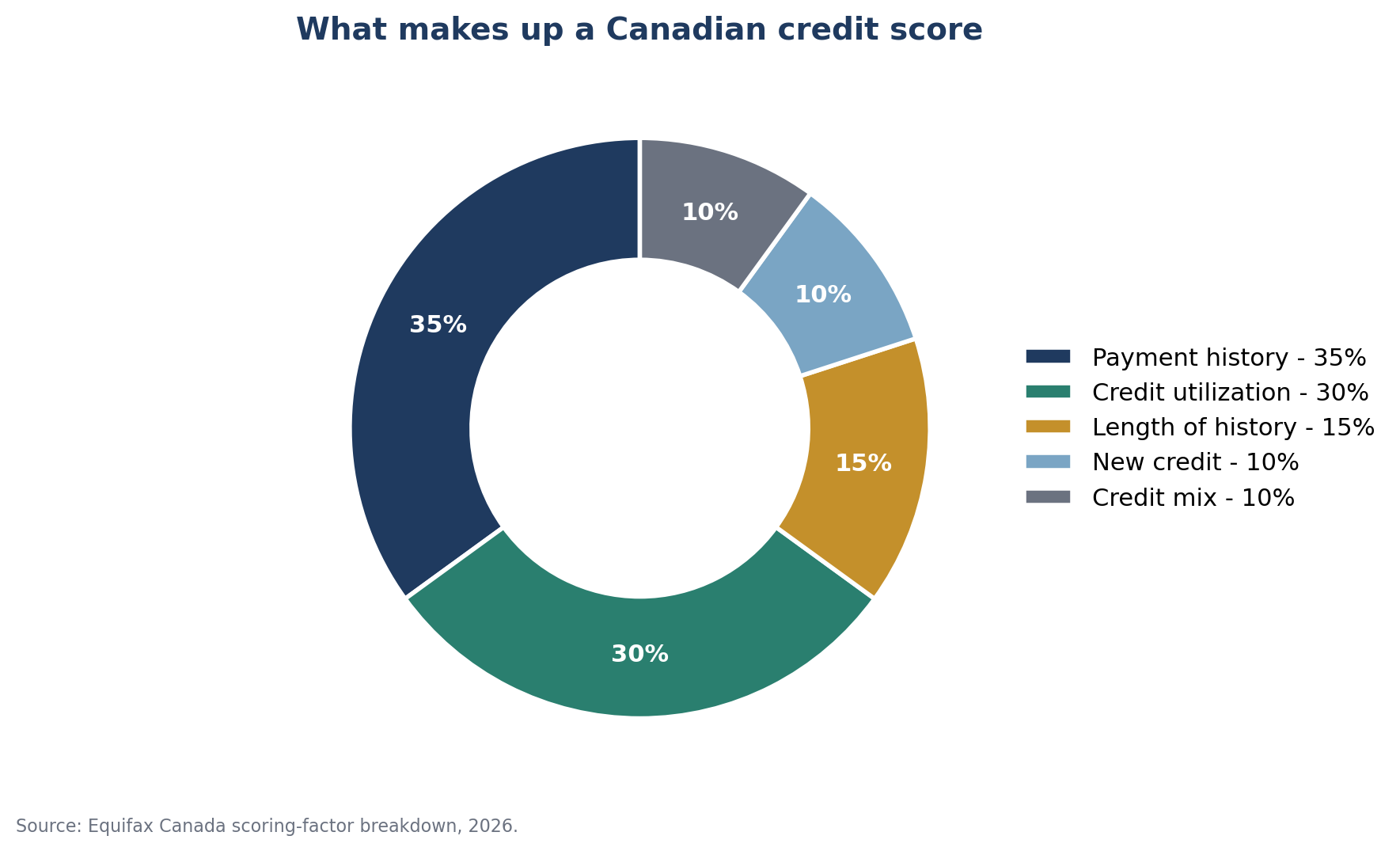
What makes up a Canadian credit score. Source: Equifax Canada scoring-factor breakdown, 2026.
Two practical lessons fall out of those weights. First, two-thirds of the score is behaviour you control month to month: pay on time and keep balances well below limits. Second, time itself is an ingredient. A thin file — common for younger buyers and for newcomers — cannot be thickened overnight, which is one reason starting a year before a purchase is so valuable. Buyers arriving in Canada face a particular version of this problem, starting with little or no Canadian file at all; our guide to buying a home as a newcomer to Canada, including mortgages with no Canadian credit history, covers the newcomer programs lenders and CMHC offer for exactly that situation.
If your score is below the prime range: B-lenders and private lenders
Alternative or “B” lenders — trust companies and dedicated alternative lenders — exist for borrowers who are close to bank standards but miss on one dimension, often credit. Typical B-lender floors are around 550 to 600 depending on the program, a down payment of at least 20 percent is normally required, rates commonly run about 0.75 to 1.50 percentage points above prime pricing, and a lender fee of around 1 percent of the loan is common. Terms are often shorter, with the explicit plan that the borrower rehabilitates the file and moves to a prime lender at renewal.
Private lenders sit one step further out. They lend primarily against the equity in the property rather than the borrower’s credit history, so there is generally no minimum score. The trade-off is cost and time: higher rates, additional fees, and short terms, usually one to two years and often interest-only. Used deliberately — to buy time after a job loss, a separation, or a business setback, with a credible exit plan — a private mortgage can be a bridge. Used without an exit, it becomes an expensive treadmill. Our detailed guide to private and alternative mortgages, B-lenders, and mortgage investment corporations explains how each tier works and what questions to ask before signing.
Bankruptcy and consumer proposals deserve a direct word, because they are the questions borrowers are most afraid to ask. A discharged bankruptcy or a completed proposal does not permanently bar a mortgage, but prime lenders generally want to see the discharge well behind you — commonly two years or more — plus re-established credit: typically at least two new accounts, paid perfectly, with meaningful limits. Insurers apply their own overlays. The exact waiting periods vary by lender and insurer, so treat any single number you read online, including in general guides, as a starting point for a conversation with a licensed mortgage professional rather than a guarantee.
The stress in the system right now
Credit scores matter more in 2026 partly because household credit stress, while still low by historical standards, has been rising for four years. Equifax Canada’s Market Pulse report for the third quarter of 2026, released on November 24, 2026, put total Canadian consumer debt at $2.74 trillion, up 4.68 percent year over year. The national 90-plus-day mortgage balance delinquency rate reached 0.32 percent, up 31.1 percent year over year and the highest level since Equifax began tracking the metric in 2013, with Ontario and British Columbia accounting for 91 percent of the annual growth in severely delinquent mortgage accounts. Equifax also counted about 9.1 million mortgage holders in Canada, including roughly 1.4 million with variable-rate mortgages and 1.3 million carrying a home equity line of credit balance over $50,000.
Read those figures carefully. A 0.32 percent delinquency rate still means the overwhelming majority of mortgage holders are paying on time, and Canadian arrears remain low compared with other countries. But the direction explains lender behaviour: when delinquencies rise for sixteen consecutive quarters, underwriters scrutinize the marginal file harder. It also connects directly to the renewal wave still working through the system, as borrowers who took low pandemic-era rates renew into a higher-rate environment — the subject of our analysis of the 2026 mortgage renewal wave and how to navigate it. In a market like this, arriving with a clean, well-documented credit file is a genuine competitive advantage, not a formality.
A six-step plan to improve your score before you apply
Scores do not move overnight, but they do move, and the levers are boring in the best way. Allow six to twelve months if you can; even ninety days of clean behaviour helps, because the most recent months weigh heavily in how a file reads. For buyers who need a home while they rebuild, see using a rent-to-own term to rebuild credit before you apply.
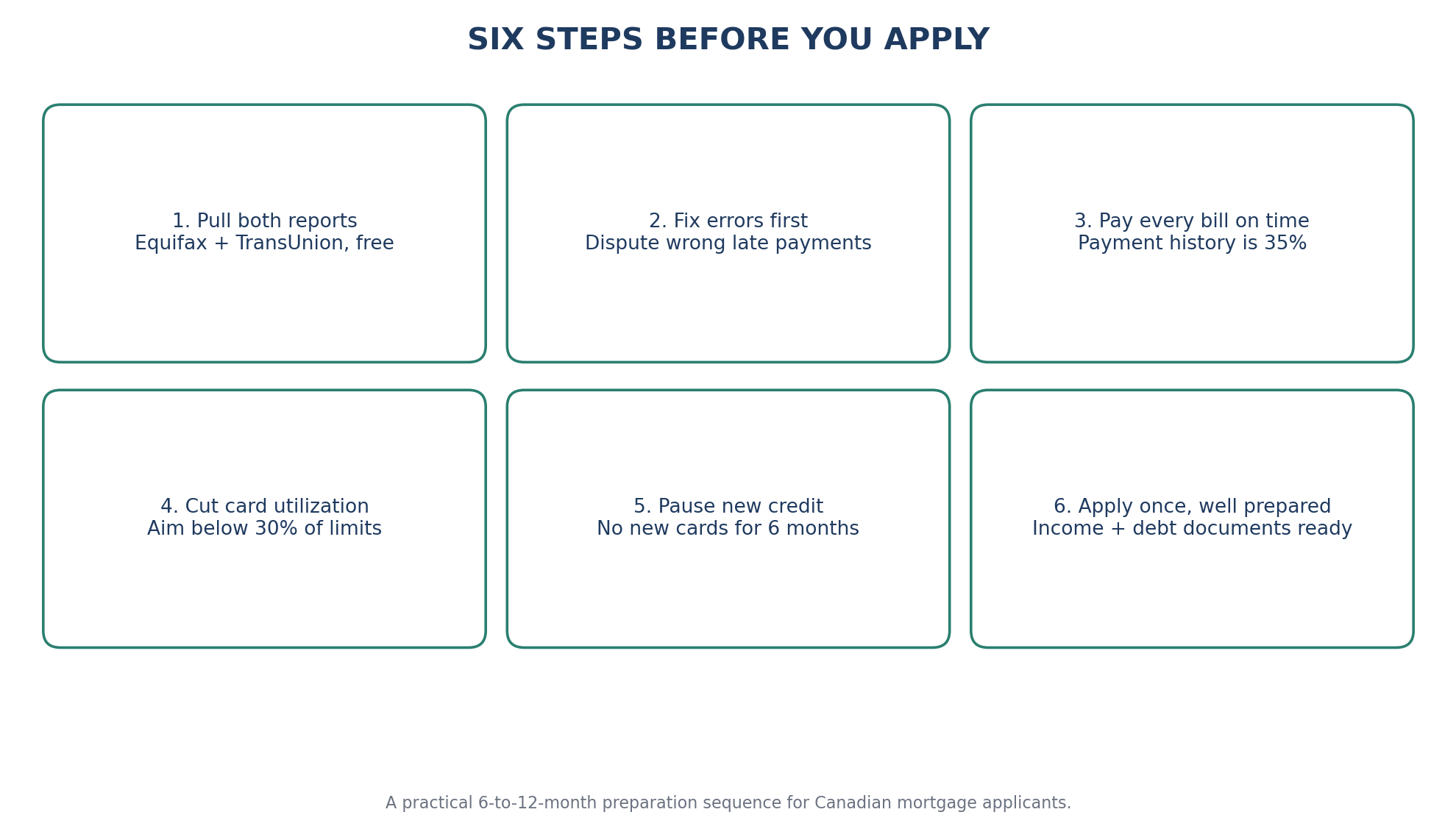
Six steps before you apply: a practical 6-to-12-month preparation sequence for Canadian mortgage applicants.
- Pull both reports. Get your free credit reports from Equifax and TransUnion and your scores from both bureaus. You are looking for the full picture: every account, every late payment, every inquiry.
- Fix errors first. Wrong late payments, accounts that are not yours, and debts reported twice are more common than most people expect. Dispute inaccuracies with the bureau in writing and keep records; corrections can move a score faster than any other single action.
- Pay every bill on time. Payment history is about 35 percent of the score. Automate at least the minimum payment on every card and loan so nothing slips, then pay more than the minimum as cash flow allows.
- Cut utilization below 30 percent. Utilization is about 30 percent of the score. Paying a card down from 85 percent of its limit to under 30 percent — and keeping it there across statement dates — is often the fastest legitimate way to gain points. Asking a card issuer for a higher limit can also lower the ratio, provided the balance does not creep up with it.
- Pause new credit. Every application can leave an inquiry, and several new accounts in a short window read as risk. In the six months before a mortgage application, avoid new cards, financing offers, and “pre-approval” sprees. Rate-shopping for a mortgage itself, compressed into a short window, is treated more gently by scoring models than scattered applications across many months.
- Apply once, well prepared. Gather income documents, down payment records, and a list of debts before you apply, and be candid with your mortgage professional about anything in the file. Surprises discovered by an underwriter are far more damaging than the same facts disclosed up front with documentation.
Co-borrowers, guarantors, and the one-borrower rule
CMHC’s rule requires a score of 600 or more from at least one borrower or guarantor — not from every applicant. That single sentence shapes a lot of household strategy. A couple where one partner has a strong file and the other is rebuilding can often proceed on the stronger score for insurance purposes, though the lender will still assess both borrowers’ debts and may weigh the weaker file in its own decision. A guarantor with a strong score can sometimes satisfy the insurer’s credit rule, but a guarantor takes on real legal responsibility for the debt, which is a family conversation, not a paperwork trick. And a co-borrower whose income is needed to pass the debt-service ratios brings their debts into the calculation too — sometimes helping, sometimes hurting. Model both versions before deciding whose name goes on the application.
Common myths that cost buyers money
- “Checking my own score hurts it.” It does not. Checking your own report is a soft inquiry and has no effect on the score. Lender checks for an application are hard inquiries, which is a different thing.
- “I should close my old cards before applying.” Usually the opposite: closing the oldest card shortens your history and can raise utilization on what remains. Keep old, no-fee cards open with occasional small use.
- “Paying off a collection erases it.” Paying a collection is generally better than leaving it unpaid, and many lenders will require it, but the record does not vanish the day you pay. Time plus clean behaviour afterwards is what rebuilds the file.
- “A high income makes up for a low score.” Income drives how much you can borrow; the score drives whether and on what terms. Lenders want both, and a large income with a chaotic payment history still lands in alternative pricing.
- “My app score is the score the bank sees.” Not necessarily. Different bureaus and different models produce different numbers. If your app shows 665, the lender’s pull could be somewhat higher or lower — another reason to build a buffer above the threshold you need rather than aiming exactly at it.
The bottom line for 2026 buyers
Memorize three numbers and you understand the Canadian system: 600 opens the insured door with as little as 5 percent down, 680 is roughly where prime lenders get comfortable, and 720 is where the best pricing typically begins. Below 600, homeownership is still possible through alternative and private lenders, but with at least 20 percent down and materially higher costs — which is why, for buyers near a threshold, a deliberate six-to-twelve-month credit plan can be the highest-return project in the entire purchase. Pull both bureau reports, fix what is wrong, pay everything on time, get card balances under 30 percent of their limits, and stop opening new credit. Then apply once, with documents ready, to a lender whose door matches the score you actually have. If a separation is behind your next application, see what happens to the family home after a divorce or separation.
Sources: CMHC mortgage loan insurance program materials (minimum credit score of 600 for at least one borrower or guarantor; insured price cap of $1.5 million; GDS 39 percent and TDS 44 percent guidelines), accessed November 2026; Financial Consumer Agency of Canada (credit scores range from 300 to 900); Equifax Canada (credit score bands and scoring-factor weights) and Equifax Canada Market Pulse, Q3 2026, released November 24, 2026 (total consumer debt of $2.74 trillion; 90-plus-day mortgage delinquency rate of 0.32 percent; 9.1 million mortgage holders). Lender-specific thresholds for prime, alternative, and private mortgages are typical market ranges as of November 2026 and vary by lender; this article is general information, not financial advice.




Comments
No comments yet. Be the first to share your thoughts.