
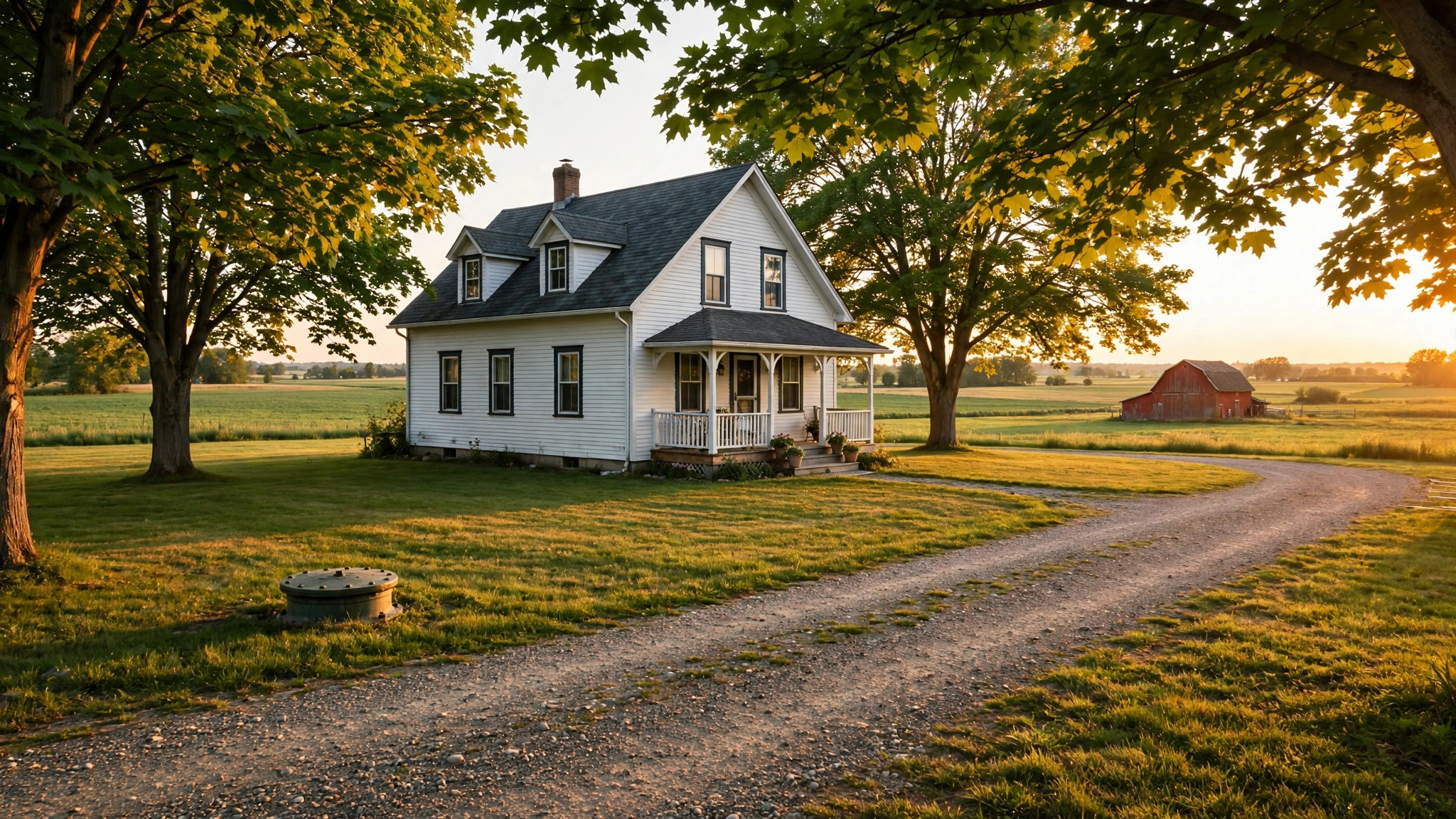
The One Thing City Buyers Never Have to Think About
When you buy a home in Toronto, Vancouver, or Calgary, the most important systems in the house belong to somebody else. The city treats your water, guarantees its quality, and tests it continuously. Your sewage leaves through a municipal pipe and becomes the municipality's problem. The road in front of your house is plowed, paved, and repaired with tax dollars.
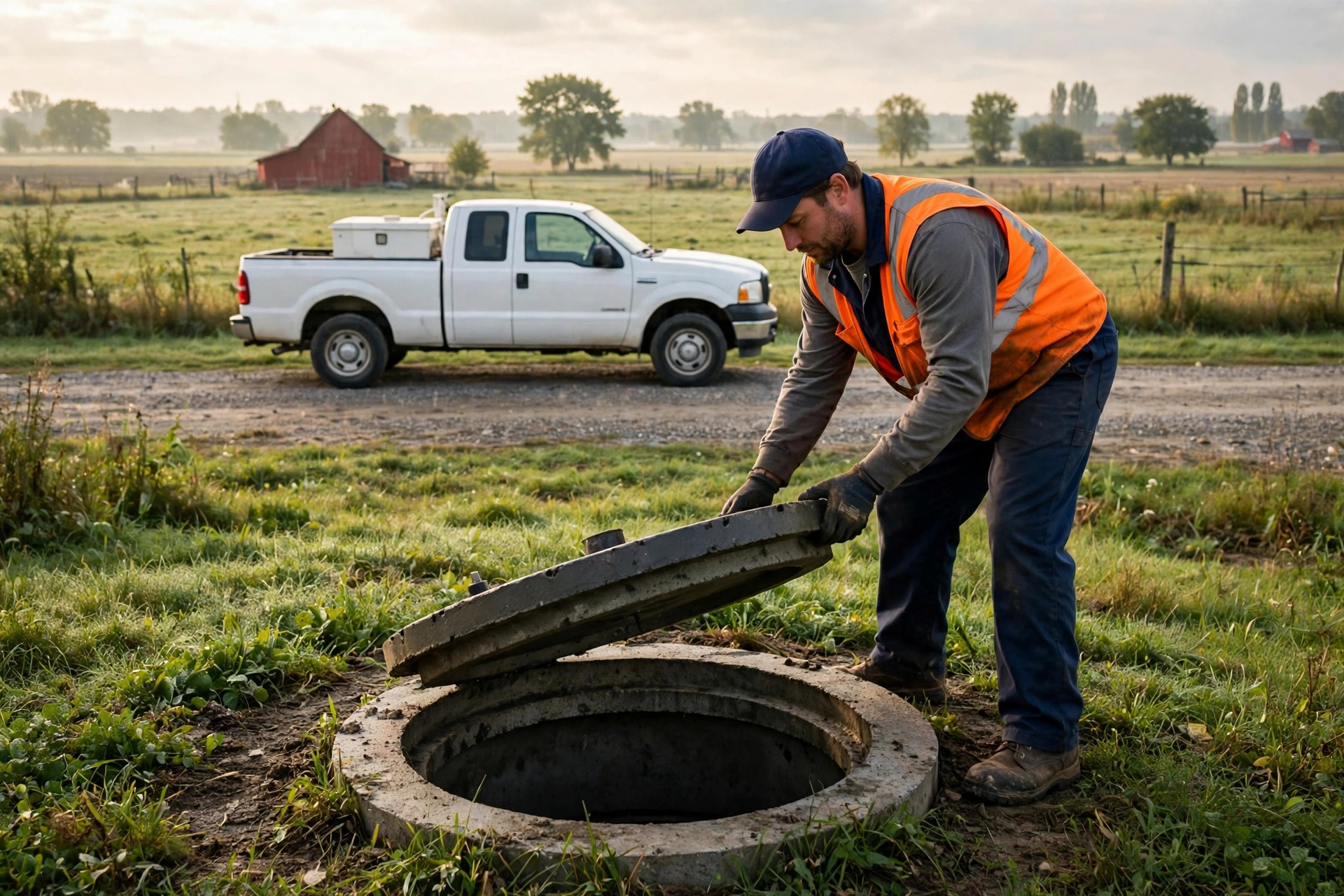
Buy a home in the country and every one of those responsibilities moves onto your shoulders — usually without anyone handing you a manual. Your water comes from a private well that you own, maintain, and are legally responsible for testing. Your sewage goes into a septic system buried in your own yard, and when it fails, the five-figure replacement bill is yours. In Ontario alone, nearly 500,000 private wells supply drinking water to about 1.3 million people, and more than a million Ontario households rely on septic systems. Across Canada, millions of homes run entirely on private services.
None of this should scare you away from rural living — for many buyers, the space, privacy, and value per acre are exactly the point. But a rural purchase demands a different kind of due diligence than a city purchase, and the buyers who get hurt are almost always the ones who inspected the granite countertops more carefully than the systems underground. This guide walks through what to check, in what order, what the warning signs look like, and what each system costs when it fails.
City Services vs. Rural Services: Who Is Responsible?
| Service | In the city | On a rural property |
|---|---|---|
| Drinking water | Municipal treatment, tested continuously | Your private well — you test it (Health Canada: bacteria at least every 6 months) |
| Sewage | Municipal sewer and treatment plant | Your septic system — pump every 3–5 years; replacement $15,000–$35,000+ |
| Road access | Public road, plowed and paved by the municipality | May be a private road — maintenance can be yours, sometimes shared by agreement |
| Heating | Usually natural gas, billed monthly | Often oil ($3,000–$5,000/winter) or propane ($2,500–$4,000/winter) |
| Fire protection | Hydrants and a nearby fire hall | Volunteer departments and tanker trucks — distance affects insurance premiums |
Your Well Is Your Water Utility
A private well is not a tap with a different label. It is a small water utility with one customer — you — and Health Canada is explicit that the owner is responsible for monitoring and maintaining its quality. Nobody tests your water for you, nobody chlorinates it, and nobody will call you if something goes wrong. That responsibility starts before you buy, not after.
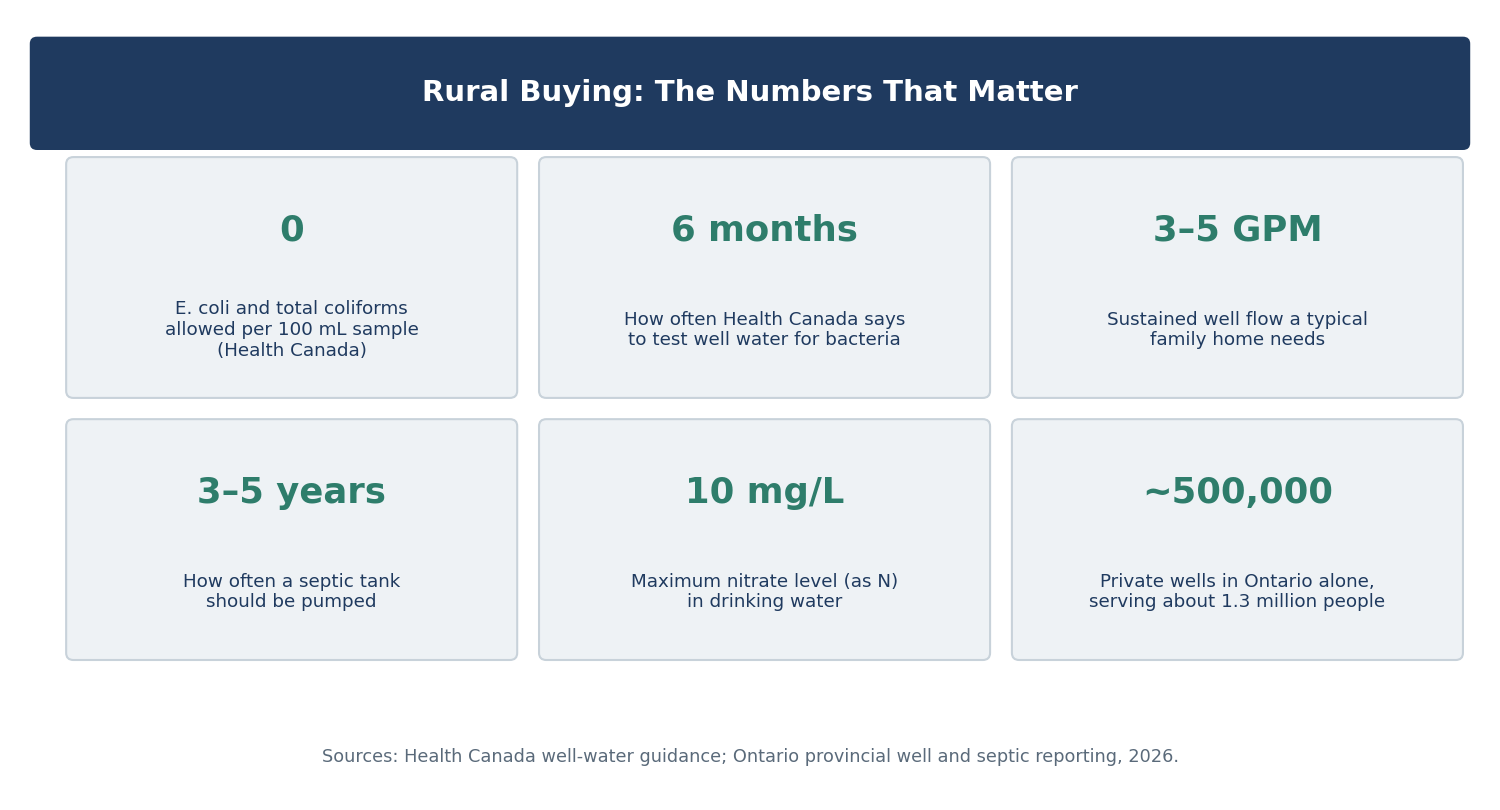
Rural Buying: The Numbers That Matter. Sources: Health Canada well-water guidance; Ontario provincial well and septic reporting, 2026.
The two tests that matter most
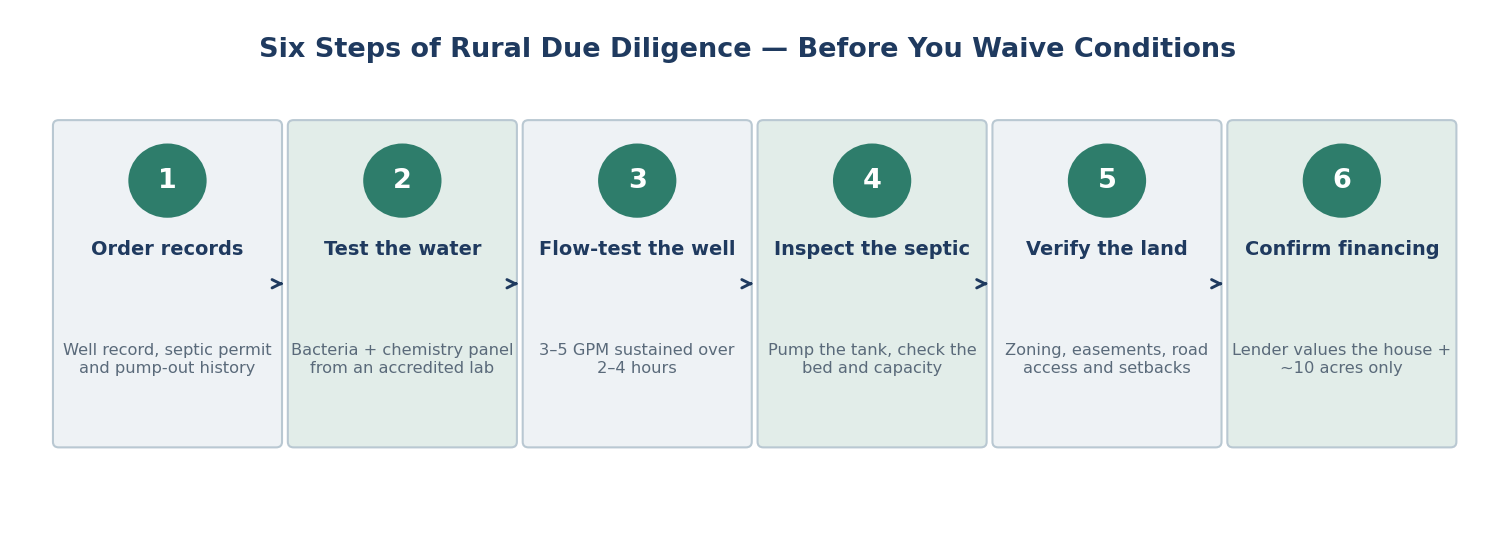
The first is a bacteriological test for E. coli and total coliforms, the indicator bacteria used in the Guidelines for Canadian Drinking Water Quality. The acceptable level is zero: no E. coli and no total coliforms in a 100 mL sample. Any detection of E. coli means the water is not safe to drink until the well is disinfected and the source of contamination is found. Health Canada recommends testing well water for microbial contamination at least once every six months, testing general water quality parameters about once every two years, and testing chemicals on the schedule your local public health authority advises. As a buyer, you want a fresh bacteria result during your condition period — not the seller's result from two springs ago — and ideally two samples a few days apart, because a single clean sample after a dry spell can miss contamination that shows up after heavy rain or snowmelt.
The second is a chemistry panel from an accredited laboratory. The item that matters most is nitrate, which has a maximum acceptable concentration of 10 mg/L measured as nitrogen. Nitrate comes from septic systems, manure, and fertilizer, it is odourless and tasteless, and it is a particular concern for infants and pregnant women. Depending on the area, a good panel also checks sodium (road salt is a common rural contaminant), iron and manganese (usually aesthetic problems that stain fixtures and laundry), hardness, and — near older plumbing or certain rock formations — lead, arsenic, or uranium. A private chemistry panel typically costs in the range of $150 to $350, which is trivially cheap insurance relative to the price of the property.
Flow: quantity matters as much as quality
Perfect water that arrives in a trickle is still a failed purchase. A flow test runs the well continuously and measures how many gallons per minute (GPM) it sustains. The working standard used by well contractors and inspectors is 3 to 5 GPM sustained over two to four hours for a typical family home; 3 GPM is the practical floor for a household of four, and 5 GPM or more gives you headroom for guests, irrigation, or a future secondary suite. Ask for the well record as well. In Ontario, a record has been required for every well constructed since the 1940s and is filed with the Ministry of the Environment, Conservation and Parks; it documents the well's depth, type, and tested yield when it was drilled. Drilled wells — typically 15 to 90 metres deep, into bedrock — are far less vulnerable to surface contamination and drought than shallow dug or bored wells, which collect surface-influenced groundwater and are the wells most likely to run dry in a hot August or test positive after a storm.
Know the replacement math before you fall in love with the view. A new drilled well, including the pump and hookup, typically runs $12,000 to $25,000, and a submersible pump replacement alone is commonly $1,500 to $3,000. Water treatment for iron, sulphur, or hardness — softeners, filters, UV disinfection — generally adds $2,000 to $6,000. None of these numbers should kill a deal by themselves, but they belong in your budget, not in your post-closing surprises.
The Septic System: The Most Expensive Thing You Can't See
If the well is your water utility, the septic system is your sewage plant, and it is the single most expensive hidden system in a rural home. A standard residential system — in Ontario, a Class 4 system under Part 8 of the Ontario Building Code — consists of a septic tank, usually 1,000 to 1,500 gallons, where solids settle and break down, and a leaching bed (also called a tile bed or drain field) where the liquid effluent filters through soil. Other provinces regulate on-site sewage under their own building codes and public health rules, but the hardware and the failure modes are the same everywhere.
What a proper septic inspection looks like
A drive-by look at the yard tells you almost nothing. A proper pre-purchase inspection, arranged during your condition period, does three things. First, the tank is located, opened, and pumped — pumping alone typically costs $300 to $500 — so the inspector can check the tank's structural condition, the liquid level, and the baffles. Second, the inspector assesses the leaching bed: soggy, spongy ground over the bed, lush green stripes in dry weather, sewage odours, or effluent surfacing are all failure signals. Third, the system's paperwork and capacity are checked against the house: the original permit, the installation year, and whether the system was sized for the number of bedrooms the home now has. A system permitted for a two-bedroom cottage in 1985 may be badly undersized for the four-bedroom, three-bathroom house standing there today — a problem that matters both functionally and when you renovate, because additions that increase flow can trigger a requirement to upgrade the system.
Ask the seller for pump-out records. Tanks should be pumped every three to five years; a seller who can produce a decade of pumping receipts is telling you something good about how the whole property was maintained, and a seller who has never pumped a tank in fifteen years is telling you something else. Age matters too: a conventional system typically lasts roughly 15 to 25 years with regular pumping, and many rural systems predate 1995. No records exist at all for systems installed before the mid-1970s in many jurisdictions, which is itself a finding worth pricing into your offer.
The failure bill
This is where rural due diligence pays for itself. Replacing a failed system in Ontario typically costs $15,000 to $35,000 for a conventional Class 4 system, and full replacements commonly run $20,000 to $50,000 once the old tank and bed are dealt with. Raised beds — required where soil is shallow, clay-heavy, or the water table is high — and advanced or tertiary treatment systems on constrained or waterfront lots reach $30,000 to $55,000 or more. Replacing just the tank, when the bed is still sound, is $5,000 to $12,000. A failed leaching bed is essentially a full-system bill. Against those numbers, the roughly $1,500 a full rural inspection package costs — well tests, flow test, septic pump-and-inspect, and record searches — is the best money in the entire transaction. For a broader look at how to scope and sequence inspections on any purchase, see our guide to home inspections in Canada in 2026.
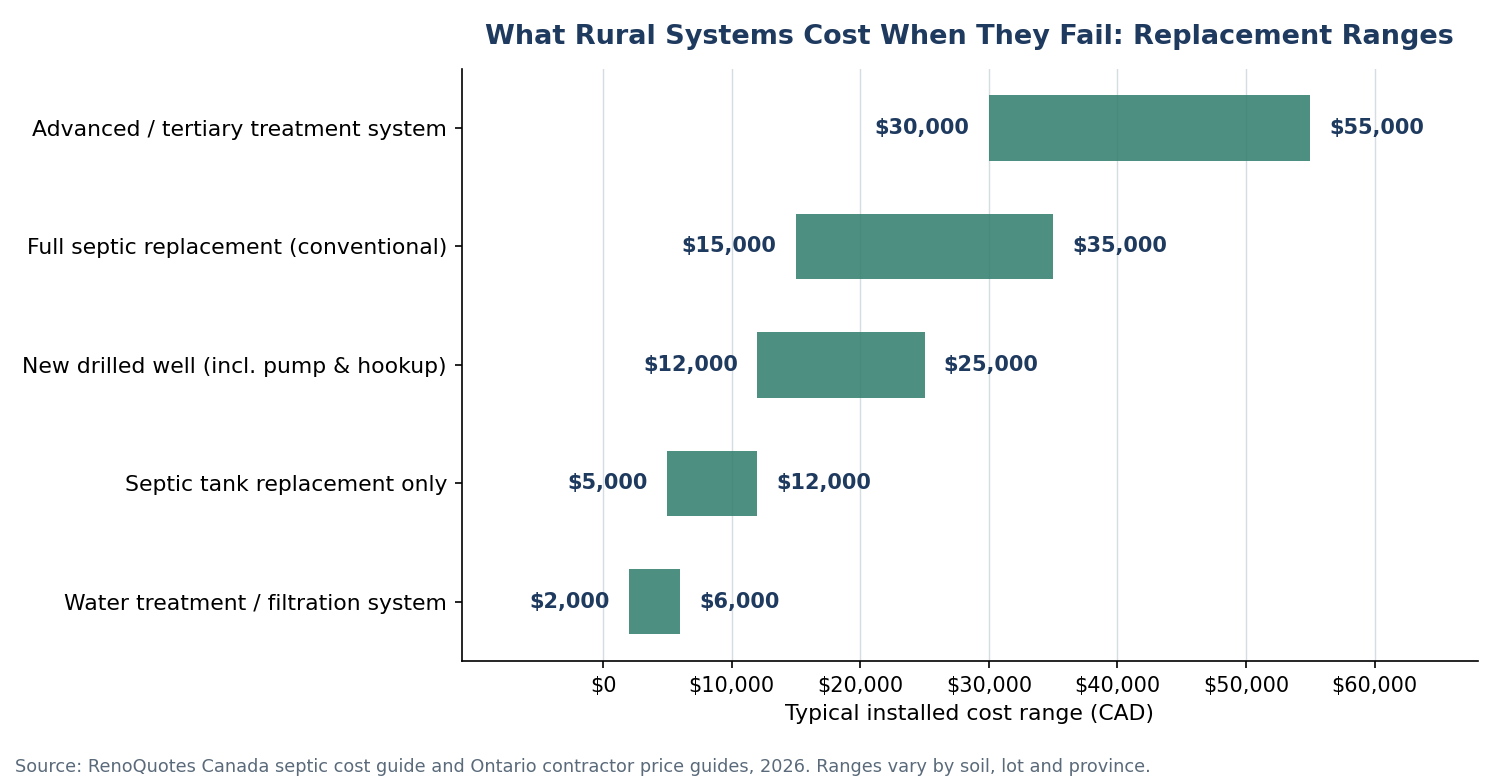
What Rural Systems Cost When They Fail: Replacement Ranges. Source: RenoQuotes Canada septic cost guide and Ontario contractor price guides, 2026.
Zoning, Easements, and the Land Itself
City buyers check zoning when they plan an addition. Rural buyers need to check it before they buy, because the gap between what a property looks like and what it is legally allowed to be is widest in the country. The same checks apply when buying vacant land in Canada - financing, zoning, and servicing all have to line up before a lot is buildable.
- Zoning and permitted uses. Confirm the zoning designation with the municipality — not from the listing. Agricultural zoning may restrict severances, secondary dwellings, and home businesses; properties in Ontario's Agricultural Land Reserve equivalents or prime-agricultural designations carry extra rules. If the barn hosts a business, the suite hosts a tenant, or the workshop hosts a trade, verify each use is legal, because an illegal use can be shut down after you buy and may complicate financing and insurance. Our explainer on zoning reform and the missing middle covers how these rules are changing in Canadian municipalities.
- Easements and rights-of-way. Rural properties commonly carry hydro, pipeline, access, and drainage easements, and shared-driveway or private-road arrangements. A private road without a registered maintenance agreement can become your dispute — and your snowplowing bill. Confirm who maintains the road and in what shares.
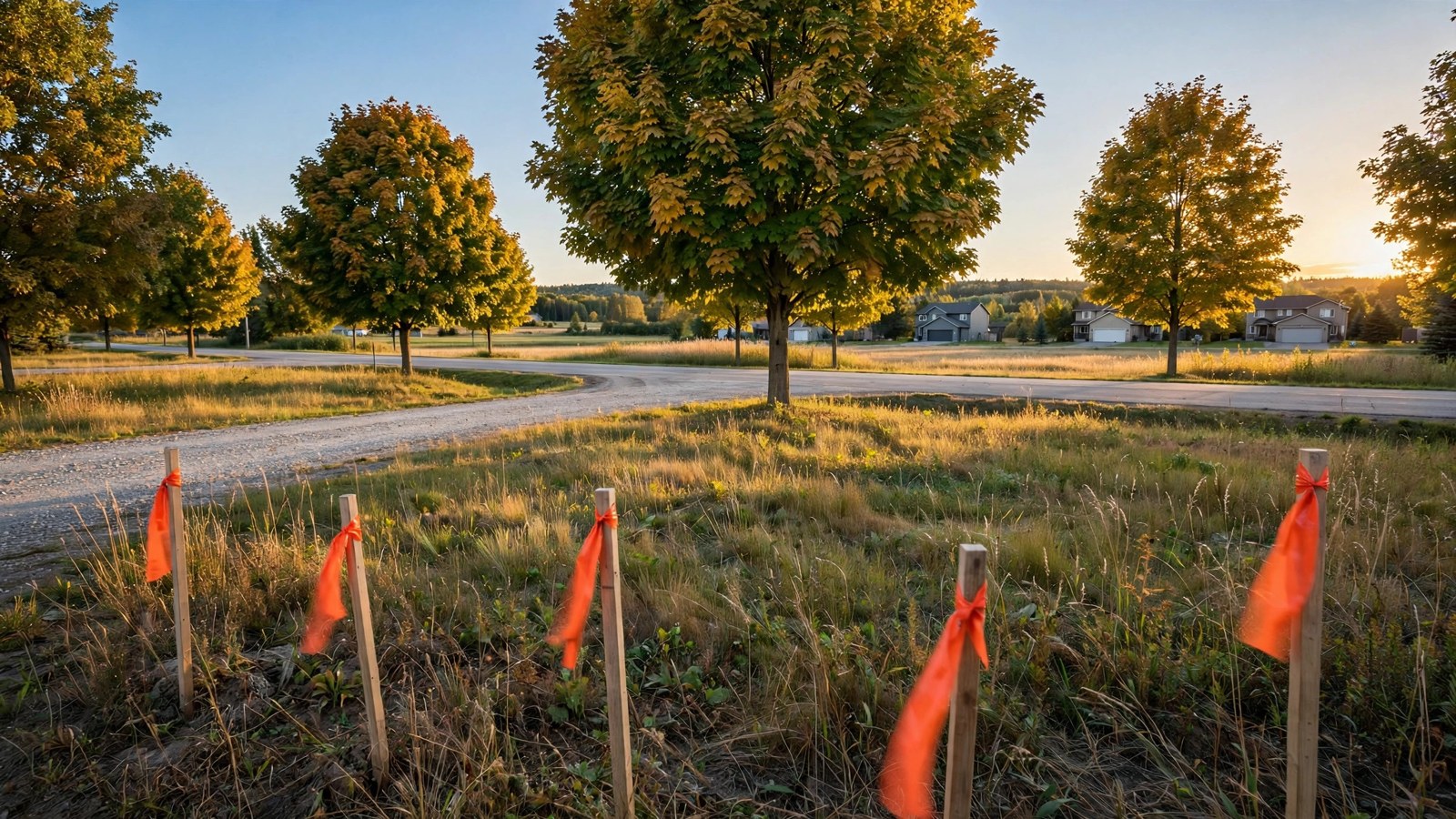
- Setbacks and regulated lands. Conservation authority regulation — floodplains, wetlands, steep slopes, and shoreline allowances — can restrict building, septic replacement, and even tree clearing on parts of your lot. A cheap lot near water is sometimes cheap because very little of it is legally buildable.
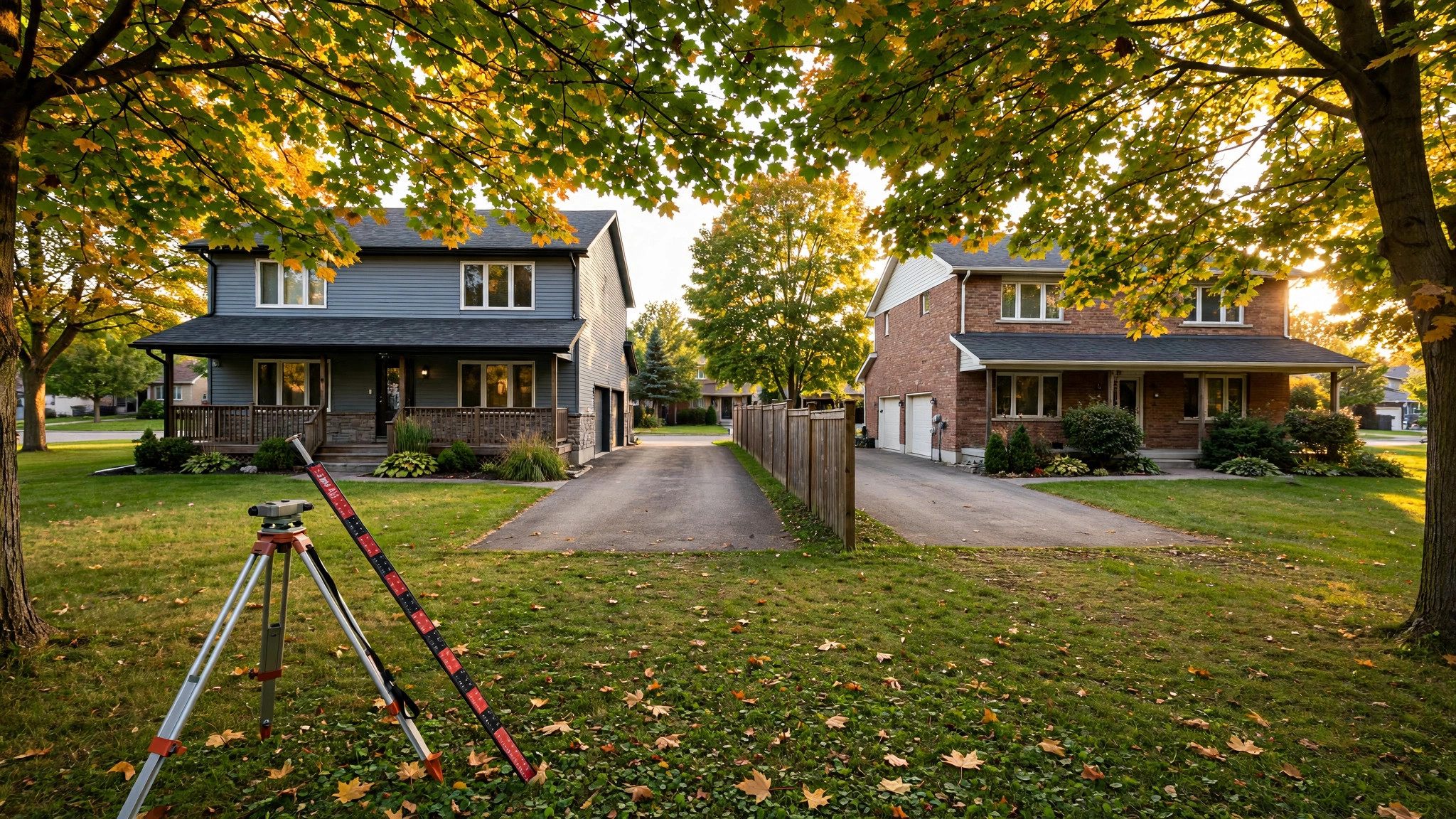
- Surveys and boundaries. Ask for a current survey. On acreage, fences are folklore: the cedar rail fence the seller calls the boundary may sit metres inside — or outside — the legal line.
- Heating fuel and outbuildings. Oil tanks have a working life and a cleanup cost if they leak; an undocumented underground tank is a serious liability. Propane is leased infrastructure with its own contract. Wood heat may affect insurance. Each of these is a question to ask before closing, not after.
These land and legal items also feed directly into your closing budget: record searches, survey work, and legal review on a rural file typically run higher than on a standard suburban purchase, which is worth remembering alongside the usual items in our closing costs guide for Canada.
Financing a Rural Property Is Its Own Discipline
Rural files are underwritten differently, and buyers who assume a city pre-approval sails through are the ones scrambling in the final week. Lenders worry about marketability: a rural home can take far longer to resell than a city home, so lenders and mortgage insurers protect themselves by limiting what they will lend against.
The key concept is residential lending value. On an acreage purchase, the appraiser is typically instructed to value the house, one garage, and roughly the first 10 acres of land — and to assign zero lending value to excess acreage and to outbuildings such as barns, shops, and arenas, however impressive they look in the listing photos. If the purchase price exceeds that lending value, the difference comes out of your pocket on top of your minimum down payment. A $600,000 acreage appraised at a $540,000 residential lending value does not need 5% of $600,000; it needs 5% of the lending value plus the $60,000 gap, in cash.
The practical consequences:
- Small acreages near town finance almost like city homes. A residential property under about 10 acres, with a house in good condition and 25 or more years of remaining economic life, can often be bought with as little as 5% down through an insured mortgage, subject to the insurer's rules. How that insurance works — and what it costs — is covered in our guide to CMHC mortgage insurance in Canada.
- Bigger and more agricultural means more money down. Large acreages, hobby farms, and working farms move into 20% to 50% down-payment territory, and true farm financing belongs with Farm Credit Canada or a bank's agricultural lending arm, not a residential mortgage.
- The property must pass basic service tests. Lenders and insurers expect potable water (a passing water test is a standard condition), a functioning sewage system, year-round road access, and a permanent heat source. A property that fails on water or access may be financeable only with a larger down payment, a specialty lender, or not at all — one more reason the well and septic conditions in your offer protect the whole deal, not just your health.
- Off-grid and unconventional properties shrink the lender pool. Homes that cannot be reached year-round, lack conventional power, or sit on leased land need to be matched to the right lender early. Tell your mortgage broker exactly what the property is before you write the offer, not after.
Insurance and the Ongoing Costs of Country Living
Budget honestly for ownership, because rural operating costs differ from city costs in ways that compound. Heating a detached rural home with oil commonly runs $3,000 to $5,000 per winter, and propane typically $2,500 to $4,000, depending on the home's size, insulation, and fuel prices — often well above the natural-gas bills city buyers are used to. Electricity delivery charges are higher in low-density service territories. Snow clearing for a long driveway, gravel driveway grading, well and septic maintenance, and water treatment consumables are all line items that simply do not exist in a city budget. Property taxes are often lower per dollar of assessment in rural municipalities, which offsets some of this, but the offset is partial.
Insurance deserves its own phone call before you firm up. Insurers price rural risks differently: distance to the nearest fire hall and whether the area has hydrants or relies on tanker trucks affects premiums materially, wood stoves require inspection and disclosure, and outbuildings, ponds, and recreational vehicle use all need to be declared. Climate exposure matters in the country too — overland flooding is largely uninsurable through standard policies, and rural properties sit closer to the rivers, fields, and forests where water and wildfire risk live. Our guide to home insurance and climate risk in Canada walks through the coverage gaps to check on any purchase; on a rural property, add well, septic, and outbuilding endorsements to that checklist. Finally, test the services city buyers take for granted at the exact address: internet speed (rural addresses can sit in dead zones between coverage maps), cell signal in the house, school bus routes, and the drive time to a hospital in February, not in July.
Putting It Together: Conditions That Protect You
Everything in this guide converts into offer language. On a rural purchase, your conditions should normally include financing, a satisfactory home inspection, a potability and bacteria water test, a well flow test, a septic inspection with the tank pumped, and a review of the well record, septic permit, survey, and zoning confirmation. Give these conditions enough time — lab results and record searches routinely take five to ten business days — and treat a seller's resistance to a septic pump-out or a second water sample as information in itself.
Buy the country property with your eyes open and it can be the best purchase of your life: more land, more quiet, and more house for the money than any city listing will offer. Just remember that in the country, you are the utility company. Test like it.
Sources
- Health Canada, "Well water and your health: Test your well water" (Canada.ca) — testing frequency, E. coli and total coliform standards, owner responsibility.
- Guidelines for Canadian Drinking Water Quality — maximum acceptable concentrations, including nitrate at 10 mg/L as nitrogen.
- Ontario Building Code, Part 8 — Class 4 on-site sewage systems; Ontario well record requirements under provincial regulation.
- RenoQuotes Canada, "Septic Tank Cost in Canada: Installation & Replacement 2026" — system, tank, and treatment cost ranges.
- Ontario contractor price guides, 2026 — conventional, raised-bed, and tertiary system ranges; pumping and inspection costs.
- Canadian mortgage insurer and lender acreage guidelines (CMHC, Sagen) — residential lending value, acreage limits, potable water and year-round access requirements.


Comments
No comments yet. Be the first to share your thoughts.