

There Is No Standard Commission in Canada — and That Is the Most Important Fact
If you ask ten sellers what real estate commission they paid, you will hear ten confident answers — and most of them will describe their rate as "the standard." In Canada, there is no standard. No province sets a commission rate, no real estate board is allowed to fix one, and Canada's competition law prohibits boards and brokerages from setting fixed rates. Provincial regulators say so explicitly: British Columbia's regulator states that commission is part of your contract with your brokerage and can vary from one brokerage to another, Ontario's regulator bars agents from suggesting a rate is fixed or approved by the regulator, a government, or a board, and the regulators in Saskatchewan and Nova Scotia likewise say there is no standard rate and the amount can be negotiated.
That does not mean rates are random. Every province has a typical structure that many brokerages start from — a flat percentage in Ontario, a tiered formula in British Columbia and Alberta — and recent transaction data gives us a useful national benchmark. A Rate-My-Agent study of 979 verified transactions, summarized by Payotte in November 2026, found sellers paid an average total commission of about 4.09% of the sale price, or roughly 2.04% per agent. Individual results ranged widely, from under 1% per agent to over 3.5% per agent, depending on the property, the market, and what was negotiated.
This guide walks through how commission actually works in Canada in 2026: who pays, how the split between the listing and buyer sides works, how flat and tiered formulas compare in dollars, what tax is added on top, what commission does and does not buy, and how to negotiate — calmly and effectively — before you sign a listing agreement. If you are also budgeting the rest of a sale, read it alongside our guide to closing costs in Canada, which covers the legal fees, adjustments, and other charges that sit beside commission on closing day.

Who Pays Commission, and When
In the standard Canadian residential transaction, the seller pays the total commission. It is not handed over when the listing is signed or when an offer is accepted. It is deducted from the sale proceeds at closing by the seller's lawyer or notary, paid to the listing brokerage, and the listing brokerage then pays the agreed share to the buyer's brokerage, which compensates the buyer's agent.
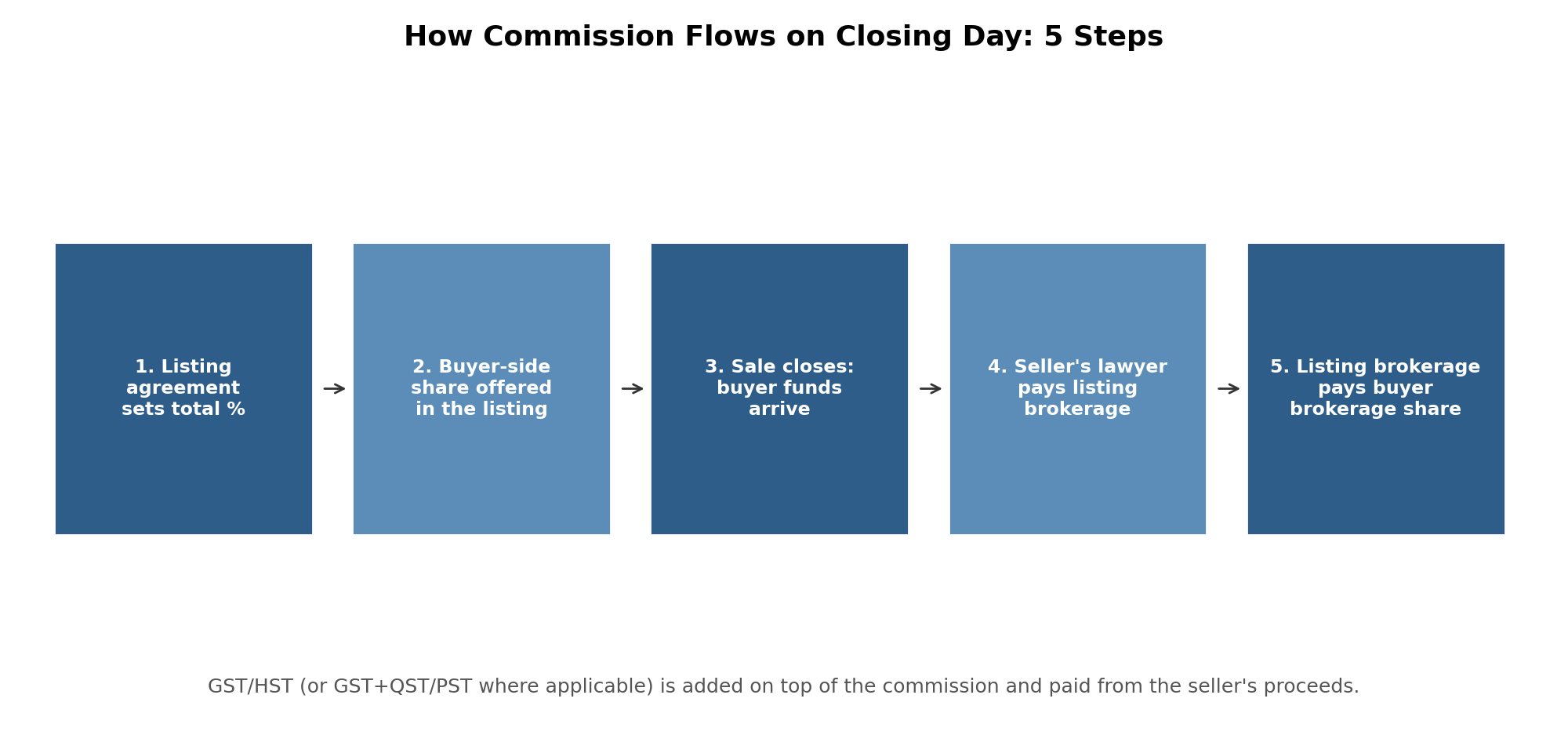
How Commission Flows on Closing Day: 5 Steps.
That structure is why buying often feels free to buyers: the buyer's agent is usually paid out of the seller's commission rather than by the buyer directly. It is not actually free — the commission is built into the economics of the price — and buyers should read their own representation agreement carefully. Some buyer agreements say that if the seller offers less than the amount agreed with the buyer, the buyer may be responsible for the difference. That clause matters more in 2026 than it used to, because sellers are increasingly testing lower buyer-side offers.
Commission is normally only payable if the sale closes, under the terms of the listing agreement. Agreements also commonly include a holdover period: if the home sells shortly after the listing expires to a buyer who was introduced during the listing period, commission may still be owed. The exact trigger, the holdover length, and any exceptions are in the contract you sign — which is why the negotiation in this guide happens before signing, not after.
How the Split Works: Listing Side and Buyer Side
The total commission is usually divided between two brokerages. The listing side markets the home, advises on price, handles offers, and negotiates for the seller. The buyer side brings a qualified buyer and negotiates for that buyer. A common division is roughly half and half. In Ontario, a 5% total is often structured as 2.5% to the listing brokerage and 2.5% to the buyer's brokerage. In Alberta's tiered model, each side commonly receives 3.5% on the first $100,000 and 1.5% on the balance; in British Columbia, each side commonly receives 3.5% on the first $100,000 and 1.25% on the balance.
Two details are often misunderstood. First, the individual agent does not keep their brokerage's whole share. Brokerages typically take a desk fee or a split of their agent's earnings — industry explainers commonly cite roughly 10% to 30% — before the agent is paid, and agents also carry licensing, insurance, board, marketing, and vehicle costs. That is part of why agents resist deep discounts: a one-point cut to the total can be a much larger percentage cut to the agent's actual take-home.
Second, the buyer-side share is set when the home is listed, and it is a marketing decision as well as a cost. Offering a competitive buyer-side commission keeps the listing fully visible to buyers working with agents. Offering far below the local norm can reduce agent enthusiasm and, in some markets, showing activity — even though buyer agents have professional duties to show suitable homes regardless. Sellers should ask their agent directly what buyer-side amount comparable local listings are offering, and weigh a small saving against a slower sale, especially in the conditions described in our guide to selling your home in a buyer's market.
Typical Rates by Province: Averages, Not Schedules
The chart in this section shows the Payotte / Rate-My-Agent averages: British Columbia at about 3.6% total, Quebec 3.7%, Manitoba 4.0%, Alberta 4.1%, Ontario 4.3%, Saskatchewan and Nova Scotia about 4.4%, New Brunswick 4.8%, and Newfoundland and Labrador 5.7% — the highest in the study, reflecting smaller average prices and different local practice. Treat these as descriptive averages from one study of 979 transactions, not as entitlements or caps. Your rate is whatever you and your brokerage agree in writing.
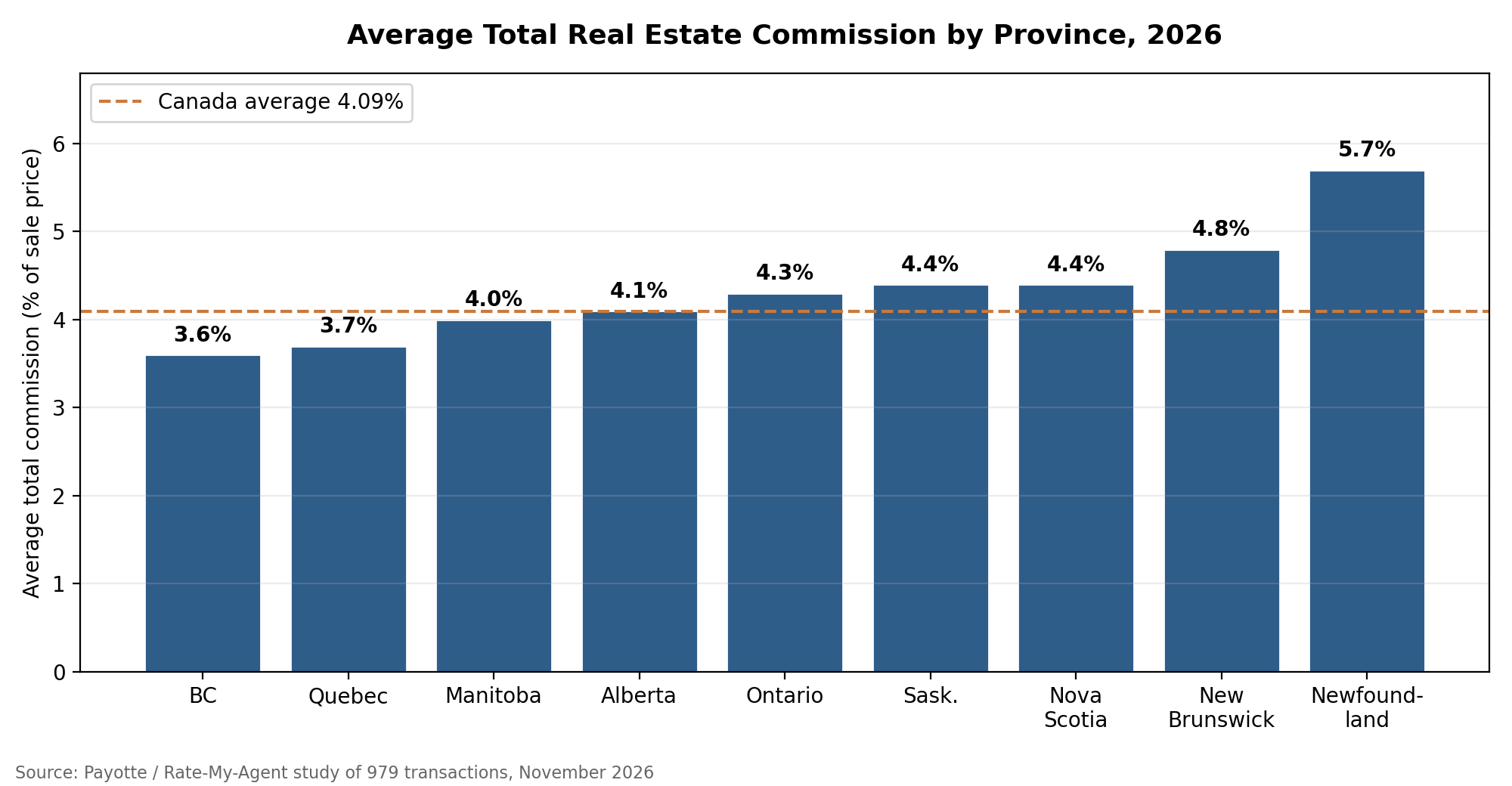
Average Total Real Estate Commission by Province, 2026. Source: Payotte / Rate-My-Agent study of 979 transactions, November 2026.
The formulas behind those averages differ by region. Ontario and several other provinces commonly quote a single flat percentage on the whole price, often cited around 5% in Ontario, with many transactions landing between 3.5% and 5%. British Columbia commonly uses 7% on the first $100,000 and 2.5% on the remainder. Alberta commonly uses 7% on the first $100,000 and 3% on the remainder. Saskatchewan is often cited at 6% on the first $100,000, 4% on the next $100,000, and 2% on the rest. Quebec is commonly cited in a 4% to 6% range, Manitoba around 3% to 5%, and much of Atlantic Canada around 5%, with local variation — particularly between cities and rural areas, and between property types.
Why tiered formulas exist is simple arithmetic: on a $300,000 home, a flat 5% and a tiered formula produce similar totals, but on a $1,500,000 home a flat 5% is $75,000, while the BC tiered formula is $7,000 plus 2.5% of $1,400,000 — $42,000. Tiering keeps the dollar commission from scaling linearly with price in high-price markets. In lower-price markets, the reverse conversation happens: a percentage that looks modest can produce a dollar amount that barely covers a full-service listing's work, which is why discount models are thinner on the ground in smaller cities.
Flat vs Tiered: The Same Home, Very Different Bills
The second chart in this article runs one concrete example — an $800,000 sale — through three formulas. Under Ontario's commonly cited flat 5%, commission is $40,000, plus 13% HST of $5,200, for $45,200 all-in. Under British Columbia's tiered 7% on the first $100,000 and 2.5% on the remaining $700,000, commission is $7,000 plus $17,500 — $24,500, plus 5% GST of $1,225, for $25,725. Under Alberta's tiered 7% and 3%, commission is $7,000 plus $21,000 — $28,000, plus 5% GST of $1,400, for $29,400. At the national average of 4.09%, the same home would carry $32,720 of commission before tax.
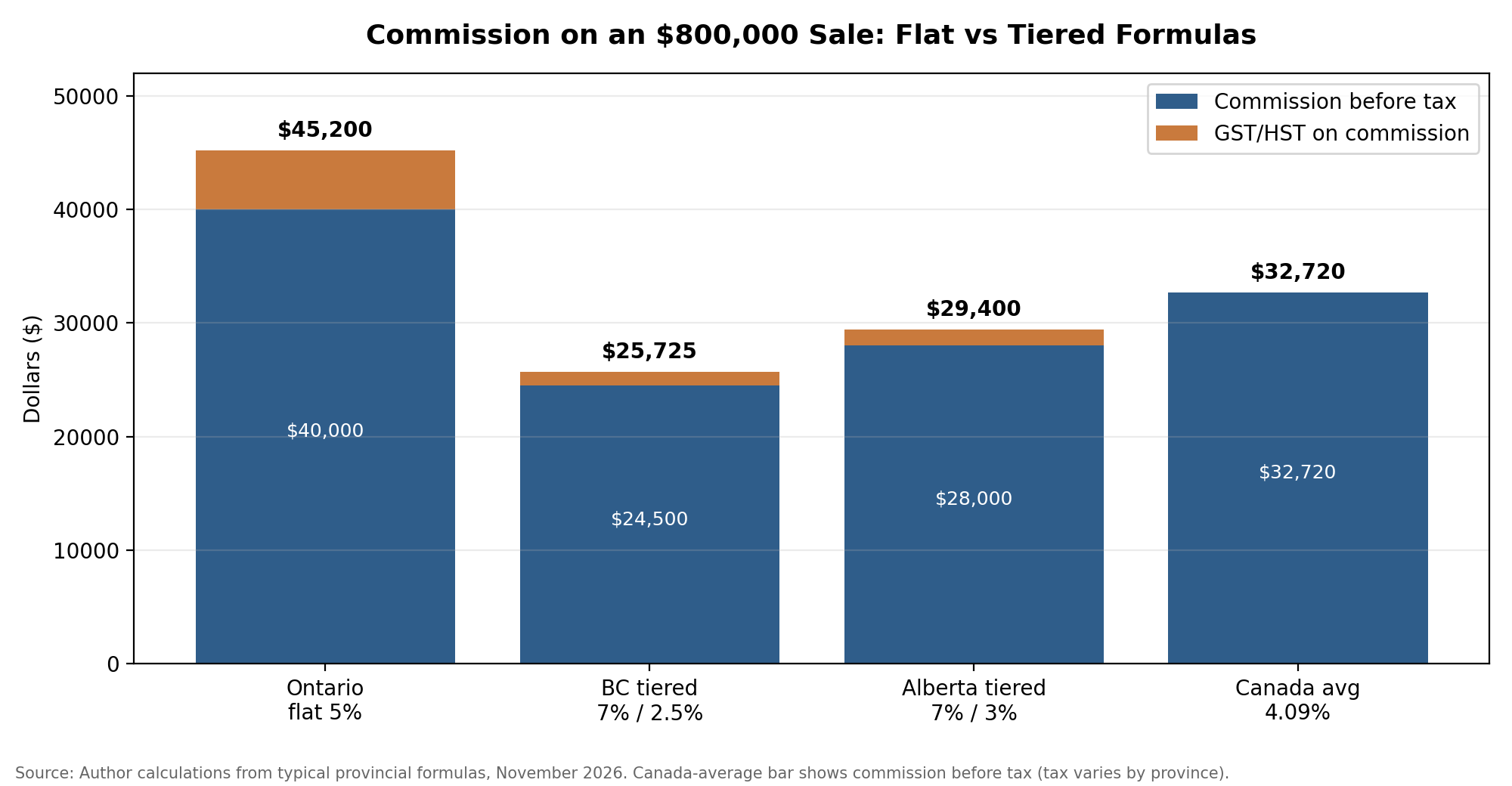
Commission on an $800,000 Sale: Flat vs Tiered Formulas. Source: Author calculations from typical provincial formulas, November 2026.
The lesson is not that one province is "cheaper" — the formulas evolved alongside very different price levels, and a BC seller's home is often worth far more than $800,000. The lesson is that the formula matters as much as the headline rate. A seller in a flat-rate province can ask about a tiered or capped structure; a seller in a tiered province should check where the tiers break. Always ask for the commission in dollars, at your expected sale price, plus tax — not just as a percentage. Percentages feel small; dollars are what leave your proceeds.
The Tax on Commission: The Line Sellers Forget
Commission is a taxable service, even though the sale of a previously occupied residential home is generally exempt from GST/HST. The tax is charged on top of the commission, and the rate depends on the province where the property is located. According to CRA-based summaries compiled by WOWA and Wealth North (checked November 2026): Alberta, British Columbia, and Manitoba add 5% GST only; Ontario adds 13% HST; Nova Scotia adds 14% HST (reduced from 15% on April 1, 2025); New Brunswick, Newfoundland and Labrador, and Prince Edward Island add 15% HST; Quebec adds 5% GST plus 9.975% QST, for 14.975% combined; and Saskatchewan adds 5% GST plus 6% PST, for 11% combined on most residential commissions.
On a $40,000 Ontario commission, that tax is $5,200 — real money that surprises sellers who budgeted only the percentage. Unlike the commission rate, the tax rate is not negotiable. When you compare quotes from brokerages, compare the all-in figure: commission plus tax. And keep the tax distinction straight in your own budgeting: the house itself, if it is a resale home, is generally tax-exempt, while the services used to sell it — commission and legal services — are taxable. New-build homes are a different case entirely, covered in our explainer on the HST rebate for new homes.
What Commission Buys — and What It Does Not
A full-service listing commission typically pays for pricing analysis, listing preparation advice, professional photography and listing copy, exposure on the MLS system and major portals, showing coordination, offer management, negotiation, and shepherding the transaction to closing. Some brokerages bundle staging consultation, floor plans, video, print marketing, and pre-listing inspection support; others price those separately. There is no universal bundle — which is precisely why comparing only the percentage is a mistake. A 4% quote that excludes photography, staging, and marketing you then buy yourself can cost more than a 5% quote that includes them.
Commission does not buy a guaranteed price, a guaranteed timeline, or a guaranteed sale. It does not cover your legal fees, mortgage discharge or prepayment penalties, moving costs, or capital gains obligations — sellers with a taxable gain should read our guide to capital gains tax on real estate in Canada. And it does not remove your own responsibilities: disclosure obligations, keeping the home showable, and making decisions on offers remain yours.
Lower-cost models exist on a spectrum. Flat-fee and mere-posting services put a listing on the MLS system for a fixed fee while the seller handles inquiries, showings, and negotiation, usually still offering a buyer-side commission. Discount brokerages offer a reduced listing-side percentage, sometimes around 1%, with varying service levels. For-sale-by-owner sales avoid the listing side entirely but require the seller to do the marketing, screening, paperwork coordination, and negotiation themselves — and to comply with the same disclosure and contract law. None of these models is inherently right or wrong; the fit depends on the property, the market's speed, and honestly, the seller's time and temperament.
How to Negotiate Commission Without Burning the Relationship
Negotiation works best when it is specific, early, and tied to value. Interview two or three agents. Ask each for their proposed total commission, the buyer-side share they recommend, what services are included, their recent local sales, and their pricing strategy — then compare the full packages, not just the rates. If one agent's rate is lower, you can fairly ask another to match the rate or explain the difference in services. Agents expect these conversations; regulators in every province confirm the rate is negotiable, and a professional will not be offended by a direct question asked before signing.
Useful levers include: asking for a tiered or capped structure on a high-priced home; asking whether the rate changes if the agent also represents you on your next purchase (a combined buy-and-sell relationship is more valuable to the brokerage); asking for a shorter listing term with a rate review if the home has not sold; asking which marketing items are included and which are extra; and asking what happens to the rate if an unrepresented buyer — one with no agent — buys the home, since there is then no buyer-side share to pay. That last clause, sometimes called a commission reduction or "no cooperating brokerage" provision, should be written into the agreement if you agree on one.
Get everything in the listing agreement itself: the total, the split, the tax treatment, the term, the holdover clause, what triggers payment, and any special provisions. Verbal understandings about fees have a way of evaporating by closing day. And negotiate the whole deal, not only the rate: in a slow market, an agent's pricing honesty and marketing effort will move your net proceeds more than half a point of commission saved on a home that sits.
Special Cases: Rentals, Commercial, New Builds, and Private Sales
Residential resale formulas are only part of the picture. Leasing commissions are commonly expressed as a portion of rent — often around one month's rent for a long-term residential lease, split between the brokerages — rather than a percentage of a sale price. Commercial sales and leases use individually negotiated fees that can be percentage-based, flat, or hourly, and are usually documented in separate fee agreements. New-build purchases from a builder may involve a commission paid by the builder to the buyer's brokerage, disclosed in the purchase documents; buyers should confirm who pays whom before signing, because it affects the agent's incentives and, occasionally, the price.
Private and family transactions — selling to a relative, a tenant, or a buyer you found yourself — are where written agreements matter most. If an agent introduced the buyer during a listing period, a holdover clause may still apply. If no agent is involved at all, many sellers still pay for a lawyer, an appraisal, and sometimes a flat-fee consultation to price the home; those costs are usually far below a full commission, but the legal paperwork is identical. Estate sales add another layer, as executors must be able to justify the commission and the price to beneficiaries — see our guide to probate and estate home sales in Canada.
The Bottom Line for Sellers in 2026
Commission is usually the largest single cost of selling a Canadian home — larger than legal fees, staging, and moving combined in many transactions. Yet it is also the cost sellers have the most control over, because it is set by negotiation and written into a contract before any work begins. Remember the shape of the deal: a national average near 4.09% total, typical totals between 3% and 5% in most markets, tiered formulas in the West that change the math dramatically on higher-priced homes, tax added on top at your province's GST/HST rate, and a split that usually sends about half to each side.
Do the arithmetic in dollars at your expected price. Compare full service packages, not just percentages. Ask about the buyer-side share, the unrepresented-buyer clause, and the holdover period. Put every agreement in writing. Sellers who do those five things rarely overpay — and rarely under-hire, either, which in a balanced 2026 market can be the more expensive mistake.
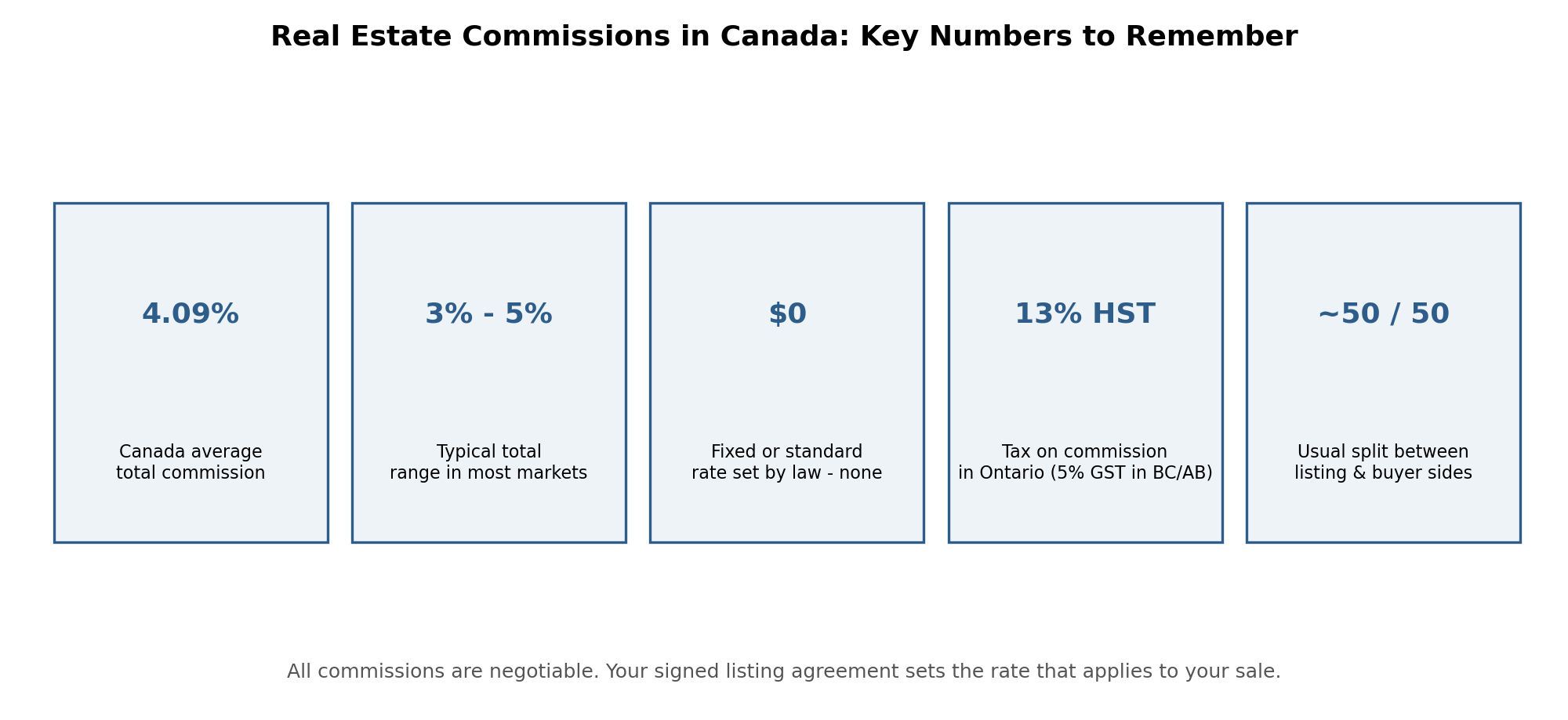
Real Estate Commissions in Canada: Key Numbers to Remember.
Sources
Payotte, "Real Estate Commission in Canada 2026" (November 2026), summarizing the Rate-My-Agent study of 979 verified transactions (2018–2026): national average 4.09% total, provincial averages as charted. Wealth North, Real Estate Commission Calculator for Canada (2026), figures verified against the Canada Revenue Agency and provincial regulators, checked November 2026: negotiability, typical provincial schedules, and sales tax on commission by province. WOWA, Cost of Selling a House in Canada (updated September 18, 2026): seller-pays structure, payment at closing through the listing brokerage, and GST/HST treatment of commission. Zolo, Realtor Fees in Canada and Cost of Selling a House in Canada (2026): typical provincial commission structures and worked examples. Bōde, Decoding Real Estate Commissions (2026): tiered splits by side in Alberta and British Columbia and Ontario's 2.5% / 2.5% structure.
Comments
No comments yet. Be the first to share your thoughts.