
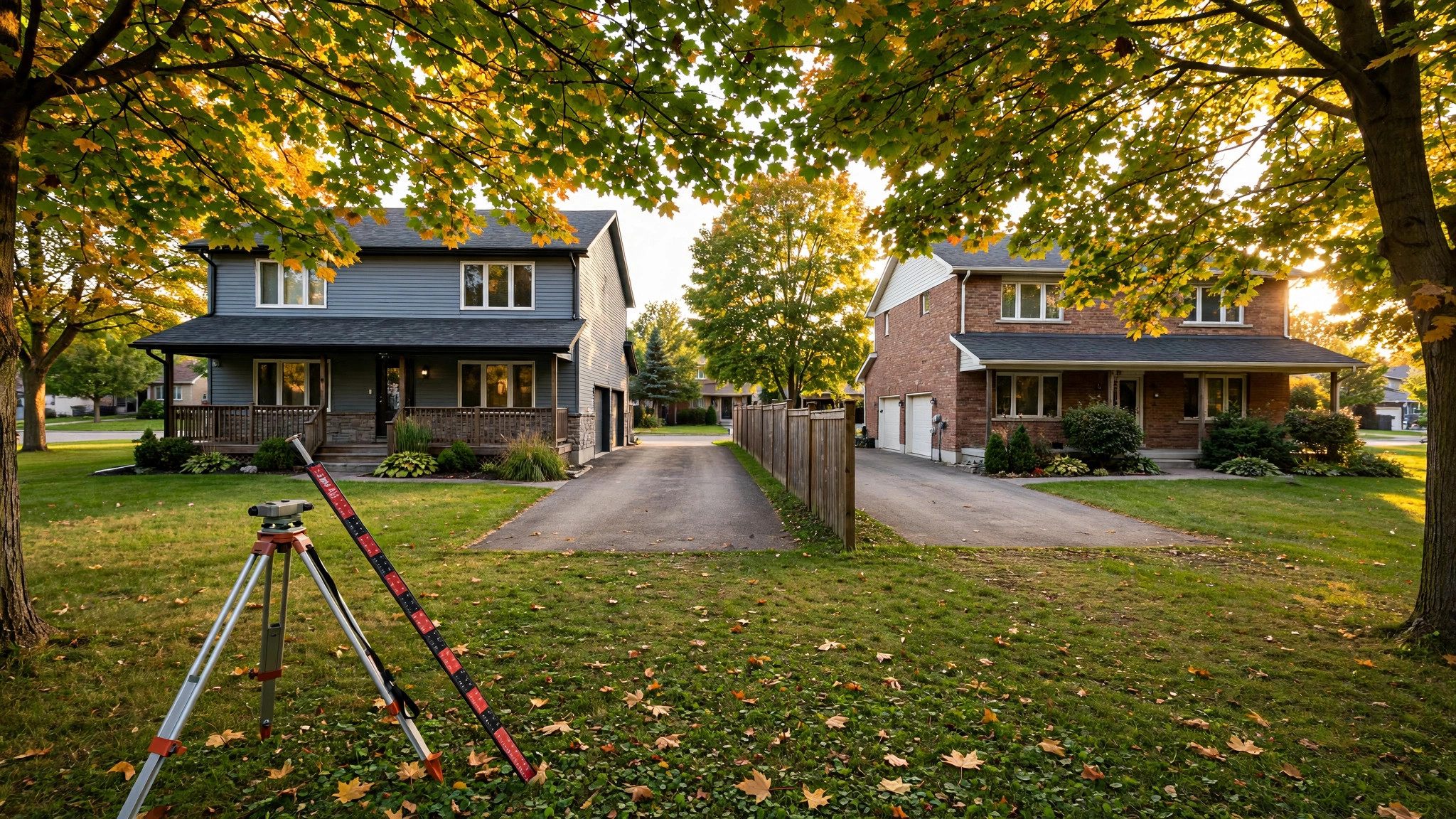
Why the invisible lines on a property matter more than the fence
Most buyers walk a property looking at kitchens, roofs and square footage. The things that most often turn into expensive legal problems are invisible: a registered easement that lets a utility cross the exact corner where you planned a pool, a fence that has sat a foot over the boundary for twenty years, or a shared driveway that two families both believe they control. None of these show up in listing photos. All of them show up — eventually — in a lawyer's office, a surveyor's report, or a courtroom.
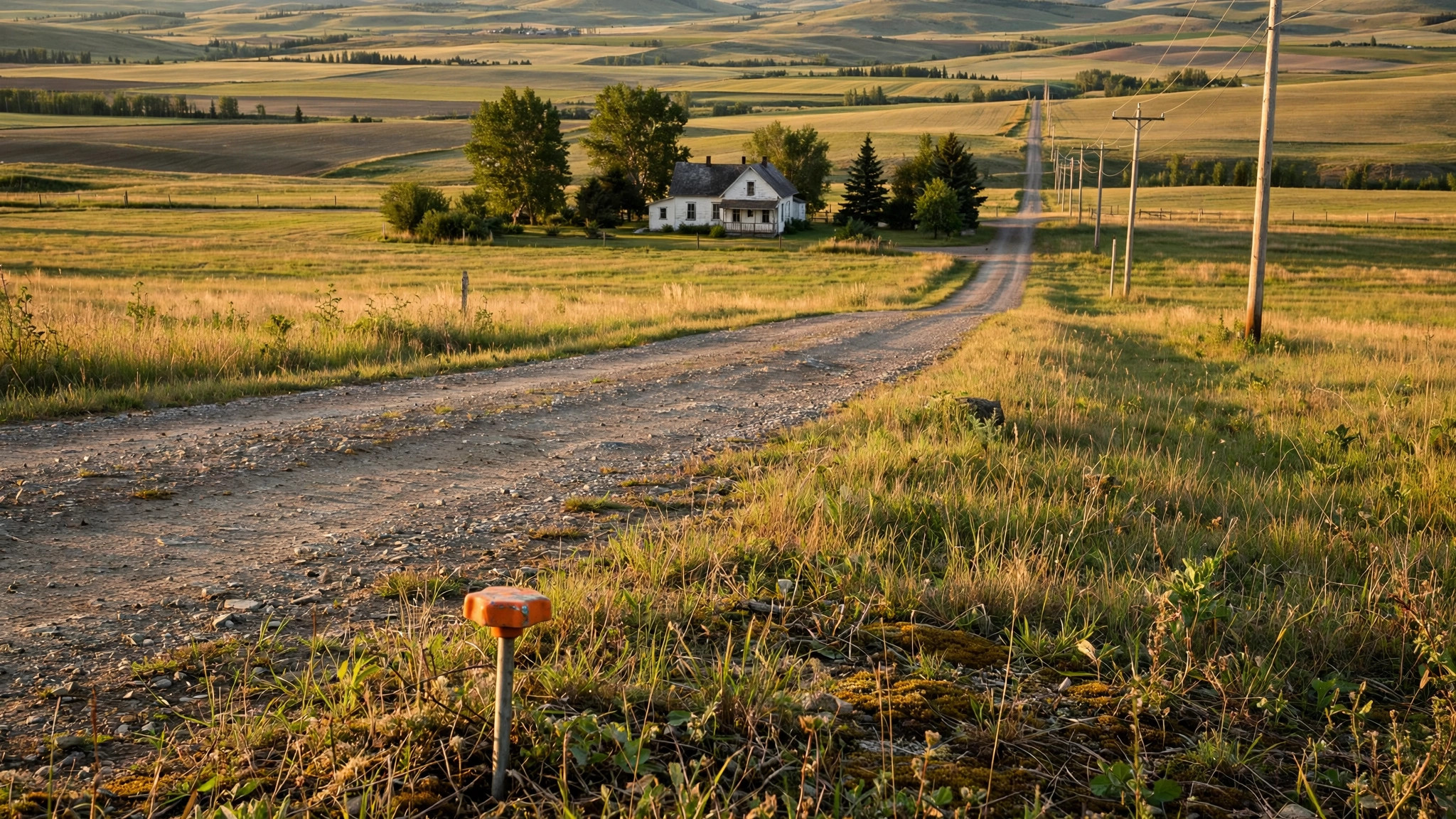
This guide explains, in plain language, what an easement actually is, how it differs from a right-of-way and from an encroachment, what a proper land survey costs in Canada in 2026 and what it proves, how boundary disputes are actually resolved, and the five checks every buyer should complete before conditions come off. It is general information, not legal advice for a specific property — boundaries are intensely local, and a licensed land surveyor and a real-estate lawyer in the property's province are the right professionals for a specific lot.
If you are also weighing up a parcel with no house on it yet, start with our guide to buying vacant land in Canada, including financing, zoning and servicing costs — then come back here, because easements and surveys are the due-diligence layer that guide assumes you will do.
What an easement is — a right to use, not a right to own
An easement is a legal right for someone else to use part of your land for a specific, defined purpose, without owning any of it. The Alberta Land Surveyors' Association puts it simply: an easement or right-of-way is an agreement that confers on an individual, company or municipality the right to use a landowner's property in some way, and it partially restricts the owner's use of the affected portion. Protect Your Boundaries, an Ontario survey-information service, makes the same central point: an easement is a right of use, not ownership, and easements are registered for and against land, not people — your property has the easement, not you personally.
Three consequences follow from that, and each one surprises buyers:
First, easements run with the land. They are usually registered on the certificate of title or parcel register, they remain with the land when it is sold, and the rights and obligations transfer automatically to the new owner. An easement stays on title until its holder formally discharges it. You do not get to renegotiate it just because you are a new owner.
Second, every easement has two sides. The parcel that is burdened is called the servient tenement; the parcel (or company) that benefits is the dominant tenement. In Ontario parcel registers you will see the shorthand: a property described as "subject to" (S/T) an easement is the burdened one, and a property described as "together with" (T/W) holds the benefit. The classic residential example, described by Protect Your Boundaries, is a narrow side yard between two Toronto houses: a right-of-way lets one owner step onto the neighbour's strip to maintain their own wall — washing windows, repairing brick — because there is physically no other way to reach it.
Third, the document defines everything. The registered instrument states the purpose, the location and width of the strip, who holds the right, and what the owner may and may not do inside it. Two easements that look identical on the ground can carry completely different restrictions on paper, which is why "there's an easement" is the beginning of the questions, not the end.
One special form deserves a warning: a blanket easement covers an entire parcel rather than one described strip — common with older utility grants. The Alberta Land Surveyors' Association notes that an owner in that position should ask the holder whether the easement is still required, or whether it can be reduced to the actual location of the infrastructure. That single conversation can restore most of a lot's buildable area.
The types of easement you will actually meet
Utility easements are the most common. They give a utility or municipality the right to run and service hydro, gas, water, sewer or telecom lines across a defined strip. In Ontario the typical holders are Hydro One for electricity transmission, Enbridge Gas for natural gas, and Bell Canada and Rogers for telecommunications. The holder can enter the strip to inspect, maintain and repair its infrastructure — and the owner generally cannot build permanent structures, pools, decks with deep foundations, or fences that block access inside it.
Rights-of-way are a type of easement about passage: a right to cross land. Shared driveways between older semi-detached houses, a lane to a landlocked back lot, and a farm access road are all rights-of-way. The burdened owner must keep the route clear and passable; the benefiting owner gets access, not ownership, and usually not the right to park, store or expand beyond what the instrument says.
Drainage and servicing easements protect the movement of water and municipal services — storm sewers, drainage swales, and pumping or maintenance access. Building over a drainage easement can redirect water onto a neighbour and create liability that has nothing to do with the easement holder at all.
Easements in gross are the exception to the "land, not people" rule: they are held by a company or person — a utility corridor is the standard example — rather than by a neighbouring parcel. There is no dominant tenement; the benefit belongs to the holder itself.
Prescriptive easements are the uncomfortable category: rights acquired through long, continuous, open use rather than a registered document. A worn path or a neighbour's driveway crossing your corner for decades is the warning sign surveyors tell buyers to look for on a site walk. Note, however, that in Ontario adverse possession — "squatter's rights" — is essentially extinct for residential properties under the Land Titles system, as Ottawa-area fencing and survey guides explain; long use alone rarely ripens into ownership of Land Titles land, though the law differs by province and by whether land sits in the older registry system, which is exactly why local legal advice matters.
Easement, encroachment, covenant: three words buyers constantly confuse
An encroachment is physical and, unlike an easement, it has no legal right to be there: a structure — a fence, shed, garage, driveway or deck — that crosses a boundary line onto someone else's land. As Ontario legal explainers put it, encroachments usually surface in one of two ways: on an up-to-date survey, or through title insurance coverage when there is no survey. Courts generally resolve a proven encroachment by ordering the structure removed at the encroaching owner's expense, not by letting it stay — which is why a fence built in the wrong place can mean paying to build it, paying to tear it down, and paying to build it again in the right place.
| Term | What it is | Legal right to be there? | Typical fix |
|---|---|---|---|
| Easement | A registered right to use part of another's land for a defined purpose (utilities, drainage, access) | Yes — registered on title | Live with it, or seek a discharge or reduction from the holder |
| Right-of-way | A type of easement for passage — shared driveways, lanes to back lots | Yes — registered on title | Keep it clear and passable; terms come from the instrument |
| Encroachment | A physical structure — fence, shed, garage, deck — crossing a boundary line | No | Negotiated encroachment agreement, or removal at the encroacher's expense |
| Restrictive covenant | A registered limit on what an owner may do on their own land (height, use, design) | Yes — registered on title | Comply, or apply to vary or discharge it where the law allows |
Easement vs. right-of-way vs. encroachment vs. restrictive covenant — the four terms buyers most often confuse.
A restrictive covenant is different again: a registered promise that limits what an owner can do on their own land — height limits, architectural controls, or a prohibition on certain uses — for the benefit of neighbouring lands. It does not give anyone a right to enter or cross; it restricts the owner.
The table in this article sets the three side by side, plus the right-of-way, because the remedy, the risk and the right professional differ for each.
What an easement stops you doing — and the $40,000 pool
Inside an easement strip, the practical rule is simple: nothing that blocks the holder's access or that the holder would have to remove to do their work. That normally rules out the house itself, garages and additions, sheds, pools and hot tubs, decks on foundations, fences across the strip, retaining walls, and deep-rooted planting over buried lines. Surface uses that can be lifted or driven over — grass, a garden bed, sometimes paving the holder approves in writing — may be fine, but "may" is doing heavy work in that sentence: only the instrument and the holder's written consent settle it.
The cautionary tale repeated in Ontario lot-buying guides is stark: the Ontario Court of Appeal ordered two Oakville homeowners to remove a swimming pool built on a utility easement and to pay $40,000 in costs. The lesson is not that easements are dangerous — most are routine and most owners never interact with theirs. The lesson is that an easement converts "we'll just build over it" from a shortcut into one of the most expensive assumptions in real estate. The easement also comes straight off your buildable envelope, exactly like a setback: a lot that looks big enough on the listing can lose the precise spot you wanted for the house, the garage or the septic system, a risk we explored from the servicing side in our guide to buying a rural property, including septic systems, well water and zoning.
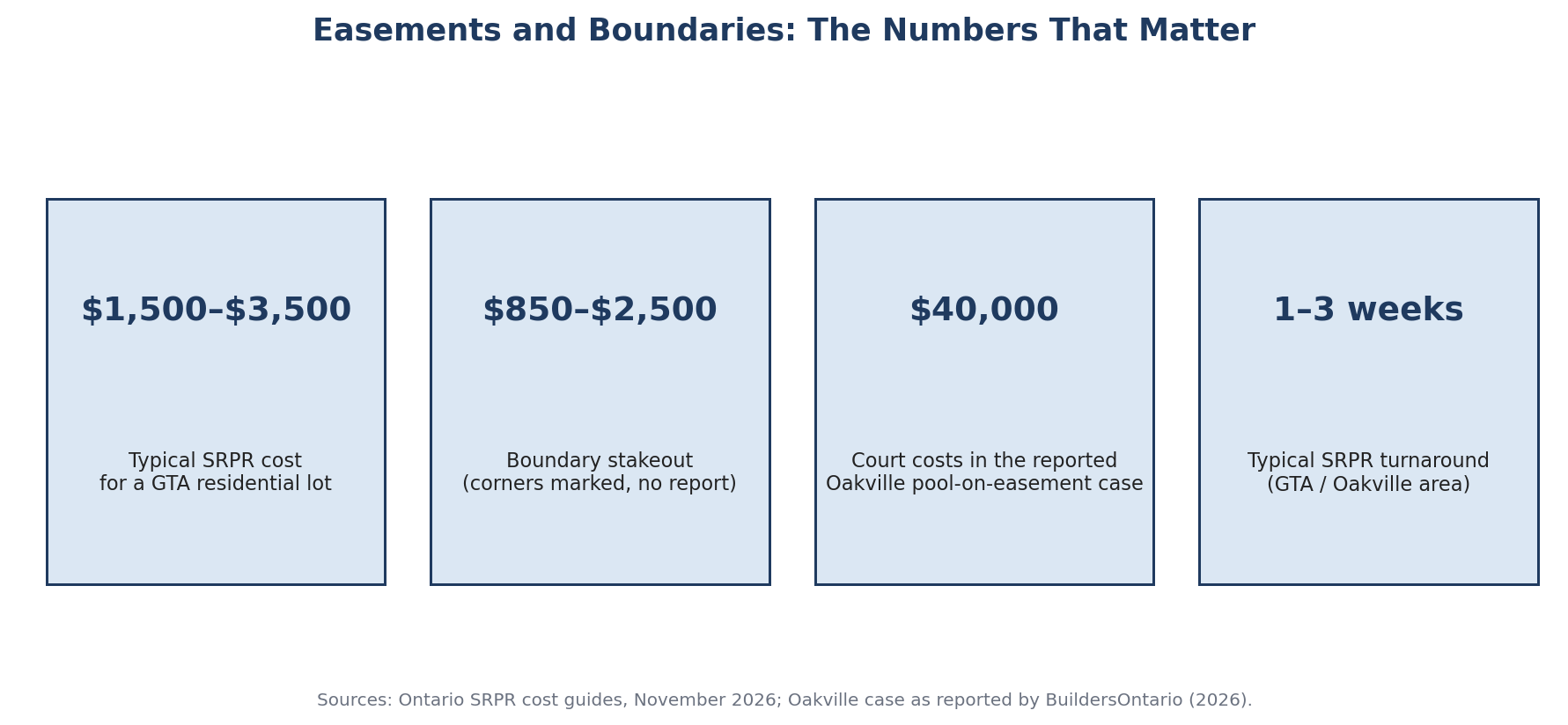
Easements and Boundaries: The Numbers That Matter. Sources: Ontario SRPR cost guides, November 2026; Oakville case as reported by BuildersOntario (2026).
Before any digging — even a fence post — Ontario homeowners are legally required to contact Ontario One Call for locates of buried utilities. Other provinces run equivalent one-call systems. It is free, it is the law, and it is also a practical way to discover where buried infrastructure actually crosses your lot.
The survey: the only document that shows where your land actually is
A listing measurement, a fence line, a municipal GIS map and a real-estate agent's sketch are all approximations. In Ontario, the only legally recognized way to confirm a property boundary is a survey prepared by a licensed Ontario Land Surveyor; every province has its equivalent licensed profession and its own name for the flagship product. In Ontario that product is the Surveyor's Real Property Report (SRPR): a plan, sealed by the surveyor, showing the property's legal boundaries, the location of the house and every other structure relative to those boundaries, fences, decks, sheds and driveways, any encroachments in either direction, and the registered easements and rights-of-way crossing the lot.
An SRPR is not a home inspection. An inspection answers questions about condition — roof, furnace, foundation. A survey answers one question only: where exactly does this property start and end, and what is sitting on it? The two are complements, not substitutes, and our guide to home inspections in Canada — what inspectors check, what they miss and what it costs covers the condition half of that pair.
Why do most resale buyers never see a fresh SRPR? Because title insurance quietly took over the job for most transactions: a standard Ontario title insurance policy includes survey coverage, protecting the buyer if an undisclosed encroachment or boundary problem causes a loss after closing. That protection is real but it is after-the-fact compensation, not advance knowledge — and specific items such as fences and boundary walls can fall outside a policy's wording. We explain the product itself in our guide to title insurance in Canada: what it covers, what it costs and when you need it. The situations where a fresh survey earns its fee are the mirror image of that gap: a dispute with a neighbour you need settled before deciding whether to close; any addition, deck, pool, shed or fence built since the last survey, so the old plan no longer matches the ground; vacant or rural land where you intend to build; and any property where an easement crosses the area you care about.
What a survey costs in 2026
The Association of Ontario Land Surveyors does not set fees, surveyors do not publish rate cards, and price moves with lot size, shape, terrain and how much title research the records require — so treat every figure here as a range to budget against, not a quote. Ontario surveyor and real-estate guides surveyed in November 2026 consistently report: a basic residential boundary survey at roughly $1,000 to $2,500; a standard SRPR for a GTA residential lot at $1,500 to $3,500, with turnaround usually one to three weeks; SRPRs in the Ottawa area at $1,500 to $4,200 or more; a simpler boundary stakeout — the surveyor physically marks the corners without producing the full drafted report — at $850 to $2,500; and topographic surveys, which map elevation, drainage and trees for a building project, at $1,000 to $5,000 and up. Rural and large parcels sit at or above the top of those ranges because of travel and archival research.
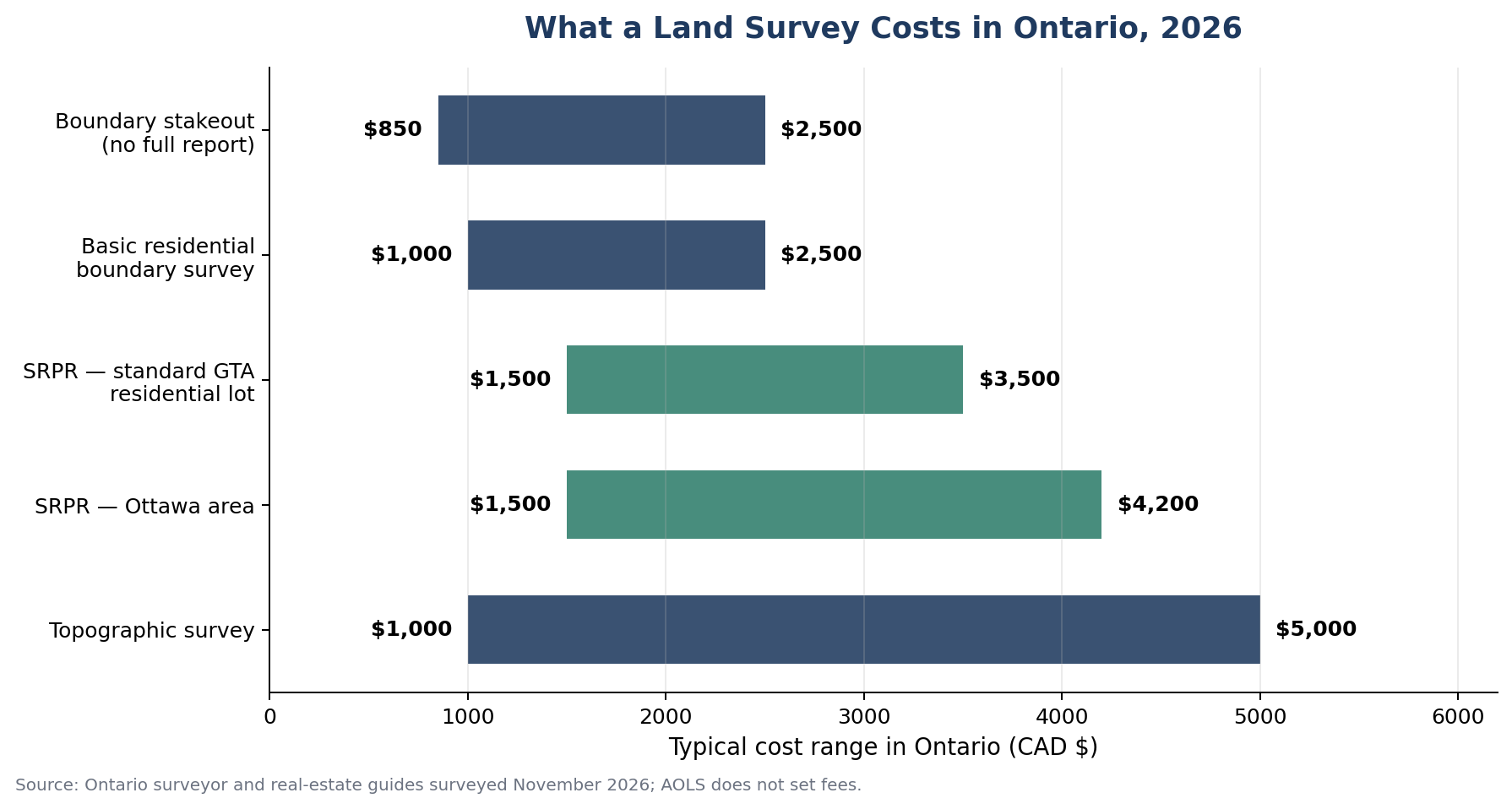
What a Land Survey Costs in Ontario, 2026. Source: Ontario surveyor and real-estate guides surveyed November 2026.
Set against what a survey prevents, the arithmetic is not close. A single forced fence rebuild, a redesigned addition, or a boundary lawsuit costs multiples of the survey fee — and the reported Oakville outcome, a removed pool plus $40,000 in costs, costs more than a dozen SRPRs. Budget the survey the way you budget the inspection: as part of the purchase, itemized in our complete breakdown of closing costs in Canada beyond the down payment.
How boundary disputes actually get resolved
Most boundary disagreements are not really about the line — the line is a fact a surveyor can establish. They are about what someone built, planted or assumed on the wrong side of it. The working sequence professionals recommend is consistent across provinces:
- Get the fact. Commission an SRPR or stakeout from a licensed surveyor. Until that exists, both sides are arguing from fence lines and memory, and neither is evidence.
- Talk, with the plan in hand. A surprising share of disputes end here: a shared copy of a sealed plan, a conversation, and an agreement to move a fence at the next replacement or to document the status quo.
- Put any settlement in writing and register what needs registering. A handshake over an encroachment survives exactly until one property sells. An encroachment agreement or a new easement, prepared by lawyers and registered on title, binds the next owners too — that permanence is the point.
- Mediation before litigation. Municipalities manage zoning and bylaws, not private boundary disputes; the City of Ottawa states this explicitly, and it is true in substance across Canada. A mediator is almost always cheaper than a court application.
- Court as the last resort. Courts can order removal, damages, or in narrow circumstances recognize long-standing rights — but litigation over a strip of grass routinely costs more than the strip is worth, which is precisely why steps 1 to 4 exist.
One trap to avoid: do not "fix" a suspected encroachment by tearing out a neighbour's fence or structure yourself. Self-help converts a civil question about a line into a claim about damaged property, and it can turn the party in the right into the party paying damages.
The five checks to run before you buy
Everything in this article compresses into a short pre-purchase routine, shown in the step graphic in this article. Have your lawyer complete a title search and pull the parcel register and every registered instrument — easements, rights-of-way and restrictive covenants all live there, and this is the single most important step, done before conditions come off. Read the instruments, not just their existence: purpose, width, holder, and what is prohibited inside the strip. Order an SRPR whenever the property, your plans, or any dispute make the physical picture matter, so you can see the easement on the ground rather than on paper. Walk the property looking for unregistered use — worn paths, a neighbour's driveway clipping the corner, hydro poles and utility boxes — and ask about anything you see. Finally, price the impact: measure the buildable area that remains after easements and setbacks, and renegotiate, require a discharge or reduction from the holder, or walk away while the conditions still let you.
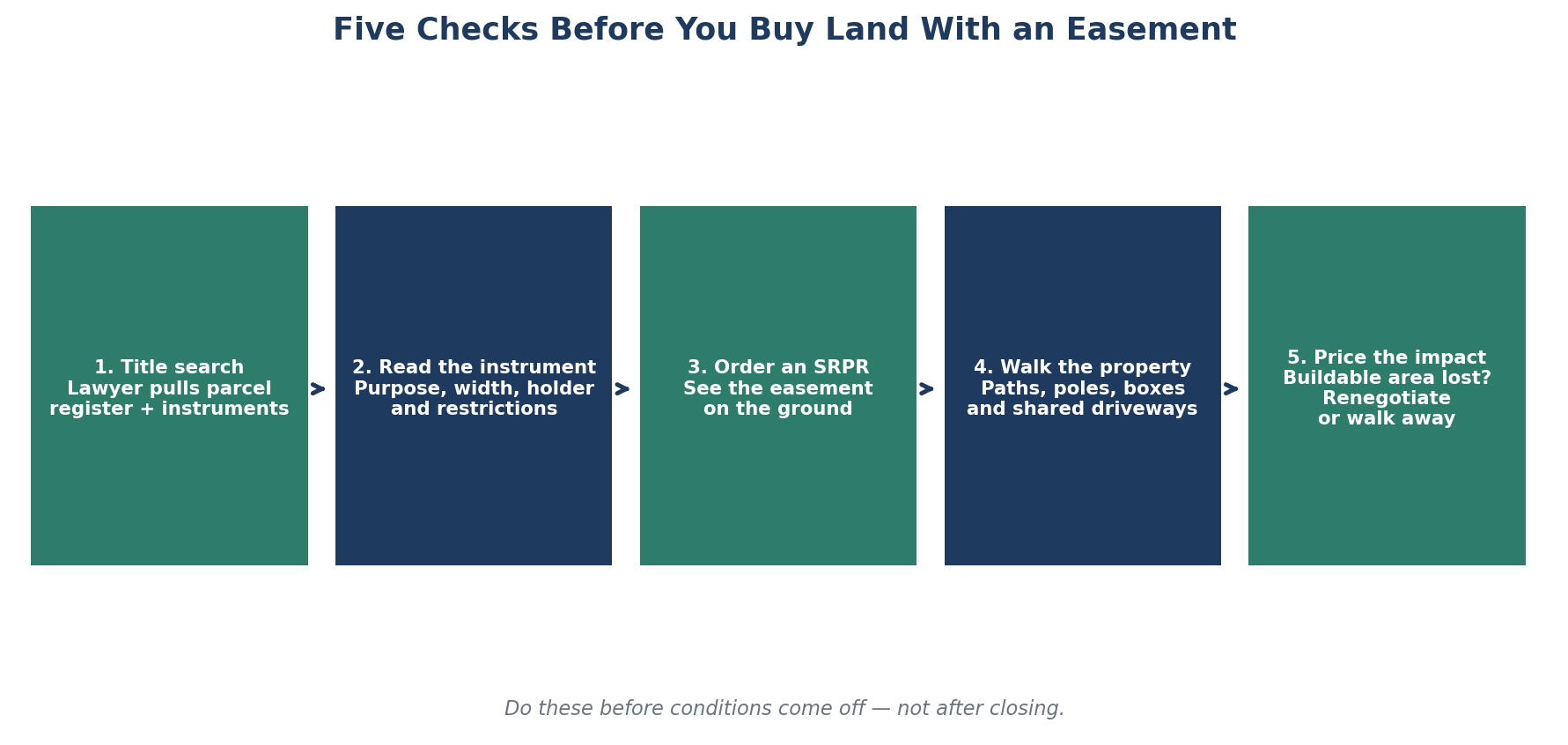
Five Checks Before You Buy Land With an Easement.
The bottom line
Easements are not defects and surveys are not bureaucracy. An easement is a defined, registered sharing of a strip of land that most owners live with uneventfully for decades; it only becomes a problem when somebody builds first and reads later. A survey is the one document that turns boundaries from an assumption into a fact, and at $1,500 to $3,500 for a typical Ontario residential SRPR it is among the cheapest certainty a buyer can purchase. Read the title, read the instruments, survey when it matters, and never build on a strip you have not checked — the homeowners who follow that order almost never meet a judge over a fence line.
Sources: Alberta Land Surveyors' Association, "Understanding Easements and Rights-of-Way"; Protect Your Boundaries (Ontario), "How easements affect private property rights"; Association of Nova Scotia Land Surveyors, "Easements"; Ontario SRPR cost and practice guides from TorontoProperty.ca, Golden Brick Homes, Commence Fence (Ottawa) and BuildersOntario, all surveyed November 2026, including the reported Oakville pool-on-easement case ($40,000 in costs). Figures are typical ranges, not quotes; this article is general information, not legal or surveying advice.

Comments
No comments yet. Be the first to share your thoughts.