
The snapshot: August 2026 in numbers
QPAREB's August 2026 statistics, drawn from the brokers' Centris provincial database, paint a picture of a market cooling in volume but not in value:

- 2,853 residential sales — down 13% from August 2025 (3,282), with seasonally adjusted sales down 2% from July.
- 20,128 active listings — up 18% year over year, with new listings at 5,874 (+7.4%).
- Median single-family price: $650,000 — up 2.8% year over year.
- Median condo price: $437,250 — up 3.6% year over year.
- Median plex price: $856,000 — up 1.7% year over year.
The slowdown, QPAREB notes, is no longer confined to any single geography or property type — it has spread across every major area of the census metropolitan area (CMA). But crucially, prices are still rising even as sales fall. That combination — persistent price growth alongside declining sales — is the signature of a market in gradual transition rather than outright decline.
"With a decline in activity and growing supply across the metropolitan area, August's results confirm that the Montreal residential market continues to rebalance," said Camille Laberge, QPAREB's assistant director and senior economist.
The inventory build-up tells its own story about where the rebalancing is most advanced. Active listings on the Island of Montreal surged first, but the wave has now reached the suburbs: listings on the South Shore rose 28% and the North Shore 26% year over year. By property type, condominiums led the supply growth at 19%, followed by single-family homes at 17% and plexes at 15%.
Why Montreal is holding up better than Toronto and Vancouver
Montreal's relative resilience is not an accident. Several structural factors insulate it from the forces hammering Canada's two most expensive markets:
1. Affordability headroom. Montreal's median single-family price of $650,000 is roughly half of Toronto's and a third of Vancouver's. When borrowing costs rose and the stress test bit, Montreal buyers had more room to absorb the shock. Royal LePage's forecast captures the divergence starkly: it expects Montreal's aggregate home price to rise 5% to $676,725 in the fourth quarter of 2026, while Toronto falls 4.5% and Vancouver falls 3.5%.
2. A smaller pandemic overshoot. Montreal participated in the 2021–2022 boom, but its peak was less extreme relative to local incomes than in the GTA or Lower Mainland. There was less froth to burn off.
3. A diversified economy. As Royal LePage Quebec broker Lefrançois noted in the spring 2026 market commentary, "the market remains confident thanks to our diversified economy." Montreal's employment base — aerospace, tech, finance, universities, public sector — doesn't hinge on a single sector, which has kept buyer morale steadier even as trade tensions with the United States rattled confidence elsewhere.
4. Steady in-migration from expensive markets. Relative affordability continues to attract buyers migrating from higher-cost regions, particularly Ontario. Interprovincial migration has been a quiet but persistent source of demand.
CREA data for the Montreal CMA shows the average home price holding remarkably steady through 2026: $579,900 in January, rising to $596,300 in June, then $590,200 in July — a flat, stable line, not a falling one.
A two-speed market: ground-oriented homes vs. condos
Look beneath the headline medians and Montreal splits into two distinct markets. Independent analysis by the Indice Tardif, which scores Montreal market segments on a 0–100 scale, found a stark divide in June 2026:
| Category | Score /100 | Market zone |
|---|---|---|
| Duplex | 82 | Strong seller |
| Fourplex | 75 | Slight seller |
| Triplex | 57 | Balanced |
| Single-family | 37 | Slight buyer |
| Condominium | 22 | Slight buyer |
| 5+ unit multiplex | 11 | Strong buyer |
Ground-oriented homes with rental income — the classic Montreal plex — are firmly in sellers' territory. Condos, particularly on the Island, have drifted toward buyers' market conditions. QPAREB's own assessment aligns: "Even as the supply of available properties increases, the single-family home market continues to favour sellers in most areas of the CMA. The condominium segment is further along in its adjustment, particularly on the Island of Montreal, where market conditions are generally sitting on the threshold between a balanced market and a buyers' market."
The transaction microstructure data from the Tardif index shows a market where negotiation has returned. On the Island of Montreal in June 2026:
- 31.0% of properties had to cut their price before selling (up from 27.5% a year earlier).
- 27.4% of sales closed at or above asking, with a median overbid of just +3.4% when they did.
- The median sold-to-initial-list-price ratio was 96.8% — a typical discount of about $19,900.
- Median time on market: 45 days.
Bidding wars haven't vanished entirely — small plexes still see overbidding more often than other categories — but the era of routine 10%-over-asking frenzies is over.
Plexes: Montreal's signature asset class
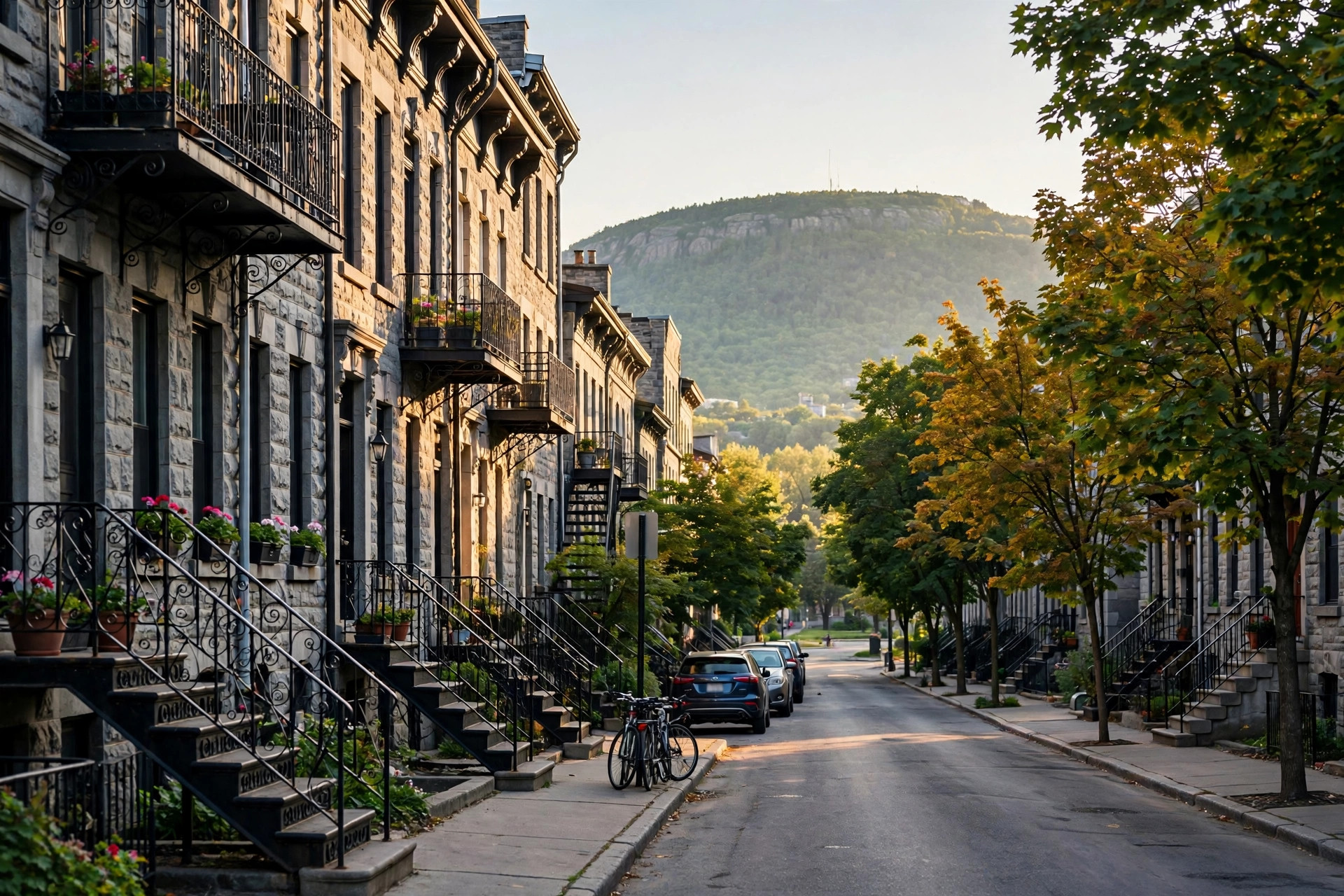
No discussion of Montreal real estate is complete without the plex — the duplexes, triplexes, and multiplexes that define the city's streetscapes from the Plateau to Rosemont to Verdun. For investors, the plex market in 2026 is arguably the healthiest segment in the CMA.
The Tardif index publishes the figures that matter to plex investors — price per door and gross rent multipliers (GRM):
| Plex type | Median price | Price per door | Median GRM |
|---|---|---|---|
| Duplex | $840,000 | $420,000 | 18.1 |
| Triplex | $937,500 | $312,500 | 17.3 |
| Fourplex | $1,150,000 | $287,500 | 17.6 |
| 5+ unit multiplex | $1,220,000 | $222,917 | 16.7 |
The pattern is instructive: per-door prices fall as unit counts rise, making larger plexes the most efficient way to buy rental income in the city. QPAREB's August data backs up the segment's strength — plex medians rose 1.7% year over year to $856,000 even as inventory grew 15%.
For house-hackers (buyers who live in one unit and rent the others), plexes remain Montreal's most distinctive path to homeownership: the rental income offsets the mortgage in a way no single-family home can match, and Quebec's rent increase framework provides predictable, if modest, rent growth.
Condos: the rebalancing frontier
The condo segment is where Montreal's adjustment is most visible. Downtown and the Sud-Ouest borough are recording the highest condominium listing levels ever captured in the Centris system, according to QPAREB's Camille Laberge, and prices there have stagnated over recent quarters. Smaller units are proving the hardest to move as buyers gain options.
This is a familiar dynamic across Canada in 2026: the condo segments of Toronto and Vancouver are in outright correction, with Royal LePage forecasting Toronto condo prices down 6.5% and Vancouver condos down 3% for the year. Montreal's condo market is following the same direction but from a gentler starting point — the Royal LePage forecast still has Montreal condos rising 2.5% to $502,558 by Q4 2026, and QPAREB's August median of $437,250 was up 3.6% year over year.
The risk for condo sellers is time. With inventory at record levels in core neighbourhoods and new rental supply competing for the same tenants-turned-buyers, overpriced listings sit. The risk for buyers is more subtle: today's soft condo prices could firm up quickly if the broader market reaccelerates, because — as we'll see — the construction pipeline is thinning.
The rental market: loosening, but still expensive by Montreal standards
Montreal's rental market is in its third year of rebalancing, according to Institutional Property Advisors' 2026 multifamily outlook. The key figures:
- Vacancy rate: 2.9% — approaching its highest level since the pandemic, driven by near-historic completions. Buildings delivered after July 2022 are running a much higher vacancy of 8.4%, and downtown two-bedroom units hit 8.3%.
- Average effective rent up 10.5% year over year — rent growth actually accelerated for a second consecutive year, concentrated in older buildings (1960–1989 stock rose 12.2%).
- Rents are up more than 40% over the past four years, despite Montreal remaining one of Canada's lower-rent major markets.
- Average asking rent for a two-bedroom sits around $1,930/month (down about 1% from recent highs, per fall 2026 coverage).
The paradox — rising vacancy alongside rising rents — reflects a split market. New supply is concentrated in downtown and a few corridors, where landlords are offering incentives to fill buildings. Meanwhile, older, well-located stock with long-term tenants continues to see strong in-place rent growth: Yardi's Q2 2026 data showed Montreal in-place rents up 3.4% ($59) year over year, even as new-lease rates softened nationally.
For renters, the practical takeaway is that leverage has improved, especially in new downtown buildings where negotiation is possible. For investors, multifamily investment volume hit a record $4.4 billion in 2025, with capital favouring suburban assets — older buildings with lower average rents in exceptionally tight submarkets.
Construction: still building, but the peak is passing
CMHC's 2026 Housing Market Outlook paints Montreal as a relative bright spot on the supply side. After record growth in 2025, Montreal housing starts are expected to remain high in 2026, with rental construction continuing to dominate. That wave of new units is precisely what's pushing vacancy rates higher.
But the peak is passing. CMHC expects housing starts to decline from recent highs across Quebec as builders respond to unsold inventory and high construction costs — just less dramatically than in Ontario and British Columbia, where condo construction is falling to historically low levels. CMHC deputy chief economist Kevin Hughes singled out Montreal alongside Calgary as markets where "stronger local conditions may help support housing market activity," in contrast to Toronto and Vancouver.
The longer-term implication matters more than any single month. As in Vancouver, today's construction slowdown is tomorrow's supply constraint. Montreal's population growth has slowed with tighter federal immigration policy, but the structural housing shortfall hasn't gone away — and when demand returns, the pipeline will be thinner than it is today.
What the forecasters expect
The consensus view on Montreal is unusually coherent:
- Royal LePage (Dec 2025 forecast): Montreal aggregate price +5.0% to $676,725 in Q4 2026 — the second-strongest forecast among major markets after Quebec City (+12%). Single-family detached +6% to $796,908; condos +2.5% to $502,558.
- CMHC (2026 outlook + summer update): "Market momentum is expected to keep sales high in Prairie and Quebec markets," with Quebec posting modest price gains on comparatively balanced conditions. Sales gradually improving through 2027–2028 as economic growth and income gains strengthen.
- Royal LePage spring 2026 commentary: Momentum in the single-family and luxury segments expected to hold in sought-after areas; the gradual end of remote work expected to pull buyers back toward the Island from the North and South Shores; condo buyers gaining negotiation room.
The risks are the same ones hanging over every Canadian market: renewed U.S. trade tensions, geopolitical shocks, and the possibility that cautious buyers stay sidelined longer than expected. Royal LePage CEO Phil Soper has been candid about the fragility — the firm got 2025 "completely wrong," and he notes that buyers will only return in force when they're convinced the economy and employment are on solid footing. Montreal's diversified economy and affordability cushion don't make it immune; they make it less exposed.
What this means for buyers, sellers, and investors
Buyers
Montreal in 2026 offers something rare in Canada: a major market where prices are rising modestly, selection is the best it's been in years, and you're not competing against fifteen other offers. The 45-day median time on market and 96.8% sold-to-list ratio mean negotiation is expected, not insulting. Focus on segments with structural support — single-family homes in established neighbourhoods, and plexes where the rental income de-risks the purchase. In the condo market, especially downtown and the Sud-Ouest, take your time and negotiate hard; inventory is at record levels.
Sellers
The market still favours sellers for single-family homes in most of the CMA — but the window is narrowing as suburban inventory builds. Price to the current market, not to last spring's peak: nearly a third of Island listings had to cut their price before selling. Well-presented, realistically priced homes are still moving; aspirational pricing just buys you extra days on market and an eventual reduction.
Investors
Plexes remain the core Montreal play: per-door pricing in the $220,000–$420,000 range with GRMs in the 16–18 band is workable in a way Toronto and Vancouver simply can't offer. The record $4.4 billion in 2025 multifamily investment volume shows institutional capital agrees. Watch the condo segment for distressed opportunities as record downtown inventory meets motivated sellers — but underwrite conservatively, since condo price momentum on the Island has stalled.
Renters
Your negotiating position is the best it's been since before the pandemic, particularly in newer downtown buildings sitting at 8%+ vacancy. But don't mistake a cyclical loosening for a structural one: in-place rents are still rising 3–4% a year, and the construction pipeline beyond 2027 is thinning.
The bottom line
Montreal's 2026 housing market is best understood as a controlled descent into balance, not a correction. Sales are down 13%, listings are up 18%, and negotiation has returned — yet median prices are still rising 2–4% across every property type, and every major forecaster expects the year to end in positive territory. The city's affordability advantage, diversified economy, and shallower pandemic overshoot have bought it something Toronto and Vancouver don't have: time.
That resilience shouldn't be mistaken for immunity. The condo market on the Island is at a genuine inflection point, suburban inventory is building fast, and the broader economic risks — trade tensions, cautious consumers, slower population growth — apply in Quebec too. But for now, Montreal remains what it has been for most of the past decade: the big Canadian city where the housing math still works.
Sources: QPAREB August 2026 market statistics (via GlobeNewswire/Centris); QPAREB assistant director and senior economist Camille Laberge; Royal LePage 2026 Market Survey Forecast (Dec 2025) and Q1 2026 House Price Survey commentary; Royal LePage president and CEO Phil Soper; CMHC 2026 Housing Market Outlook and Summer 2026 Housing Market Update; CMHC deputy chief economist Kevin Hughes; Indice Tardif June 2026 Montreal market analysis; Institutional Property Advisors Montreal Multifamily Market Report 1Q26; Yardi Q2 2026 Canadian multifamily data; CREA monthly average price data; The Canadian Press, Sept. 4, 2026.


Comments
No comments yet. Be the first to share your thoughts.