

Few phrases in Canadian housing carry as much frustration as “blind bidding.” At the peak of the pandemic boom, buyers across the Greater Toronto Area, Greater Vancouver and a dozen smaller markets were asked to name the largest cheque they would ever write — for a house they had often seen once, for twenty minutes — without being told what anyone else was offering, whether the competing offers were real, or even, in some cases, how many there were. Sellers loved the system. Buyers felt they were bidding against themselves. Politicians promised to end it.
Three years later, the picture is more complicated — and more interesting — than either side of that debate admits. Ontario now allows a form of open bidding, but only when the seller chooses it. British Columbia gave every resale buyer a statutory cooling-off period, but left blind bidding itself in place. And the market did much of the reformers’ work for them: in October 2026, the average GTA home sold for 97 per cent of its asking price, according to the Toronto Regional Real Estate Board (TRREB), a world away from March 2022, when the average home sold for 113 per cent of asking in eight days.
This guide explains how multiple-offer situations actually work in Canada in 2026, what the law in each major province requires to be disclosed, what changed in Ontario and BC, and — most importantly — how buyers can compete intelligently in the pockets of the market where bidding wars still happen, and how sellers can run a fair, legal, effective offer process.
What “blind bidding” actually means
In a standard Canadian multiple-offer process, a home is listed — often at a deliberately attractive price — with a stated offer date and time. Interested buyers submit written offers through their own brokerages. The seller’s brokerage presents all the offers to the seller, usually in a single sitting. The seller may accept one, reject all of them, or counter one. Here is the “blind” part: the buyers are not told the price or terms of the competing offers. Traditionally, in most provinces, they were entitled to know only that competition existed.

Three features make the process feel like an auction while behaving like something else:
- It is a single-round, sealed-bid contest in most cases. Unlike an auction, you usually get one number. Some sellers send all buyers back for a “second round,” but there is no right to one.
- Price is only one column. Sellers weigh the deposit, the closing date, and above all the conditions. A lower firm offer (no financing or inspection conditions) routinely beats a higher conditional one, because a conditional offer can still collapse.
- The list price is a marketing tool, not a valuation. In a planned multiple-offer strategy, the asking price is set below expected market value to generate competition. Paying “over asking” is therefore not the same as overpaying — and paying “under asking” in a soft market is not automatically a bargain. What matters is value relative to comparable recent sales, a point we return to below and in our guide to how home appraisals work and what happens when one comes in low.
The emotional mechanics are well documented by anyone who lived through 2021: scarcity, a deadline, social proof (“eleven other offers!”), and the fear of losing yet another home push bids past the buyer’s own valuation. Understanding that machinery is the first defence against it — a lesson Canada learned the hard way during the 2021 boom and the sharp 2022 correction that followed.
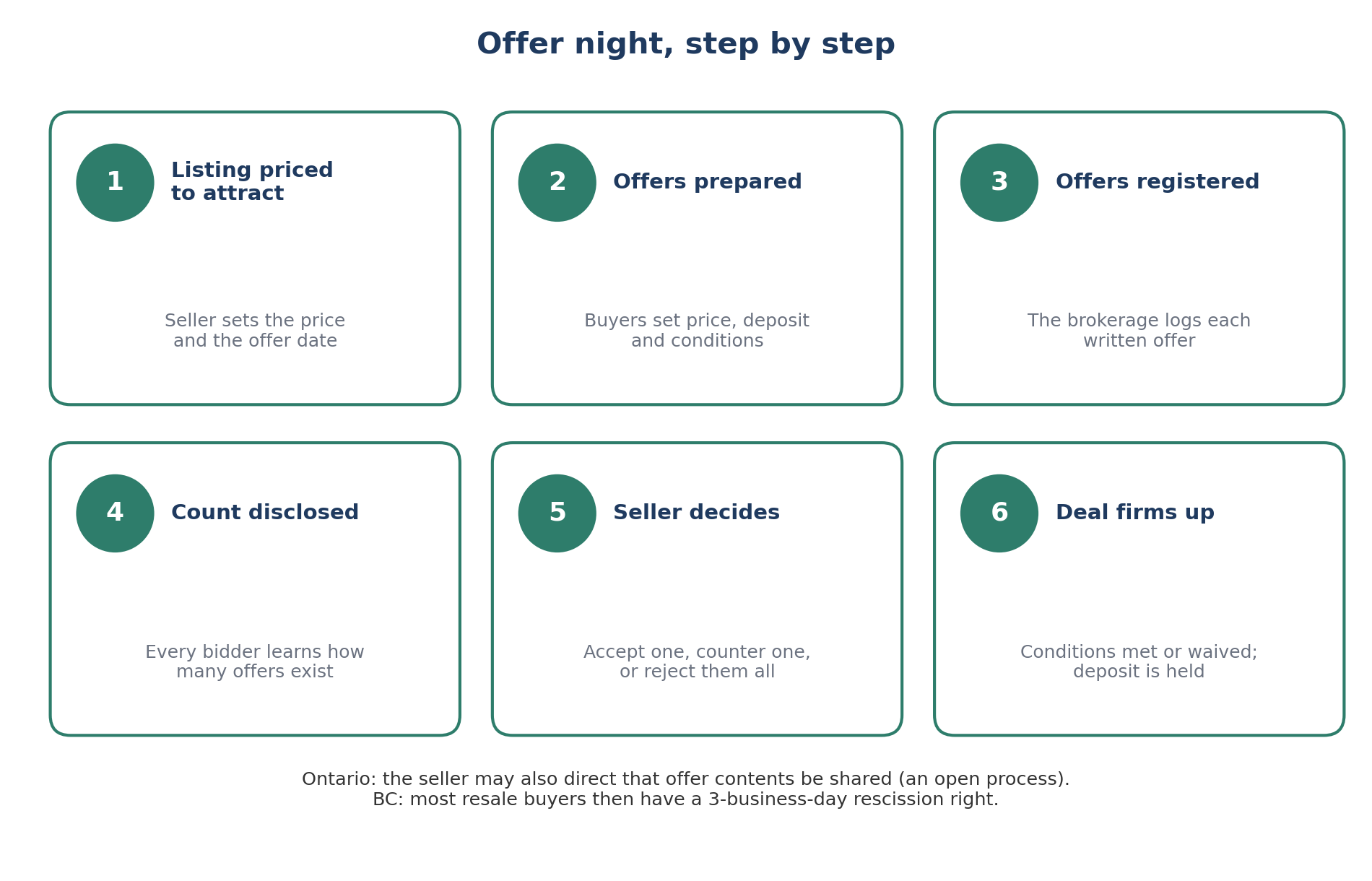
Offer night, step by step: how a multiple-offer process unfolds, from pricing strategy to a firm deal.
The 2026 reality: bidding wars are now a local event, not a national one
Before the rules, the numbers — because the single biggest change since the blind-bidding debate peaked is the market itself.
TRREB’s monthly Market Watch data tells the story cleanly. In March 2022, at the frenzy’s peak, GTA homes sold for an average of 113 per cent of list price, with 0.9 months of inventory and an average of just eight days on market. By October 2025 the sale-to-list ratio had fallen to 98 per cent, and through 2026 it has hovered at 97–98 per cent, with roughly 4.6 to 4.9 months of inventory and homes taking about a month to sell. In September 2026, the GTA average price was $1,006,409 — down 5.1 per cent from a year earlier — and the average home sold at 98 per cent of asking.
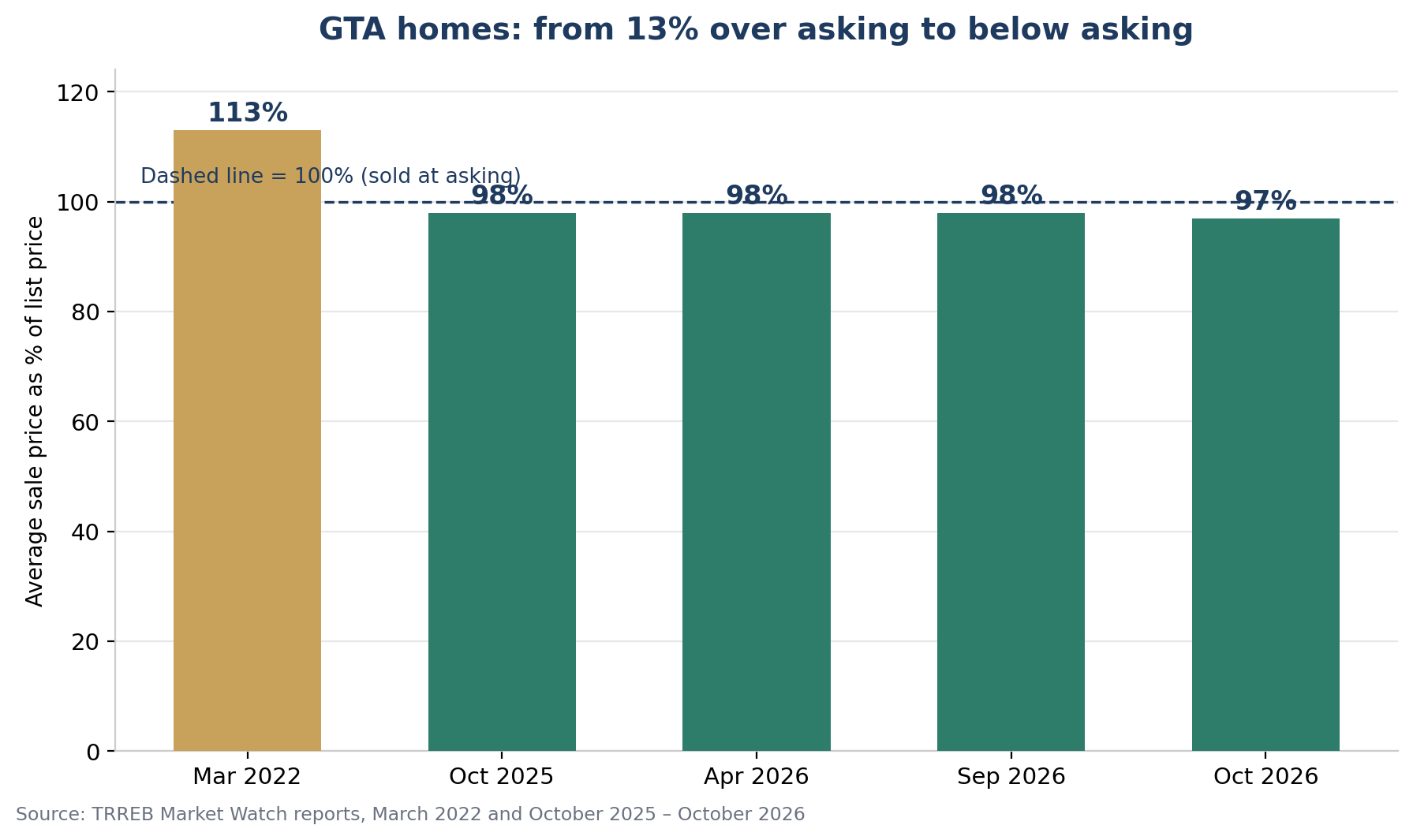
GTA homes: from 13% over asking to below asking. Source: TRREB Market Watch, March 2022 and October 2025 – October 2026.
That is a negotiating market, not a bidding-war market. But averages conceal pockets. In that same September 2026 data, semi-detached homes in the City of Toronto sold for 104 per cent of asking in 21 days, and freehold townhouses for 102 per cent. Well-priced freeholds in desirable pockets still draw multiple offers; condos and overpriced listings mostly do not. The practical takeaway for 2026 buyers: assume you will negotiate, prepare for the possibility you will compete, and know which situation you are actually in before offer night. Our step-by-step guide to buying your first home in 2026 walks through the preparation that makes either path manageable.
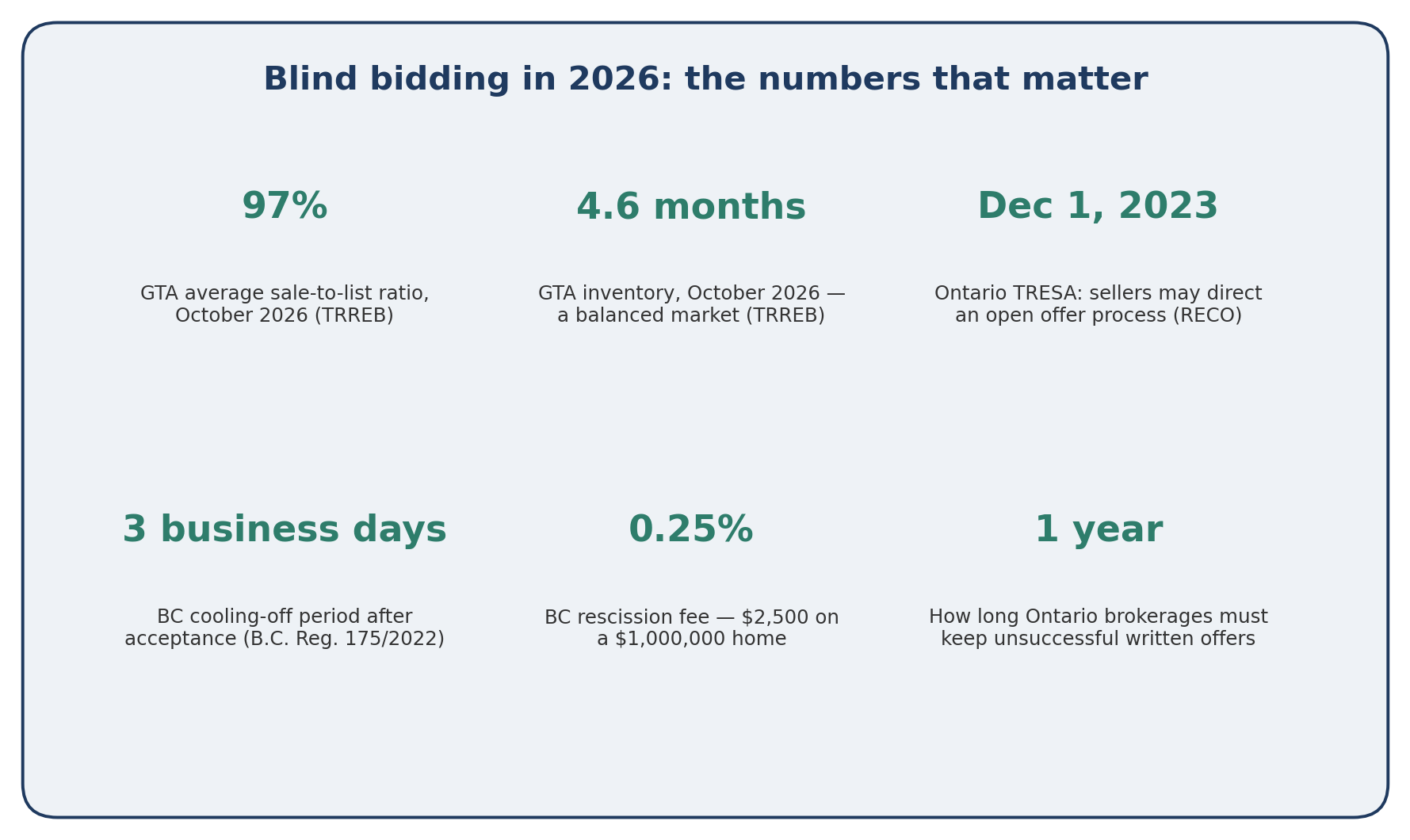
Blind bidding in 2026: the numbers that matter. Sources: TRREB, RECO, B.C. Reg. 175/2022.
Ontario after TRESA: open offers are allowed — if the seller chooses
Ontario is the province that moved furthest on transparency, and its model is widely misunderstood, so it is worth stating precisely.
Phase 2 of the Trust in Real Estate Services Act (TRESA) took effect on December 1, 2023. Under the rules administered by the Real Estate Council of Ontario (RECO):
- The number of offers is always disclosed. When a seller’s brokerage receives competing written offers, it must communicate the number of competing written offers to every person who has submitted one. A seller cannot suppress the count, and a brokerage must not misrepresent it.
- The contents are disclosed only at the seller’s written direction. A seller may direct their brokerage, in writing, to share the substance of competing offers — price, conditions, closing dates — with everyone who submitted a written offer. This is the “open offer process.” The direction can cover all or part of the substance, and the seller can change or revoke it.
- Identity is never disclosed. Nothing that would identify a competing buyer — names or other personal information — may be shared, even in an open process.
- The paper trail is real. Brokerages must keep copies of unsuccessful written offers for at least one year, and a buyer who doubts the stated number of offers can ask RECO’s registrar to inquire.
Two practical consequences follow. First, Ontario did not ban blind bidding; it made openness the seller’s option. Sellers who believe transparency will produce a better result — auction dynamics tend to raise prices when bidders can see they are close — can choose it; sellers who prefer the traditional sealed process can keep it. Early experience suggests open processes remain the minority choice, which is itself information: most sellers and listing agents still believe a sealed process, with its fear premium, serves the seller best.
Second, even in a sealed Ontario process, a buyer today knows more than a buyer in 2021 did: a verified count of genuine written offers, a regulator who can check, and a one-year paper trail. Phantom bids — the nightmare scenario of the boom years — are much harder to sustain inside that framework.
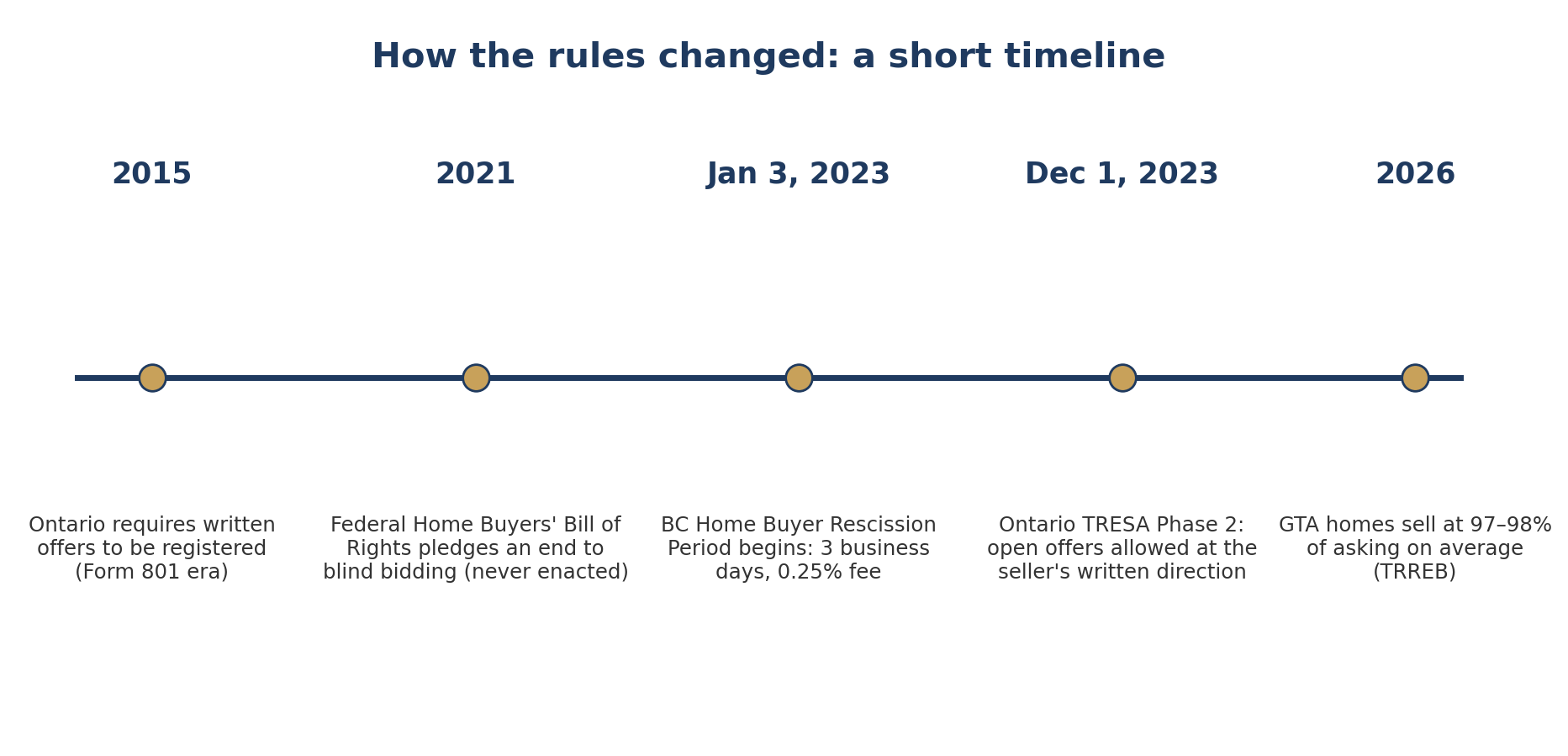
How the rules changed: from Ontario’s 2015 offer-registration rules to the TRESA open-offer option and BC’s cooling-off period.
British Columbia: no open bidding, but a cooling-off period instead
BC chose a completely different lever. Rather than changing what bidders can see, it changed what winning costs if you regret it.
The Home Buyer Rescission Period (HBRP), in force since January 3, 2023 under section 42 of BC’s Property Law Act and B.C. Regulation 175/2022, gives buyers of most residential property — detached houses, townhouses, strata units, duplexes, manufactured homes affixed to land, and even private sales — the right to rescind an accepted contract within three business days after acceptance, for any reason at all, by serving written notice on the seller.
The key mechanics:
- The fee is 0.25 per cent of the purchase price — $1,500 on a $600,000 home, $2,500 on a $1,000,000 home — paid to the seller, normally out of the deposit, with the balance of the deposit returned to the buyer.
- The right cannot be waived. Neither party can contract out of it, and it applies even to subject-free offers.
- There are exemptions: properties sold at auction, under court order or supervision, on leased land, or as leasehold interests. Developer presales are excluded because they already carry a separate seven-day rescission right under BC’s Real Estate Development and Marketing Act.
- Three business days is short. It is a safety valve for buyer’s remorse and rushed decisions, not a substitute for conditions — it is rarely enough time to complete a full inspection, financing approval and strata-document review, which is why BC buyers are still advised to use subjects where competition allows.
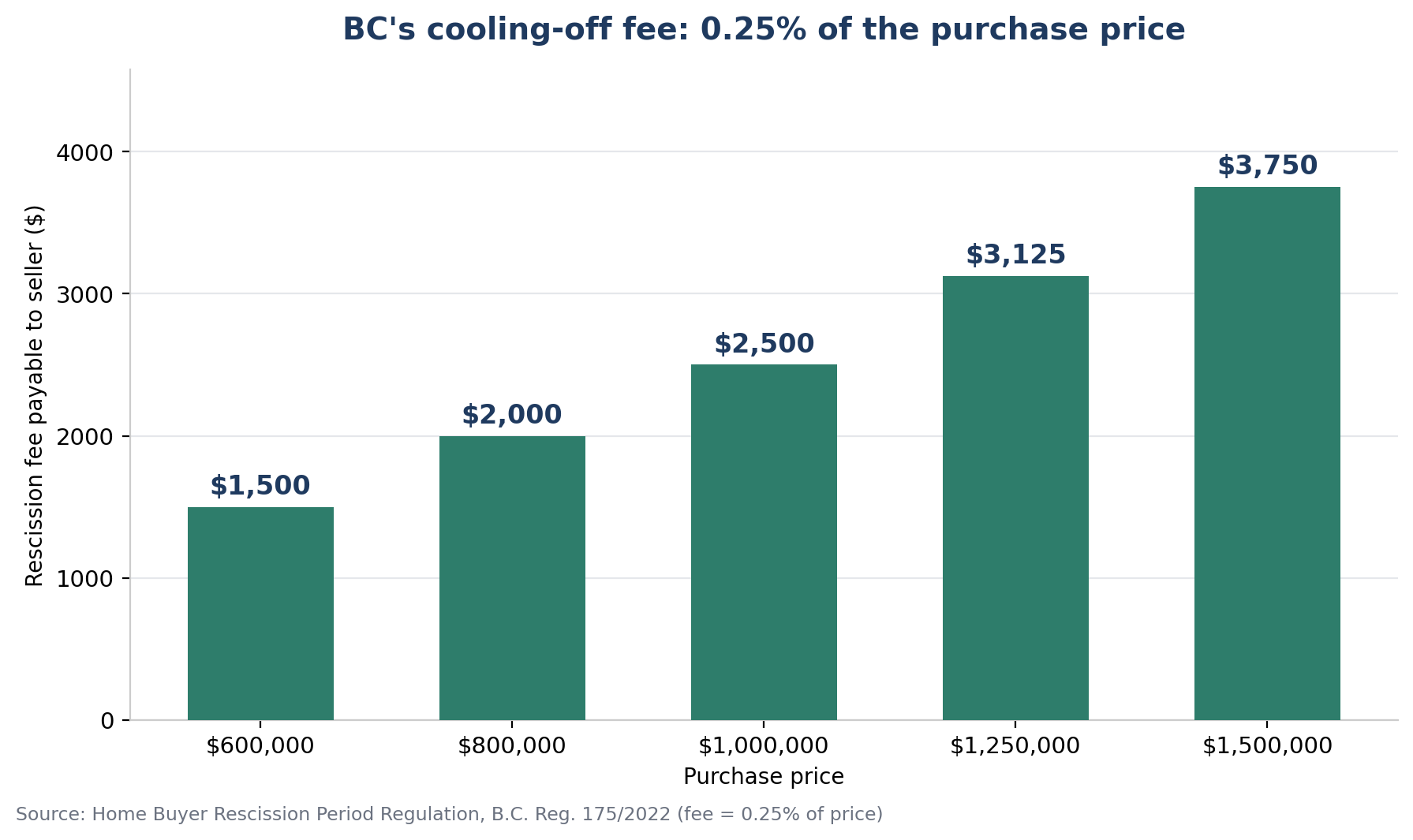
BC’s cooling-off fee: 0.25% of the purchase price. Source: Home Buyer Rescission Period Regulation, B.C. Reg. 175/2022.
On disclosure itself, BC remains a sealed-bid province: the BC Financial Services Authority (BCFSA) requires competing offers’ contents to stay confidential; a listing brokerage may confirm that multiple offers exist and invite best offers, but may not reveal another buyer’s price or terms. The HBRP is BC’s answer to the worst harm of blind bidding — the irreversible, panic-driven firm offer — without adopting open bidding.
The rest of Canada, briefly
Alberta, Manitoba, Saskatchewan and the Atlantic provinces retain the traditional model: sealed offers, disclosure practices governed by provincial real estate councils’ standards of practice, and no statutory cooling-off period for resale homes. Quebec’s market runs through its own system under the Organisme d’autoréglementation du courtage immobilier du Québec (OACIQ), with prescribed forms and a strong culture of conditional offers (inspection and financing conditions remain far more common in Quebec than in Toronto or Vancouver). Federally, the 2021 Home Buyers’ Bill of Rights commitment to end blind bidding nationally was never enacted as a federal ban — real estate trading is provincial jurisdiction — which is why the reform map is a patchwork led by Ontario and BC.
Escalation clauses: legal, rare, and usually refused
An escalation clause promises to beat the highest competing offer by a set increment (say $1,000 or $5,000) up to a stated cap. It sounds like the rational answer to a sealed process, and buyers ask about it constantly. In practice:
- In Ontario, RECO’s longstanding position is that nothing in the legislation prohibits escalation clauses — but RECO does not endorse them and advises buyers to consult a lawyer before using one. The verification problem is structural: the clause’s trigger is another offer’s price, which the listing side historically could not disclose.
- In BC, the same confidentiality rules make the trigger effectively unverifiable, and most listing brokerages decline offers containing escalation clauses and ask for a clean, single price instead.
Ontario’s open-offer option actually solves the escalation clause’s core problem — if the seller directs disclosure, prices are visible and escalation is unnecessary. Outside an open process, treat an escalation clause as a conversation to have with your agent and lawyer, not a standard tool.
How to compete without overpaying: a buyer’s playbook
For the pockets of the 2026 market where competition is real, discipline beats bravado. The buyers who win well do six things:
- Set the walk-away number before offer night — from comparables, not from the list price. Your agent should pull the most recent comparable sales, adjust for differences, and land on a defensible value. Your maximum is that value plus whatever personal premium the specific home justifies for you — decided in a calm room, not at 7:40 p.m. with nine offers on the table.
- Know your financing ceiling, not just your approval. A pre-approval is not a guarantee, and in a firm offer the gap between your bid and a later appraisal is your cash problem. Remember that federal qualification rules still apply at the mortgage stress test rate, whatever you bid.
- Compete on the columns the seller actually reads. A larger deposit (cheque ready on acceptance), the seller’s preferred closing date, and flexibility on inclusions can beat a slightly higher price. Clean beats clever.
- Shorten conditions instead of deleting them, where you safely can. A pre-offer inspection, a fully underwritten pre-approval, and pre-reviewed status documents let you offer with short — or sometimes no — conditions without gambling. Deleting protections you have not replaced with preparation is how bidding wars produce casualties.
- Use the transparency you now have. In Ontario, confirm the registered offer count. Ask whether the seller has directed an open process. In BC, remember the rescission period exists — but do not bid carelessly on the theory that you can unwind; the 0.25 per cent fee on a $900,000 home is $2,250, and deposits and reputations are real.
- Be genuinely willing to lose. There is always another house. The defining skill of the 2021 survivors was walking away from the eleventh bidding war and buying calmly in the twelfth week.
For sellers: running a fair process that still gets the best price
Sellers and listing agents design these contests, and the design choices matter legally and financially — a theme we also explore in our guide to selling your home in a buyer’s market, where the same principles apply with the leverage reversed.
- Price to the strategy. Underpricing to force multiple offers works when inventory is scarce and demand deep; in a 4.6-months-of-inventory market it can simply produce a disappointing offer night and a stale listing. Match the strategy to your segment’s actual sale-to-list behaviour.
- Decide on openness deliberately. In Ontario, weigh an open process: transparency can build trust and still produce auction momentum, and it eliminates any suspicion of phantom bids. Whatever you choose, give the direction in writing and apply it to every bidder equally.
- Judge the whole offer. The highest price with a financing condition and a 5 per cent deposit may be worth less, risk-adjusted, than a firm offer $10,000 lower with a bank draft in hand. Experienced sellers rank offers by certainty-adjusted value, not headline price.
- Keep the record. Retain all written offers for at least a year (an Ontario legal requirement), and expect that the count you announce may be checked.
What reform did — and did not — change
Three honest conclusions emerge from the 2026 vantage point. First, the feared and celebrated effects of blind bidding were always partly market effects: when inventory rose from 0.9 months to 4.6 months in the GTA, sale-to-list ratios fell from 113 per cent to 97 per cent with no bidding ban anywhere in Canada. Scarcity, not secrecy alone, was the engine. Second, transparency reforms still matter at the margin that counts — the individual hot listing where ten buyers gather. Ontario buyers now bid knowing the field is real and documented, and BC buyers know a rushed firm offer is no longer literally irreversible. Third, the patchwork will persist: with real estate firmly provincial, “how blind is bidding?” will keep having a different answer in Toronto, Vancouver, Calgary and Montreal.
The bottom line
Blind bidding in Canada in 2026 is neither the unregulated frenzy of 2021 nor the open auction reformers wanted. It is a sealed process with better guardrails: verified offer counts and an open-bidding option in Ontario, a statutory cooling-off period in BC, and — most powerfully — a balanced market in which the average GTA home sells below asking. Compete where you must, with a number set by comparables and a walk-away line set in advance, and the process loses most of its power to hurt you.
Sources: Ontario Ministry of Public and Business Service Delivery, TRESA Phase 2 announcement, November 28, 2023; Real Estate Council of Ontario (RECO), competing-offers guidance and Bulletin 4.1; Home Buyer Rescission Period Regulation, B.C. Reg. 175/2022, and BC Financial Services Authority (BCFSA) guidance, January 2023; Toronto Regional Real Estate Board (TRREB) Market Watch reports, March 2022 and September–October 2026; RECO, escalation clause guidance, 2017. This article is general information, not legal or financial advice; offer rules vary by province and change over time — confirm the rules that apply to your transaction with your brokerage and lawyer.


Comments
No comments yet. Be the first to share your thoughts.