

Some of the best-priced homes in Canada come with a complication sitting in the living room: a tenant. Tenanted houses, duplexes and condos often sell for less than identical vacant homes, because the buyer pool shrinks to people willing to take on someone else's lease. That discount can be an opportunity — or an expensive misunderstanding — depending on whether you understand one foundational rule before you write an offer.
The One Rule Everything Else Follows From: A Sale Does Not End a Tenancy
In virtually every Canadian province, a tenancy runs with the land. When a landlord sells a rented home, the buyer steps into the seller's shoes at the moment title transfers. The lease does not restart, the rent does not reset, and the tenant does not have to sign anything new. The buyer simply becomes the landlord, on exactly the terms that existed the day before closing.
This surprises many buyers. Becoming the new owner gives you no fresh start: you cannot set a new rent outside your province's increase rules, you cannot add new lease terms, and you cannot end the tenancy just because ownership changed. A sale, by itself, is never a lawful reason to make a tenant leave in Ontario, British Columbia, Alberta or Quebec — and in New Brunswick it is not a ground to end a tenancy at all. The only sale-related route to an empty home is a specific statutory process, available when the buyer (or a close family member) genuinely intends to live in the unit, and each province runs that process differently.
Everything in this guide flows from that rule. If you keep it in mind, a tenanted purchase becomes a series of manageable, priceable questions. If you ignore it — and assume the home will simply be empty on closing day — it becomes the most common source of blown closing dates and legal bills in residential real estate.
What You Actually Inherit on Closing Day
When you buy a tenanted home, you inherit a legal relationship, not just a building. Concretely, that means:
- The existing lease or tenancy agreement, including its rent, its term, and any lawful terms the seller agreed to. In Ontario, when a fixed term ends, the tenancy continues month-to-month on the same terms automatically.
- The current rent — whatever it is. If the tenant is paying below-market rent, that is now your rent until a lawful increase or a turnover changes it.
- The rent deposit. In Ontario the last month's rent deposit the tenant paid the seller transfers to you, and you cannot ask the tenant to pay it again. In BC, the security deposit (at most half a month's rent) becomes your responsibility to return, even though the seller collected it — which is why deposits must be dealt with in the purchase contract and closing adjustments.
- The seller's obligations, including outstanding repairs and maintenance. A repair the old landlord owed the tenant is now owed by you.
- The paperwork position — any notices already served, any applications before the tenancy board, and any arrears. All of it should be disclosed and priced before you waive conditions.

The practical consequence: due diligence on a tenanted purchase is two investigations at once — one of the property, and one of the tenancy. Our guide to home inspections in Canada covers the building side; the tenancy side is covered below.
The Money Question: Sitting Tenants Usually Pay Below-Market Rent
Why does any of this matter financially? Because in rent-controlled provinces, a long-standing tenant's rent drifts further below market every year, and the gap only closes when the unit turns over. CMHC's October 2025 Rental Market Survey puts hard numbers on that gap. Across Canada, a two-bedroom purpose-built apartment rented by a new tenant averaged $1,783 a month, while the same survey put a sitting tenant's two-bedroom at $1,497 — a difference of $286 a month, or about $3,400 a year. For one-bedrooms the gap was $1,562 versus $1,334. CMHC also found that roughly 40 per cent of the increase in average two-bedroom rents came from turnover: vacated units being repriced when a new tenant moved in.
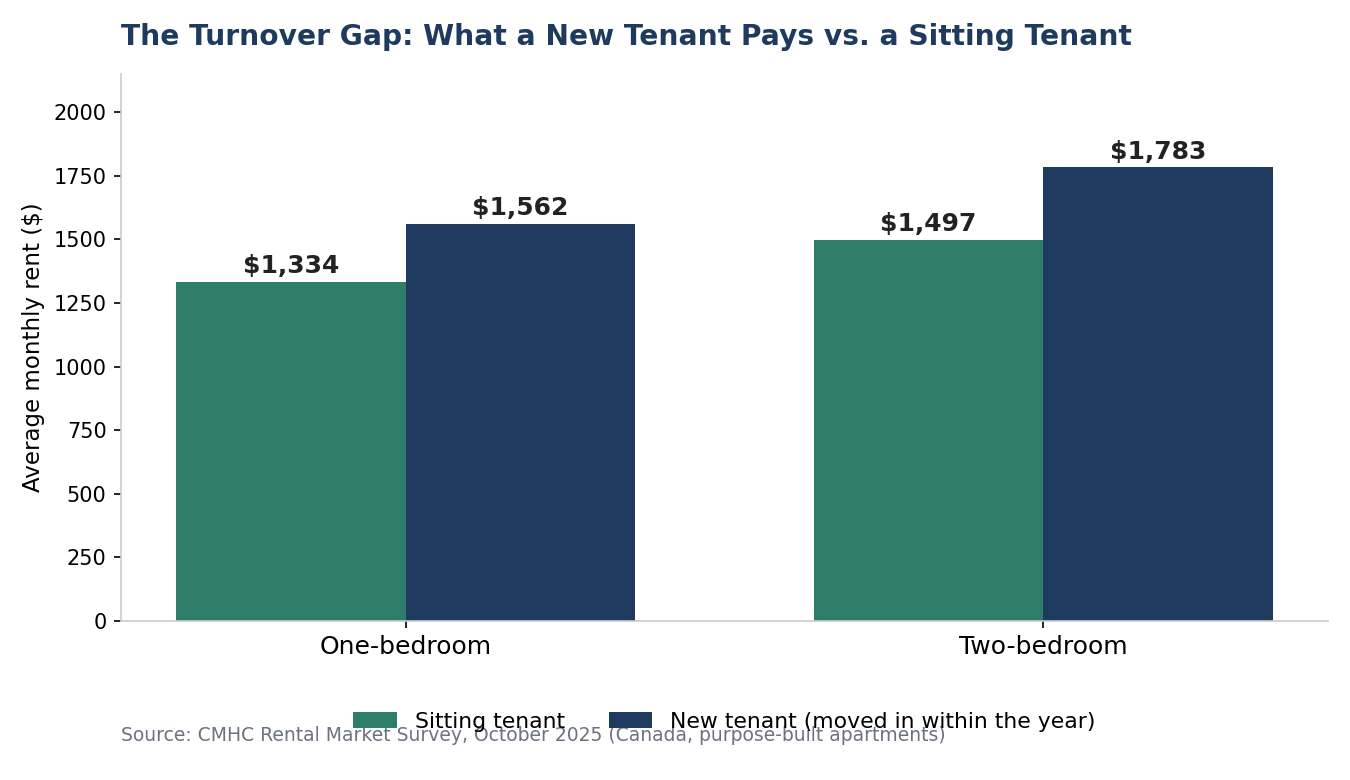
The Turnover Gap: What a New Tenant Pays vs. a Sitting Tenant. Source: CMHC Rental Market Survey, October 2025.
For a buyer, that gap cuts both ways. If you plan to keep the tenant, you must underwrite the home on the rent that actually exists — $1,497 in the national example — not the rent you hope to charge someday. If you plan to move in yourself, the gap is part of what you are paying to eliminate, through the notice-and-compensation process described later. Either way, the sitting rent is the single most important number in the deal, and it belongs in your offer math from day one. For the wider market picture — vacancy, asking rents and the buy-versus-rent math — see our Canada rental market 2026 guide.
The starting point differs sharply by province. CMHC's October 2025 survey found the average two-bedroom purpose-built rent ranged from $1,273 in Quebec to $2,065 in British Columbia, with a national average of $1,550 and a national vacancy rate of 3.1 per cent — up from 2.2 per cent a year earlier, and back above the 3 per cent level CMHC has long treated as a balanced market.
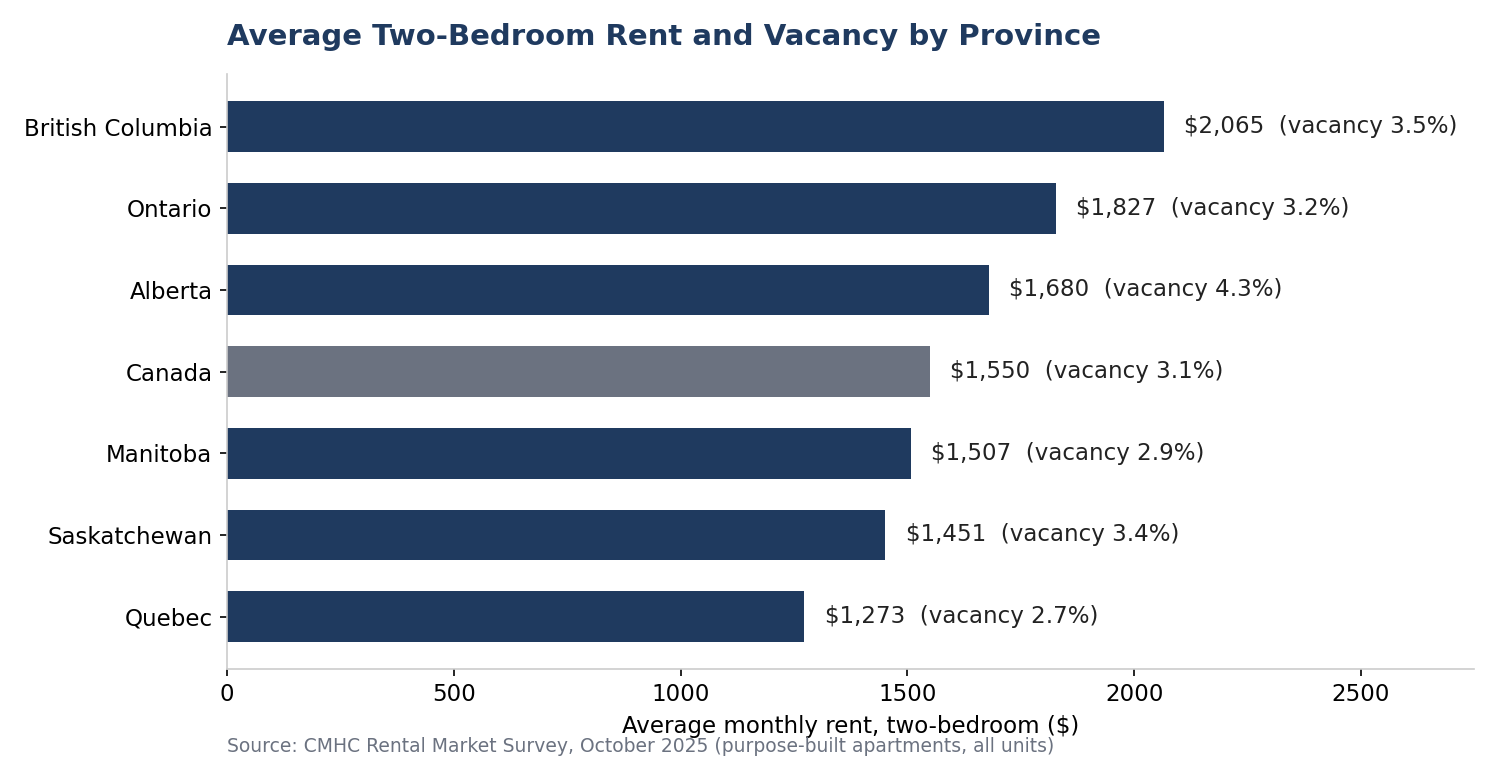
Average Two-Bedroom Rent and Vacancy by Province. Source: CMHC Rental Market Survey, October 2025.
Route A: Keep the Tenant and Become the Landlord
Many buyers of tenanted homes never ask the tenant to leave. A reliable tenant paying on time is, in effect, part of what you bought: immediate income, no vacancy loss, no re-leasing costs. If that is your plan, three things decide whether the purchase works.
1. Underwrite today's rent, with today's caps
Your rent can only grow at the pace your province allows for a sitting tenant. Ontario's rent increase guideline is 2.1 per cent for 2026 (down from 2.5 per cent in 2025), applied at most once every 12 months on 90 days' written notice — and units first occupied after November 15, 2018 are exempt from the cap. British Columbia's maximum increase is 2.3 per cent for 2026 and 2.2 per cent for 2027, once every 12 months with three full months' notice. Alberta has no rent-increase cap, but increases are limited to once per year. Quebec's system works through the Tribunal administratif du logement's rent-fixing criteria. Our province-by-province explainer on rent control rules across Canada walks through each regime in detail.
2. Verify the tenancy like an investor
Ask for the lease, a rent roll or payment history, the deposit amount, and disclosure of arrears, notices served, or board applications. A tenant who is behind on rent, or already in a dispute, is a cost you are buying. Serious investors also confirm who actually lives in the unit — unauthorized occupants complicate everything downstream. The cash-flow and cap-rate framework in our guide to real estate investing in Canada applies directly: run the numbers on the verified rent, not the listing's suggested rent.
3. Price the discount honestly
A tenanted home that cannot be emptied quickly is worth less to owner-occupiers, which is precisely why investors can sometimes buy below vacant value. But the discount is only real if the rent, the caps and the tenant's track record support it. A $286-a-month turnover gap, in a province where you cannot trigger turnover, is not a discount — it is a permanent feature of the income stream until the tenant chooses to leave.
Route B: You Want to Move In — The Purchaser-Use Notice, Province by Province
If you or a close family member genuinely intends to live in the home, most provinces give you a route to end the tenancy — but it is the seller who usually starts it, the timelines are measured in months, and none of them guarantee an empty home on a fixed date. A notice is not an eviction: if the tenant stays, the landlord must apply to the provincial board or tribunal, and only an enforcement officer can carry out an eviction order.
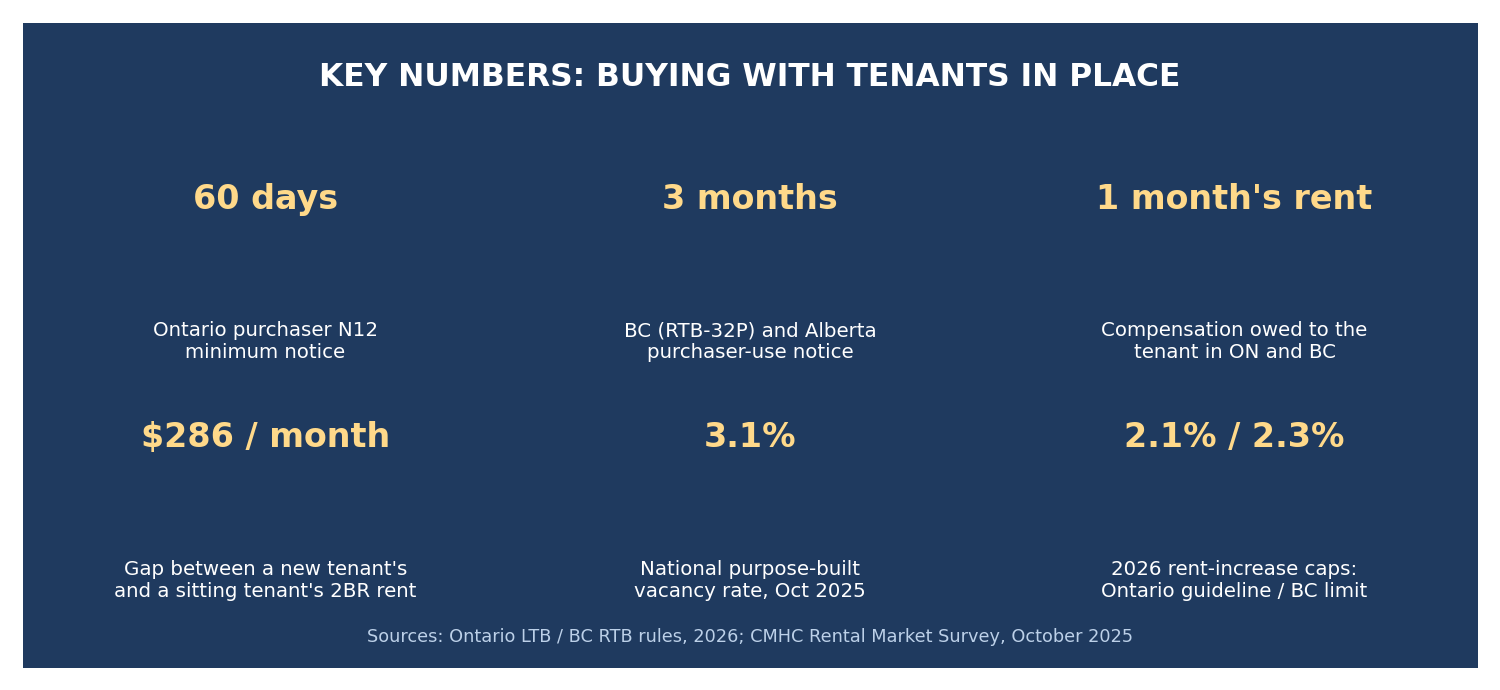
Key Numbers: Buying With Tenants in Place. Sources: Ontario LTB / BC RTB rules, 2026; CMHC, October 2025.
Ontario: the purchaser's N12
Under section 49 of Ontario's Residential Tenancies Act, once an agreement of purchase and sale is signed, the selling landlord may serve a Form N12 on the buyer's behalf. The conditions are strict:
- The residential complex must have no more than three units, or the unit must be a condominium. A fourplex does not qualify.
- The buyer, the buyer's spouse, a child or parent of either, or a caregiver must in good faith require the unit for residential occupation.
- Notice must be at least 60 days, and the termination date must be the last day of a rental period or of the fixed term — an N12 cannot cut a fixed-term lease short.
- The selling landlord pays the tenant one month's rent as compensation by the termination date, or offers another acceptable unit. Note that the September 21, 2026 change letting landlords skip compensation when they give 120 days' notice applies to a landlord's own-use notice — the Landlord and Tenant Board confirms it does not apply to purchaser notices.
- If the tenant does not leave, the landlord must file an L2 application within 30 days after the termination date, supported by an affidavit from the person who will move in. The tenant may also choose to leave earlier, on at least 10 days' written notice.
- Good faith is policed afterwards: if the buyer does not actually move in, the former tenant can file a T5 bad-faith application within one year of moving out.
British Columbia: the RTB-32P three-month notice
BC's route is longer and more formal. Once all conditions of the sale have been satisfied and the buyer asks in writing, the seller generates a Three Month Notice to End Tenancy for Purchaser's Use (Form RTB-32P) through the Residential Tenancy Branch web portal. A notice not generated through the portal is legally unenforceable, and serving the notice cannot be made a condition of the sale. The tenant has 21 days to dispute the notice, receives one month's rent in compensation, and the buyer or close family member (spouse, parent or child — siblings do not count) must then live in the unit for at least 12 months. Failing to use the home for the stated purpose can expose the landlord to compensation of 12 months' rent. After completion, a buyer who has become the landlord can instead serve the landlord's-use form, RTB-32L, on the same three-month timeline.
Alberta, the Prairies, Atlantic Canada and Quebec
Alberta never lets a sale cut a fixed term short, but a periodic tenancy can be ended with three tenancy months' notice once the sale conditions are met and the buyer asks in writing — where the buyer or a relative will move in, or where a detached house, semi-detached house or condo unit has been sold. Manitoba ties the notice period to the vacancy rate: one month for a periodic tenancy when vacancy is 3 per cent or higher, three months when it is under 3 per cent, plus reasonable moving costs up to $500. Saskatchewan requires one month's notice, with 15 days for the tenant to dispute. Nova Scotia uses Form DR2 for buildings of four or fewer units, with at least two months' notice and a sworn affidavit. New Brunswick does not treat a sale as a reason to end a tenancy at all. In Quebec, leases continue and renew automatically after a sale; a new owner who wants the home must use the Civil Code's repossession process for themselves or close family, with its own notice deadlines tied to the lease term, and the tenant can ask the Tribunal administratif du logement to review it.
| Province | Purchaser-use route | Notice | Compensation |
|---|---|---|---|
| Ontario | Form N12 (seller serves), 3 or fewer units or condo | 60+ days, ends on last day of period/term | One month's rent (seller pays) |
| British Columbia | Form RTB-32P, generated in the RTB portal | 3 months; 21 days to dispute | One month's rent; occupy 12 months |
| Alberta | Buyer's written request after sale conditions met | 3 tenancy months (periodic only) | No set amount |
| Manitoba | Buyer who will live in the unit | 1 or 3 months, by vacancy rate | Moving costs up to $500 |
| Saskatchewan | Buyer or family will live in the unit | 1 month; 15 days to dispute | Claim if purpose not carried out |
| Nova Scotia | Form DR2, 4 or fewer units, with affidavit | 2+ months | Per provincial rules |
Purchaser-use notice rules by province, 2026. New Brunswick does not allow a sale to end a tenancy; Quebec uses the Civil Code repossession process instead.
Writing the Offer: Where Tenanted Purchases Are Won or Lost
Because a seller can promise to serve a notice but cannot promise a tenant will actually leave, the offer has to allocate every risk explicitly. Work through these points with your agent and lawyer:
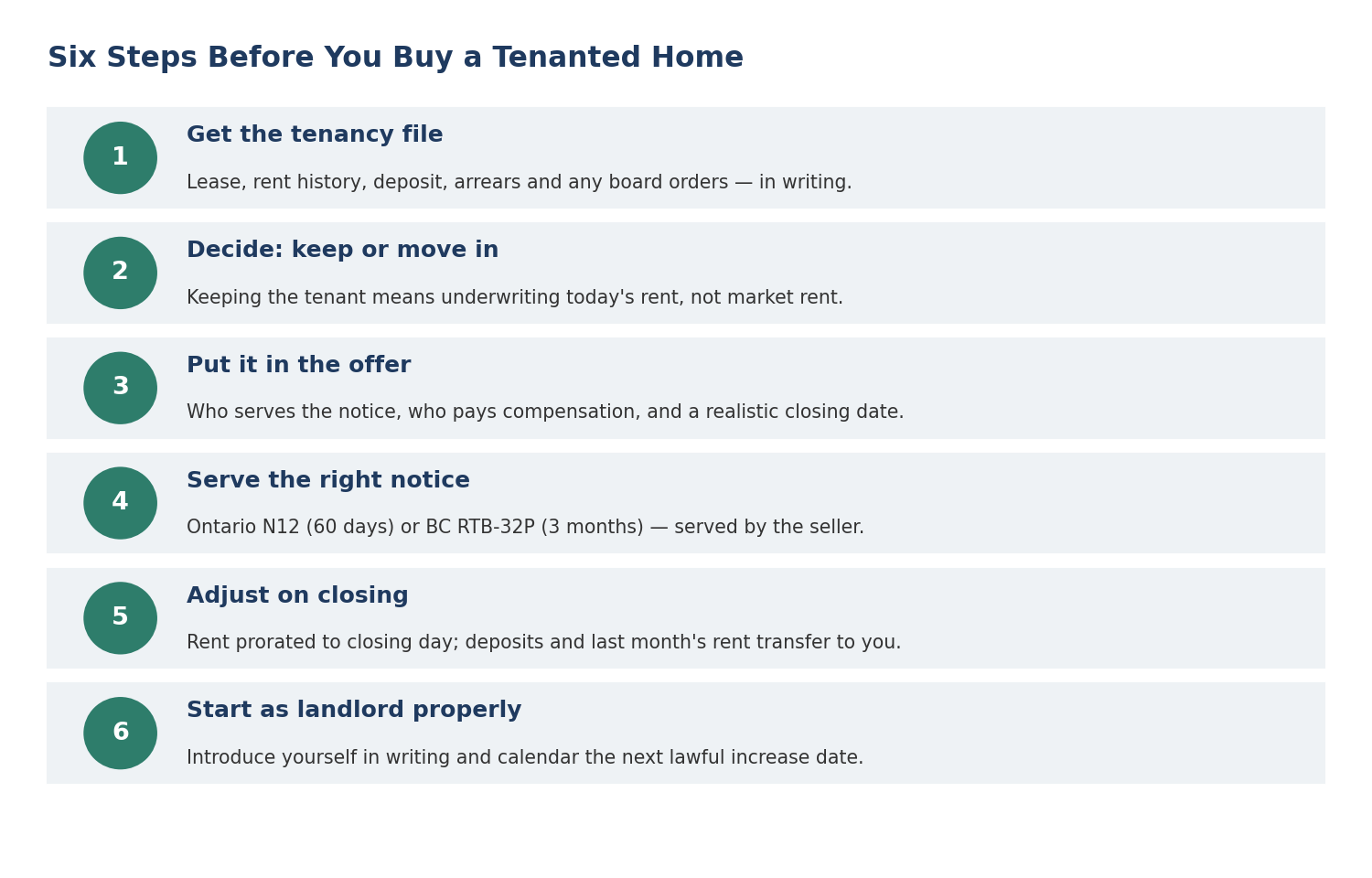
Six Steps Before You Buy a Tenanted Home.
- Vacant possession wording. Decide whether the agreement requires vacant possession on closing, or whether you accept the tenancy. If vacant possession is required, the clause should say what happens — an extension, a holdback, or termination rights — if the tenant is still there.
- Who serves, who pays. In Ontario the seller serves the N12 and pays the one month's compensation; in BC the seller generates and serves the RTB-32P after your written request. Put both obligations, with deadlines, in the agreement.
- A closing date the calendar can meet. Work backwards: BC's three months and Ontario's 60-days-plus-period-end rule mean a quick 30-day closing and a purchaser-use notice almost never fit together. If the tenant disputes or stays, board timelines — not your moving truck — set the real date.
- The tenancy file as a condition. Make delivery of the lease, rent history, deposit details and a statement of arrears and notices a seller's obligation, and review them before waiving conditions.
- Closing adjustments. Rent is prorated to the closing day, prepaid rent and deposits transfer to you, and the statement of adjustments should show it. These items sit alongside the usual items in our closing costs in Canada guide — budget for both lists.
- A negotiated exit is always an option. A tenant may agree in writing to leave by a set date, sometimes in exchange for a payment ("cash for keys"). Get any such agreement properly documented before you rely on it — a verbal understanding is worth nothing if the tenant changes their mind.
The Risks Buyers Underestimate
- Bad-faith exposure. Purchaser-use notices are audited by life: move in, stay for the required period (12 months in BC), and do not re-rent or relist. Ontario's T5 and BC's 12-months'-rent compensation exist because some buyers used "moving in" as a route to market rent.
- Arrears and damage travel with the tenancy. You inherit the relationship as it is. Undisclosed arrears become your collection problem on day one.
- Financing and insurance friction. Lenders treat tenanted purchases differently — some require the property to be owner-occupied within a set period, and rental income is counted by formula, not at face value. Tell your lender the home is tenanted at application, not at closing.
- Showings and access friction before closing. Tenants are entitled to proper notice of entry (24 hours in most provinces) and cannot be required to vacate for showings. Build your inspection and appraisal timing around that.
Your First 30 Days as the New Landlord
- Introduce yourself in writing — your name, contact details, and exactly where and how rent is to be paid from closing day forward.
- Confirm the deposit and prepaid rent you received on the statement of adjustments, and diarise the deposit-interest obligations your province imposes.
- Do a move-in-condition walkthrough with the tenant if they agree, and photograph the unit's condition with their knowledge.
- Calendar the tenancy dates: the last increase date, the next date an increase can take effect, and the notice form and lead time your province requires (90 days on Ontario's Form N1; three full months in BC).
- Set up the landlord basics: insurance in your name as a rented property, utility accounts where the landlord is responsible, and a simple file for every notice and payment.
The Bottom Line
Buying a home with tenants in Canada is neither a loophole nor a trap — it is a purchase of two things at once: a property, and a tenancy that the law protects independently of who owns the walls. Price the tenancy you can verify, choose deliberately between keeping the tenant and using your province's purchaser-use process, and write an offer that assigns every notice, payment and delay to a named party with a deadline. Buyers who do that routinely get good homes at fair discounts. Buyers who assume the home will simply be empty tend to meet their province's tenancy board — as the applicant, on someone else's timeline.
This article is general information about Canadian rules as of November 2026, not legal advice. Tenancy law is provincial and changes frequently — Ontario's purchaser-notice compensation rules changed as recently as September 2026 — so confirm the current forms and timelines with your province's tenancy authority or a local lawyer or paralegal before serving any notice.
Sources
- Ontario Landlord and Tenant Board — Form N12 instructions and purchaser's own-use rules (Residential Tenancies Act, s. 49), including the September 21, 2026 compensation update.
- Government of Ontario (Ontario Newsroom) — 2026 rent increase guideline of 2.1 per cent.
- Government of British Columbia / Residential Tenancy Branch — selling a rental property, Form RTB-32P purchaser's-use notice, and the 2026 rent increase limit of 2.3 per cent.
- CMHC — Rental Market Report and Rental Market Survey data tables, October 2025 (vacancy 3.1 per cent; average two-bedroom rent $1,550; turnover rents by province).
- Provincial tenancy authorities and summaries for Alberta, Manitoba, Saskatchewan, Nova Scotia, New Brunswick and Quebec (Tribunal administratif du logement).




Comments
No comments yet. Be the first to share your thoughts.