
For decades, the Canadian housing ladder was simple: buy a condo, build equity, move up to a detached house. In 2026, that ladder is bending. Condominium apartments are falling in value faster than detached homes in nearly every major market, a record price gap has opened between the two, and the math of what you pay each month looks very different depending on which side of the gap you stand. But dig past the headlines and a more interesting picture emerges: the same pressures hammering condo prices are quietly creating the best buying conditions for entry-level buyers — and arguably for investors — that Canada has seen in years.
This article walks through the numbers behind the condo-versus-detached decision in 2026: the price data, the monthly cost math, the risks, and where the value actually sits for buyers, sellers, and investors.
The price gap, by the numbers
Start with the national picture. According to the Canadian Real Estate Association’s August 2026 data, the national MLS Home Price Index benchmark for apartments stood at $459,800, against $731,200 for single-family homes. That is a gap of roughly $271,400 — apartments benchmarking at about 63 cents on the dollar versus single-family. Meanwhile the national average sale price sat at $674,819 in July (up a marginal 0.2% year over year), while the composite benchmark fell 3.3% to $661,800, a reminder that the benchmark — which controls for the mix of homes sold — is the more reliable guide when sales shift between price tiers.
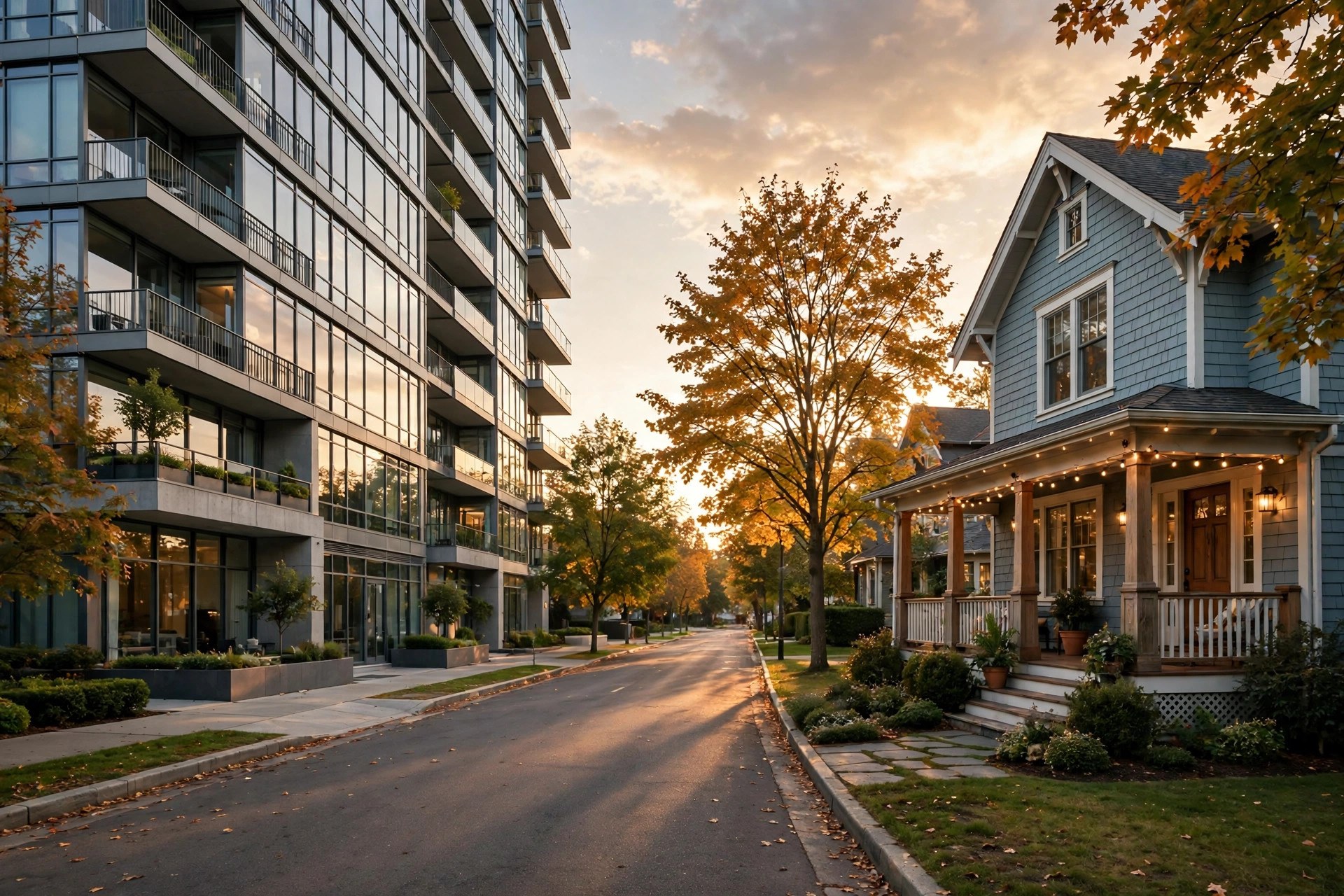
The spread is far wider in Canada’s two most expensive markets. In the Greater Toronto Area, the Toronto Regional Real Estate Board’s August 2026 Market Watch report put the average resale price at $993,410. Beneath that headline, the useful numbers were:
- Condominium apartment average: $617,593
- Detached home average: $1,288,669
- The gap: $671,076
Between those poles sit the stepping stones: condo townhouses averaged $681,447, attached and row townhouses $882,060, and semi-detached homes $931,665. The distinction between the two townhouse categories matters more than most summaries suggest — grouping them together conceals a $200,613 difference in average selling price.
The price bands tell the story in human terms. In August, there were 1,058 condo apartment sales below $700,000 across the GTA, compared with just 182 detached sales under that threshold. A softer market has not moved the detached ladder down to meet first-time budgets; it has simply made the entry rung cheaper. For a household deciding what to buy, that $671,000 gap is arguably the single most important number in the region.
Geography stretches the gap further. Within the GTA in August, condo apartments averaged $651,648 in the 416 (City of Toronto) versus $549,868 in the 905 suburbs. Detached homes averaged $1,525,749 in the 416 against $1,218,148 in the 905. In Vancouver, the damage to condos has been steeper still: CENTURY 21 Canada’s price-per-square-foot survey, covering sales from January to June 2026, found Vancouver condo prices down almost 15% in the first half of the year, with Toronto condos down roughly 8%. For contrast, the price of a detached house in Regina surged 13% over the same period — though to a price per square foot still less than half that of a Toronto or Vancouver condo.
Royal LePage’s annual forecast, released in December 2025, anticipated exactly this divergence for the year: the firm projected single-family detached prices would rise 2% to $876,934 in the fourth quarter of 2026, while condominium prices would fall 2.5% to $563,918. For the first time in recent memory, the two segments are moving in opposite directions.
Why condos are falling faster than detached homes
Four forces are weighing on the condo segment more heavily than on ground-oriented housing.
1. New supply arrived as demand reversed
Several years of heavy condominium construction were completed just as international migration — a key source of rental and first-time-buyer demand — slowed sharply. The unsold overhang has weighed on prices ever since. Investors and first-time buyers, the two groups most concentrated in the condo segment, have stepped back simultaneously.
2. The investor bid has thinned
Small investors who bought pre-construction condos in 2021–2022 expecting endless appreciation are now facing appraisals 20–25% below their original purchase prices at completion — a gap that forces many to walk away from deposits, face developer lawsuits, or try to sell their contracts as assignments at a loss. With that cohort sidelined or distressed, resale condos have lost a major source of demand.
3. Monthly carrying costs have eaten the rate-cut benefit
The Bank of Canada cut its policy rate four times through the 2025 cycle and held it at 2.25% on September 2, 2026. But condo owners have found that soaring maintenance fees and property taxes are absorbing much of the mortgage savings. Data from the real estate platform Wahi, covering roughly 2,000 GTA condo buildings, found monthly maintenance fees for one-bedroom units ranging from $254 to $2,275 — a spread of more than $2,000 across buildings. Toronto’s total residential property tax rate for 2026 is 0.767311%, and assessments for the 2026 tax year are still based on January 1, 2016 values. A 600-square-foot unit at a typical $0.75-per-square-foot fee runs about $450 a month in maintenance, plus roughly $288 in property tax — around $780 a month before any mortgage payment.
4. Detached homes have structural scarcity
You cannot build more land in established neighbourhoods. While detached prices have softened too — the GTA’s June 2026 benchmark for detached fell 5.27% year over year, versus 8.2% for condo apartments — the segment is cushioned by move-up buyers with equity, by families who need the space, and by supply that barely grows. The result: in June 2026, GTA detached averaged $1,364,204 (down just 2.0% year over year on the average-price measure) while condo apartments averaged $630,688 (down 9.5%).
The monthly-cost math: what you actually pay
Sticker prices only tell half the story. Consider what each option costs a buyer to carry, using realistic 2026 figures.
The condo path. A $550,000 resale condo — a typical price for a one-bedroom or compact two-bedroom in the GTA’s 905 region — with 5% down ($27,500) and CMHC insurance on the mortgage. At a 4.29% five-year fixed rate on a 30-year amortization (available to first-time buyers with insured mortgages), the mortgage payment lands near $2,668 a month. Add roughly $480 in maintenance fees, $412 in property tax, and about $100 for heat and hydro, and the all-in monthly carry is around $3,660, before internet and insurance.
The detached path. The same buyer profile looking at the GTA’s $1,288,669 average detached home needs roughly $102,522 just for the minimum down payment (5% on the first $500,000, 10% on the remainder up to $1.5 million) — nearly $78,000 more cash before closing than the condo buyer. With 20% down on a $1.29 million home, the mortgage at similar rates runs well past $5,000 a month, plus property taxes roughly double the condo figure.
The implication is stark: the condo remains the only major GTA segment where a six-figure down payment buys a full home rather than a share of one. Qualifying for a $1 million GTA home with 20% down at current stress-tested rates typically requires household income of roughly $210,000 to $240,000, and every $100,000 of purchase price shifts the required income by about $22,000 to $28,000. For most first-time buyers, the detached segment is not a choice being postponed — it is a choice that does not currently exist.
One underappreciated tailwind for condo buyers: because first-time buyers with insured mortgages can now use 30-year amortizations on resale purchases, monthly payments on a typical entry condo are roughly $300 lower than under the old 25-year rules — a meaningful offset to rising maintenance fees.
The investor equation is quietly improving
For investors, 2026’s condo market contains a genuine paradox: the segment’s weakness is exactly what is making the math work again.
Rental demand remains the floor under the segment. Downtown Toronto one-bedroom condos have been trading at an average of about $530,000 since the spring, and market watchers tracking the segment put average downtown rental yields at roughly 5% — the best in about eight years. Sub-$600,000 condos with meaningful amenities have been drawing disproportionate buyer interest, with bidding wars reported in some cases even as the broader condo market softens. The spread within the segment is wide: the same one-bedroom layout can close $100,000 apart depending on the building, which means building-level due diligence matters more than neighbourhood-level data.
The vacancy warning is real, though. One month of vacancy knocks roughly half a point off an investor’s yield, so buying where the renters are — near transit, employment, and campuses — is doing more work than it did in the boom years. And the maintenance-fee trajectory is the variable that sinks more condo investments than any other: fees grow, special assessments in 1990s- and 2000s-era buildings are becoming more common, and a cheap unit in a troubled building is not cheap.
The rule of thumb for 2026 condo investing: underwrite the building first. Request the status certificate, read the reserve fund study, confirm rental rules, check for pending litigation, and pull recent sales in the same building rather than the same neighbourhood. In a soft condo market, that discipline is the entire edge.
The pre-construction warning still applies
None of the above should be read as a blanket endorsement of buying new. The pre-construction segment remains the riskiest corner of the Canadian condo market in 2026.
Buyers who signed presale agreements in 2021 and 2022 — when the market was red-hot — are now completing into appraisals as much as 20–25% below their contract prices, according to mortgage brokers working the files in both Vancouver and Toronto. On a $700,000 contract, a 20% shortfall is $140,000 in cash the buyer must produce on closing day or walk away from their deposit. An estimated 28,000 units are expected to complete in the GTA in 2026, making it what one industry analysis called the “biggest, problematic year” for the pre-construction market.
Assignment sales — buying a presale contract from the original purchaser — can offer discounts at or below original purchase prices, and they are one of the few places genuine bargains are surfacing. But builders must approve assignments, fees can run into the tens of thousands, and financing an assignment is its own obstacle course. For most buyers in 2026, resale condos offer the same discounted pricing with far less contractual risk.
The supply cliff: why today’s weakness may not last
Here is the twist that long-horizon buyers should weigh. The same collapse in pre-construction sales that is punishing today’s market is setting up a supply drought tomorrow. Condos take five to seven years to go from sales launch to completion. With presale launches having collapsed, very few projects are in the pipeline:
- 2026: supply from the boom-era pipeline is still completing — the peak of the glut.
- 2027: completions begin to drop as the thin 2021–2022 launch cohort works through.
- 2028: new supply nearly stops in some markets — one of the lowest completion periods in decades.
If demand normalizes — through population growth, continued employment strength in city cores, or simply the return of buyers currently sitting on the sidelines — a market moving from oversupply to undersupply can reprice quickly. That does not mean condos will repeat the 2021 run, and it does not mean every building participates. But it does mean the current window — discounted prices, motivated sellers, improving rental yields — has a plausible expiry date.
Note the early signal: TRREB reported that new condominium listings in the GTA fell 19.0% year over year in the second quarter of 2026, while active listings fell 15.4%. Sales, meanwhile, rose 8.8%. When listings thin while sales hold or improve, the usual pattern is that choice narrows before prices move. TRREB itself noted that if sales continue to improve relative to available inventory through the second half of 2026, the annual rate of price decline should keep diminishing — “providing a foundation for renewed price growth in 2027.”
Who wins where: a 2026 decision framework
First-time buyers: The condo segment is unambiguously the value play. The price gap to detached has never been wider, borrowing costs are the lowest in years, the 30-year amortization is available on insured mortgages, and sellers are negotiating. The non-negotiable: due diligence on the building. Fees, reserve fund health, and special-assessment risk will determine whether your “deal” stays a deal.
Move-up buyers: If you own a detached home, 2026 is a challenging year to sell — detached prices are soft but not distressed, and the buyers for your home are stretched. If you own a condo and want to move up, the math is painful in the short term (your condo has fallen more than the detached home you want) but the gap is what matters: a wider gap costs you more to cross. Watch the gap, not the headlines.
Downsizers: The empty-nester trade — sell the suburban detached, buy a city condo — has rarely looked better on paper. High condo inventory means selection and negotiating room; the detached sale captures still-elevated ground-oriented pricing. Just be sure the condo’s monthly fees fit a fixed-income budget, because they will rise.
Investors: Underwrite to cash flow, not appreciation. The segment is approaching cash-flow neutrality at current prices and rents — the first time in years — but only at today’s discounted prices, in buildings with healthy finances, in locations with durable rental demand. Micro-units under about 450 square feet continue to underperform larger layouts on resale and should be approached with extra caution.
Sellers of condos: Price to the building, not the neighbourhood, and price to sell. With 1,058 sub-$700,000 condo sales in a single GTA month, there is a deep buyer pool — but it is price-sensitive and well-informed. Overpricing into a falling benchmark burns your listing’s momentum.
The bottom line
In 2026, “condo vs. detached” is not really a debate about which is the better asset. It is a debate about which buyer you are. Detached homes remain the more resilient store of value, cushioned by land scarcity and move-up demand. Condos are the more volatile, more discounted, and — for the first time in years — arguably the more useful asset: the entry point to ownership, the downsizer’s landing pad, and a cash-flowing investment at prices not seen since the early 2020s.
The value in 2026 is not in the segment. It is in the specifics: the right building, the right price band, the right monthly math. Buyers who do that homework are finding the best conditions in years. Those who buy the headline instead are the ones the next cycle’s cautionary tales will be about.
Market data in this article is drawn from the Canadian Real Estate Association’s national statistics, the Toronto Regional Real Estate Board’s June, Q2, and August 2026 Market Watch reports, Royal LePage’s December 2025 national forecast, the Bank of Canada’s September 2026 rate decision, CENTURY 21 Canada’s 2026 price-per-square-foot survey, and CMHC’s mortgage insurance rules. Prices and rates move; verify current figures with a licensed professional before making decisions.


Comments
No comments yet. Be the first to share your thoughts.