
The Notice Almost Every Homeowner Misreads
Every year, millions of Canadian homeowners open a property assessment notice, see a large number, and draw one of two wrong conclusions: either "my home is worth this much" or "my property taxes are about to go up by that percentage." Both conclusions are usually wrong, and in Ontario in 2026 the first one is wrong by an entire decade.

A property assessment is a mass-appraisal estimate produced for one purpose only: dividing up the property tax bill fairly among all the properties in a municipality. It is not an appraisal for a sale, not a lender's valuation, not a listing price, and not a prediction. It is a snapshot of value as of a legislated valuation date, produced by statistical models applied to hundreds of thousands — in Ontario's case, more than five million — properties at once.
Understanding three things about that snapshot will save you money and anxiety: the valuation date (how old the number is), the relative nature of assessment (your value only matters compared with everyone else's), and the appeal window (short, strict, and different in every province). This guide walks through all three, province by province, using the rules that actually apply to the 2026 tax year.
What a Property Assessment Actually Is
Assessment agencies value property using mass appraisal: they collect sales data, building permits, property characteristics (living area, lot size, age, condition, bathrooms, finished basements, location) and apply statistical models across whole neighbourhoods. No assessor walks through your kitchen. The model estimates what your property would have sold for on the valuation date, in its recorded condition, alongside every comparable property valued the same way on the same date.
That design has two consequences owners often miss.
First, errors are baked into the system at the individual level. A model cannot know your roof leaks, your basement floods, or your recorded square footage is wrong. That is precisely why every province provides a correction and appeal process — and why checking your property's recorded characteristics is the single highest-value step in this entire guide.
Second, assessment is relative, not absolute. Your municipality first decides how much money it needs to raise from property tax. Your share of that total depends on your assessed value compared with the total assessed value of all properties in your tax class. If every assessment in town rises 10 per cent, nobody's tax share changes. If your assessment rises 10 per cent while the average rises 2 per cent, your share — and your bill — goes up. If your assessment falls while others rise, your bill can fall even in a year when council increased the overall tax levy. Municipal guidance in Ontario states this plainly: an assessment at the average means no impact from reassessment; below average means lower taxes; above average means higher taxes.
Ontario in 2026: A Valuation Date Frozen in 2016
Ontario is the extreme case, and every Ontario homeowner should understand it. The Municipal Property Assessment Corporation (MPAC) assesses more than five million properties across the province. Ontario normally reassesses every four years, but the province postponed the reassessment that was due in 2020 during the pandemic — and has kept postponing it ever since.
In December 2025, the province filed Ontario Regulation 296/25, which extended the January 1, 2016 current value assessment base year to the 2026 taxation year. The practical result: for the 2026 tax year, your Ontario assessment still reflects what your property was worth on January 1, 2016 — a full ten years before the tax year it is being used for. Excluding changes to the property itself, your 2026 assessment is the same number that was used for 2025.
This explains the most common Ontario puzzle: an assessed value far below what the home would sell for today. A Toronto home assessed at $650,000 that would sell for well over $1 million is not under-assessed by mistake; it is correctly assessed at its 2016 value, exactly like every other Ontario property. Because everyone is valued on the same frozen date, the relative shares still work — which is why the province can keep postponing without the tax system breaking.
There are two important exceptions. When a property changes — a new build, an addition, a renovation, a severance, a change of use — MPAC issues a Property Assessment Change Notice and updates the record. But even then, the updated value is expressed in January 1, 2016 dollars: the question MPAC answers is "what would this property, in its current state, have sold for on January 1, 2016?" A brand-new house therefore gets a 2016-style value, not a 2026 market value. Owners of new builds are often startled by a supplementary or omitted assessment arriving after closing; it is not a penalty, it is the frozen system catching up, and it can reach back to cover the period since occupancy.
A worked example shows how the frozen value becomes a bill. The Town of Oakville's published 2026 final residential rate is 0.850960 per cent — $850.96 for each $100,000 of residential assessment. A home assessed at $500,000 (in 2016 dollars) therefore carries a 2026 Oakville tax calculation of roughly $4,254.80 before any special charges. The rate, not the assessment alone, is where municipal budget decisions show up; the assessment only decides your share.
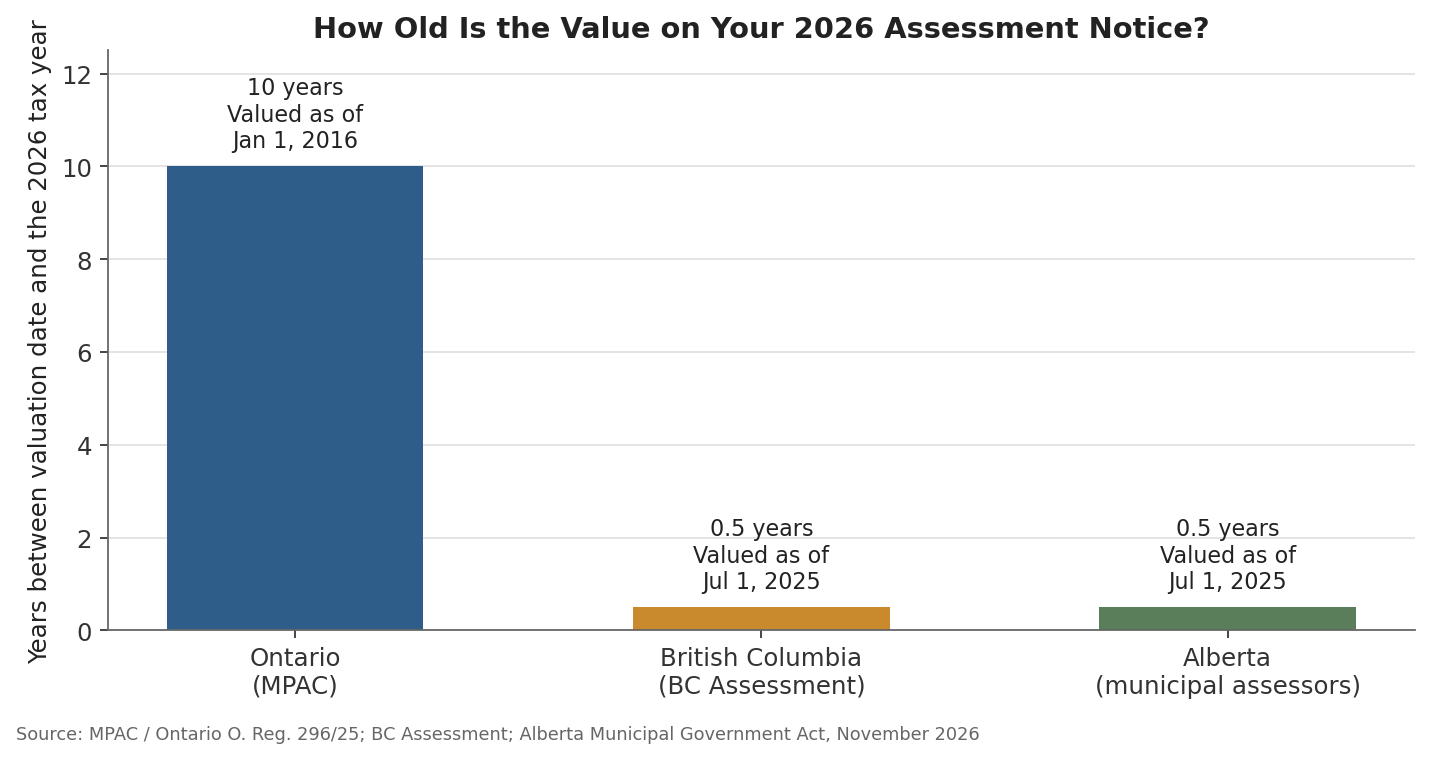
How Old Is the Value on Your 2026 Assessment Notice? Source: MPAC / Ontario O. Reg. 296/25; BC Assessment; Alberta Municipal Government Act, November 2026.
British Columbia: An Annual System With a Six-Month Lag
British Columbia runs the opposite model: fresh values every year. BC Assessment, a provincial Crown corporation, values roughly two million properties annually. The notice that arrives in early January 2026 reflects market value as of July 1, 2025, with the property's physical condition and permitted use fixed as of October 31, 2025.
That six-month lag matters in a moving market. The January 2026 notices were anchored to a July 2025 market; where prices softened through late 2025, owners received assessments that looked high compared with what their home would fetch on the day the envelope arrived. That gap alone is not grounds for a successful appeal — the panel's question is what the property was worth on July 1, 2025, not what it is worth today.
BC Assessment's own regional releases show how quiet the 2026 roll was in much of the province. In the Southern Interior, total assessments rose from about $323 billion in 2025 to almost $330 billion in 2026. The typical single-family home in Kelowna was assessed at $938,000 on the 2025 roll (valued July 1, 2024) and $918,000 on the 2026 roll (valued July 1, 2025) — a decline of about 2 per cent. BC Assessment described most Thompson-Okanagan homeowners as seeing changes in the −5 per cent to +5 per cent range, with Kootenay-Columbia communities in a slightly wider −5 per cent to +10 per cent band.
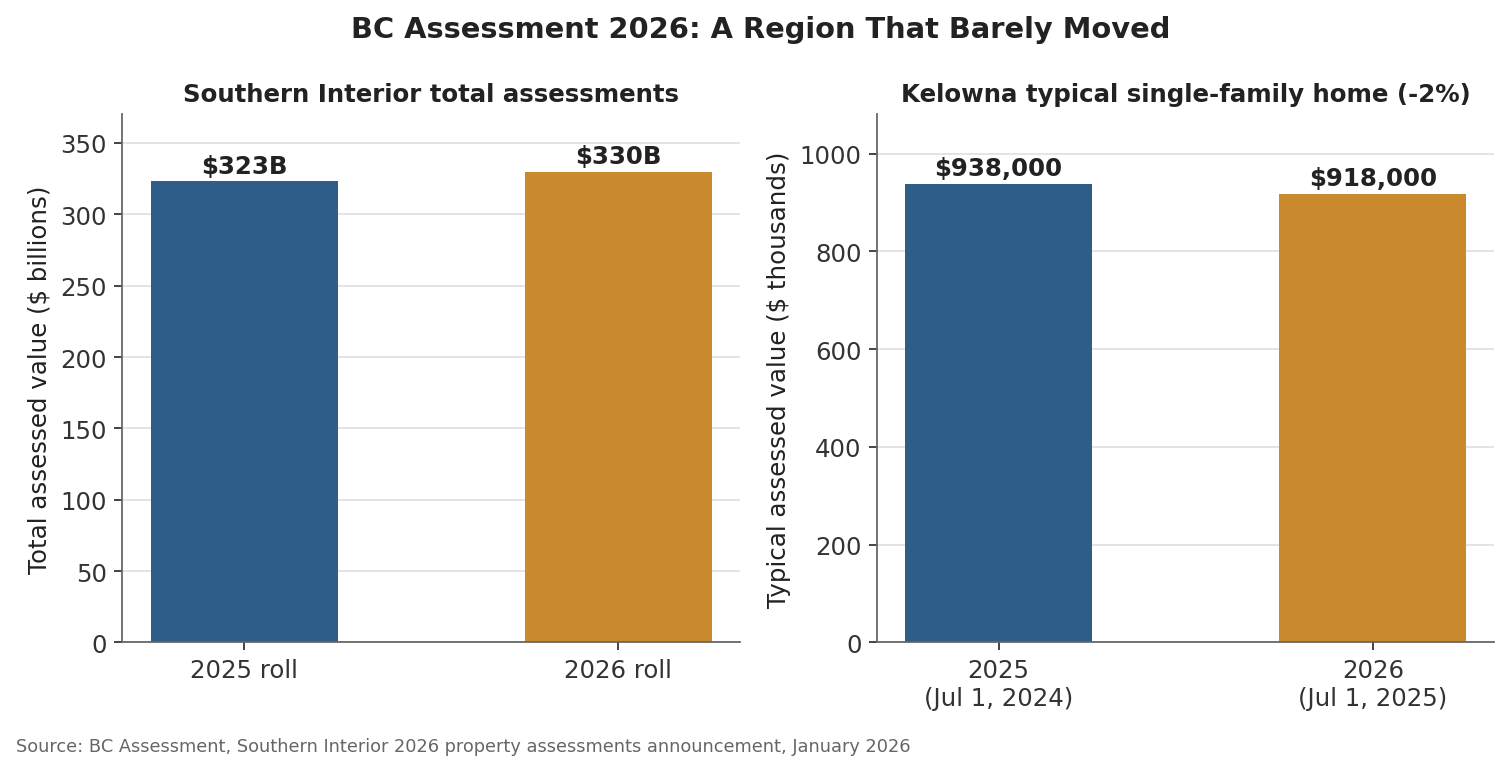
BC Assessment 2026: A Region That Barely Moved. Source: BC Assessment, Southern Interior 2026 property assessments announcement, January 2026.
Remember the relativity rule here: a Kelowna owner whose assessment fell 2 per cent, matching the typical change, should expect no tax shift from reassessment itself. An owner whose assessment rose 8 per cent while neighbours were flat is the one whose share climbs — and, if the recorded facts are wrong, the one with something worth appealing.
Alberta: Municipal Assessors, a July 1 Valuation Date, and a 60-Day Clock
Alberta assesses annually too, but through municipalities rather than a single provincial agency for most properties. The valuation date is July 1 of the previous year, and the property's physical condition is taken as of December 31 of the previous year. A January 2026 Alberta notice therefore reflects market value on July 1, 2025, for the property as it stood on December 31, 2025.
The critical Alberta detail is the clock. There is no single province-wide deadline: each municipality sets its own notice date, and owners generally have 60 days from the notice of assessment date printed on their notice to file a complaint with the local Assessment Review Board. Calgary, for example, builds a Customer Review Period of roughly sixty days from mailing into its process, and the formal complaint deadline is the same date printed on the notice — owners who spend the whole window on informal phone calls can run out of time to file. The sensible Alberta routine is: read the notice the week it arrives, call the assessment office early with any factual errors, and calendar the printed complaint deadline immediately.
The Rest of Canada, Briefly
Quebec municipalities maintain assessment rolls that are typically deposited every three years, with values referenced to a valuation date set by law well before the roll takes effect — so a Quebec owner, like an Ontario owner, should always ask "as of when?" before reacting to the number. Saskatchewan reassesses on a four-year cycle. Nova Scotia and New Brunswick use provincial assessment services with annual or cyclical updates and their own appeal deadlines, administered in Nova Scotia by the Property Valuation Services Corporation. The details differ, but the pattern is national: a legislated valuation date, a mass-appraisal model, a short appeal window, and a deadline printed on the notice that always wins over any general guide — including this one.
Assessed Value vs. Market Value: Why They Differ
Owners regularly treat a gap between assessed value and expected sale price as an error. Usually it is arithmetic, not error:
- Different dates. Ontario's gap is ten years of market movement. BC's and Alberta's gaps are six months of it.
- Different methods. An assessment is a model output across a neighbourhood; a sale price is two parties negotiating over one specific house on one specific day.
- Different facts. The model uses recorded characteristics. If the record says your basement is finished and it is not, the model is wrong in a way that is fixable — that is an appeal ground. If the record is right and you simply believe the model overvalues your street, you need comparable sales evidence from around the valuation date.
- Different purposes. Lenders, insurers and buyers each value your home for their own purposes. None of them is bound by the assessment, and the assessment is not bound by any of them. A high purchase price does not automatically raise your assessment to that price, and a low assessment is not evidence a listing is overpriced.
How to Check Your Assessment in Twenty Minutes
Whatever your province, the same checklist applies:
- Confirm the property record. Living area, lot dimensions, age, condition, bathrooms, finished areas, outbuildings, and classification (residential, farm, commercial). Factual errors are the most common — and most winnable — assessment problem.
- Compare like with like, on the valuation date. Find similar nearby properties and compare assessed values per the same date. In Ontario, use MPAC's AboutMyProperty service; in BC, BC Assessment's free Assessment Search; in Alberta, your municipality's assessment search using the access code on your notice.
- Ask the relativity question. Did my value move more than my neighbourhood's typical change? If not, an appeal is unlikely to change your tax bill even if it succeeds.
- Do the tax math before filing. Estimate the saving: the assessment reduction you realistically seek, multiplied by your local tax rate. In the Oakville example above, a $40,000 reduction at a 0.850960 per cent rate is worth about $340 a year — worth a free reconsideration request, and a useful yardstick before paying any appeal fee or hiring help.
- Calendar the deadline on the notice. Every system in this guide runs on strict deadlines, and late filings are not accepted because the reason was good.
How to Appeal, Province by Province
Ontario: Request for Reconsideration first, then the ARB
For residential, farm, managed forest and conservation land properties, the mandatory first step is a free Request for Reconsideration (RfR) filed with MPAC. For the 2026 tax year, the RfR deadline was March 31, 2026 (a new assessment notice can carry its own deadline — use the date on your notice). MPAC reviews the file and issues a recommendation; if you agree, the settlement is recorded and the assessment is corrected. If you disagree, you may appeal to the Assessment Review Board (ARB), an independent tribunal, within 90 days of the mailing date of MPAC's RfR recommendation. The ARB filing fee is $132.50 for residential properties. Owners of other property classes may choose either an RfR or a direct ARB appeal, with a March 31 deadline for annual assessment appeals.
British Columbia: Notice of Complaint by January 31, then the Appeal Board
Start by calling BC Assessment — many factual errors are corrected informally. If that fails, file a written Notice of Complaint with the Property Assessment Review Panel (PARP) by January 31 of the year the notice arrives; for the 2026 roll, because January 31 fell on a weekend, the deadline moved to Monday, February 2, 2026. Panels hold hearings roughly from February to mid-March, and decisions follow in the spring. If you still disagree, the next level is the Property Assessment Appeal Board, with an April 30 filing deadline. The burden of proof rests with the owner throughout: bring sales evidence tied to the July 1 valuation date, not today's listings.
Alberta: Talk to the assessor early, complain within 60 days
Contact your municipal assessment office during the review period first — assessors can correct errors without a formal complaint. If unresolved, file a complaint with the Assessment Review Board within 60 days of the notice of assessment date printed on your notice. A filing fee applies (Calgary's residential complaint fee is $50, discounted for early filing) and is generally refunded if the complaint succeeds or settles in your favour.
When an Appeal Is — and Is Not — Worth It
An appeal is worth pursuing when the property record contains a real factual error, when genuinely comparable properties on the same street carry materially lower assessments, or when sales evidence from around the valuation date shows the model overshot your property's value. It is usually not worth pursuing when your only argument is that taxes are too high (panels decide value, not tax policy), that the market has moved since the valuation date (the date is fixed by law), or that your assessment rose — when it rose by the same percentage as everyone else's, your tax share has not changed.
One caution for buyers and sellers: an assessment is a weak pricing tool. Use it to understand taxes, to sanity-check a property's recorded facts, and to spot a possible appeal — never as a substitute for a comparative market analysis or an appraisal.
The Bottom Line
Your 2026 assessment is a dated, model-built, relative number. In Ontario it is a January 1, 2016 value, frozen by regulation through the 2026 tax year; in BC and Alberta it is a July 1, 2025 value delivered each January. Your taxes move when your value moves relative to your neighbours, not when the number merely looks big. Check the recorded facts, compare on the valuation date, do the rate math, and respect the deadline printed on your notice — March 31 in Ontario, January 31 in BC, and 60 days from the notice date in Alberta. Twenty minutes with your notice each year is the cheapest property-tax advice in Canada.
Sources: Municipal Property Assessment Corporation (MPAC) and Ontario Regulation 296/25 (December 2025) on the extended January 1, 2016 valuation base for the 2026 tax year; Halton Region 2026 Current Value Assessment and Tax Policy Reference Manual; Town of Oakville 2026 final residential tax rate (0.850960%); City of Brampton and Tribunals Ontario (Assessment Review Board) guidance on Requests for Reconsideration, the March 31 deadline, the 90-day appeal window and the $132.50 residential filing fee; BC Assessment key dates and appeal guidance (July 1, 2025 valuation date, October 31, 2025 condition date, January 31 complaint deadline extended to February 2, 2026, April 30 Appeal Board deadline) and BC Assessment's Southern Interior 2026 assessment announcement (total assessments about $323 billion in 2025 to almost $330 billion in 2026; Kelowna typical single-family $938,000 to $918,000); Alberta Municipal Government Act assessment guidance and City of Calgary assessment review materials (July 1 valuation date, December 31 condition date, 60-day complaint window). Figures verified November 2026. Deadlines and rules change; the date printed on your own notice always governs. This article is general information, not tax or legal advice.




Comments
No comments yet. Be the first to share your thoughts.