
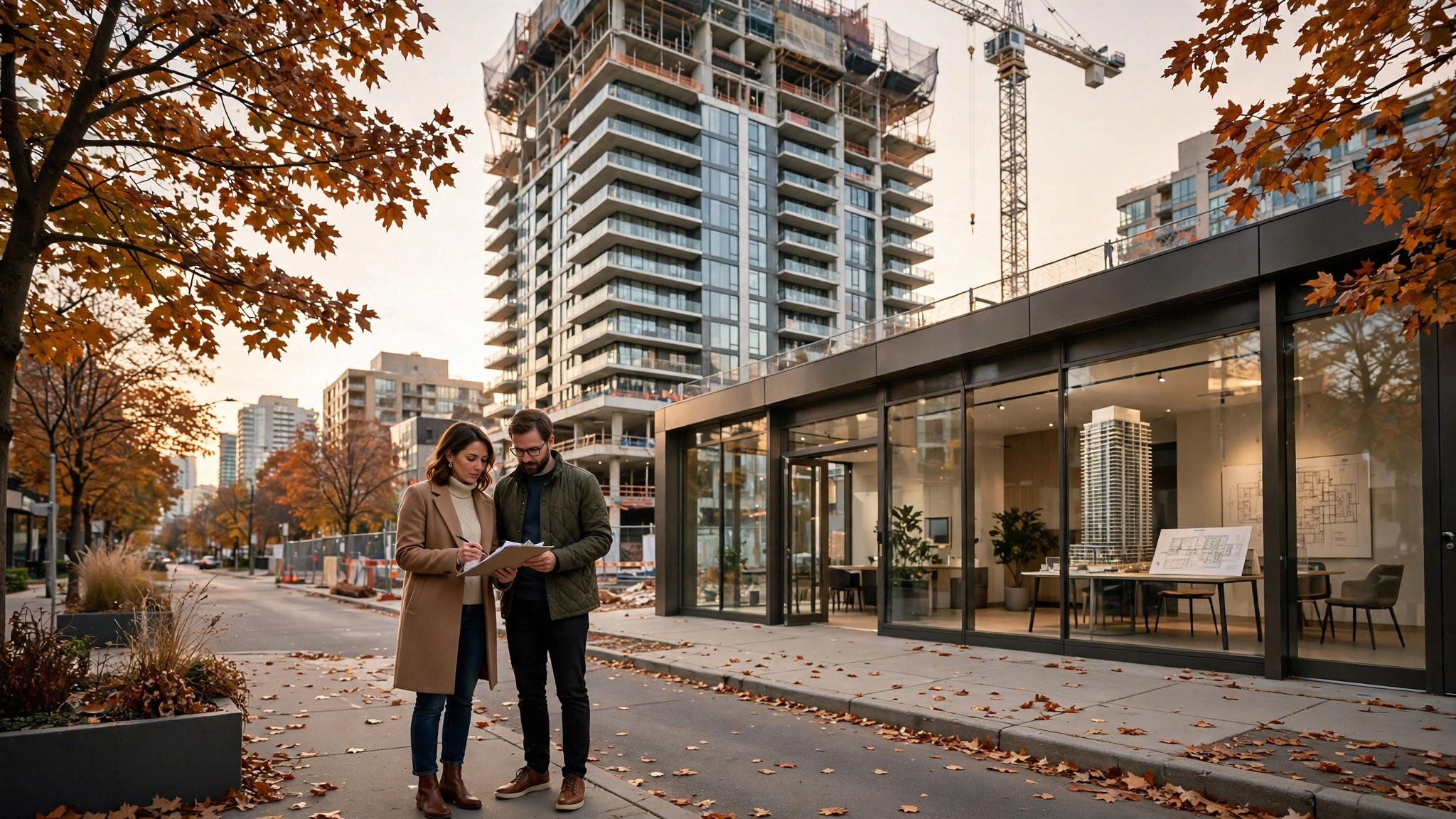
What an assignment sale actually is
An assignment sale is the sale of a contract, not the sale of a home. When you buy a pre-construction condominium or a new house from a builder, you sign an agreement of purchase and sale and pay deposits over time, but you do not own anything yet — the builder still owns the land and the unfinished unit. What you hold is a bundle of rights and obligations: the right to complete the purchase at the agreed price when the home is finished, and the obligation to pay the balance and close.

An assignment transfers that bundle to someone else. The original buyer is called the assignor. The new buyer is the assignee. The builder remains the seller under the original agreement throughout. When the home is finally complete, the assignee — not the assignor — closes with the builder, pays the balance due under the original contract, and takes title.
That distinction matters for almost everything that follows. Because the property itself is not being sold, an assignment is governed first by the wording of the original builder contract, not by the ordinary rules of resale. Because the assignee steps into the original agreement exactly as it stands, they inherit its price, its deposit schedule, its closing adjustments, its occupancy terms and its deadlines — including any terms that have become unfavourable since the contract was signed. And because two different federal tax changes in 2022 and 2023 were aimed squarely at this kind of transaction, the tax treatment of an assignment is now very different from what many buyers who signed in 2020 or 2021 assumed it would be.
Assignments used to be a niche, mostly investor-driven corner of the pre-construction market. In the current market they have become something else: for many buyers who purchased at peak prices and now face a closing they cannot or do not want to complete, an assignment — even at a loss — is the only exit from a pre-construction deal before final closing that does not involve defaulting on the contract.
Why assignments are everywhere in 2026
To understand the assignment market, you have to understand the market the assignees are being asked to step into. The national backdrop, reported by the Canadian Real Estate Association (CREA) on November 17, 2026, is a market that has steadied but not recovered: national home sales edged up 0.3% month over month in October 2026, while actual sales were 10.6% below October 2025. The national average sale price was $678,584, down 1.6% year over year, and the MLS Home Price Index was down 3.1% year over year. Inventory sat at roughly five months — within the balanced range CREA uses, but far from the seller's market in which most of today's pre-construction contracts were signed. On October 28, 2026, the Bank of Canada raised its policy rate by 25 basis points to 2.50%, its first increase in this cycle, which pushed chartered-bank prime to 4.70% and added to the financing pressure on buyers approaching closing.
The pre-construction condo sector is weaker still. Urbanation's Q3 2026 Condominium Market Survey, released October 19, 2026, reported that only 60 presale condos were sold in the Greater Toronto and Hamilton Area in the third quarter — down 61% from a year earlier — and that just 381 units started construction. At the same time, 5,127 completed but unsold new condo units were sitting in inventory at quarter-end. In other words, an assignee in 2026 is rarely choosing between an assignment and nothing. They are choosing between an assignment, the builder's own unsold completed inventory, and resale units in recently completed buildings — and they price the assignment accordingly.
Urbanation's third-quarter figures also show who is buying at the margin. Investment groups purchased 339 of the 760 new condo units sold in the region in Q3 2026 — about 45% of all sales — at an average of $763 per square foot in bulk transactions. Individual buyers purchasing new condos outside bulk and luxury transactions paid an average of $1,045 per square foot. That gap is measured against prices in the same buildings, many of which were set when the market was stronger, and it illustrates the central pricing problem for assignors: the contract price written into a 2021 or 2022 agreement may be well above what the same unit would fetch today, and no assignee will pay a premium on top of an already above-market contract price.
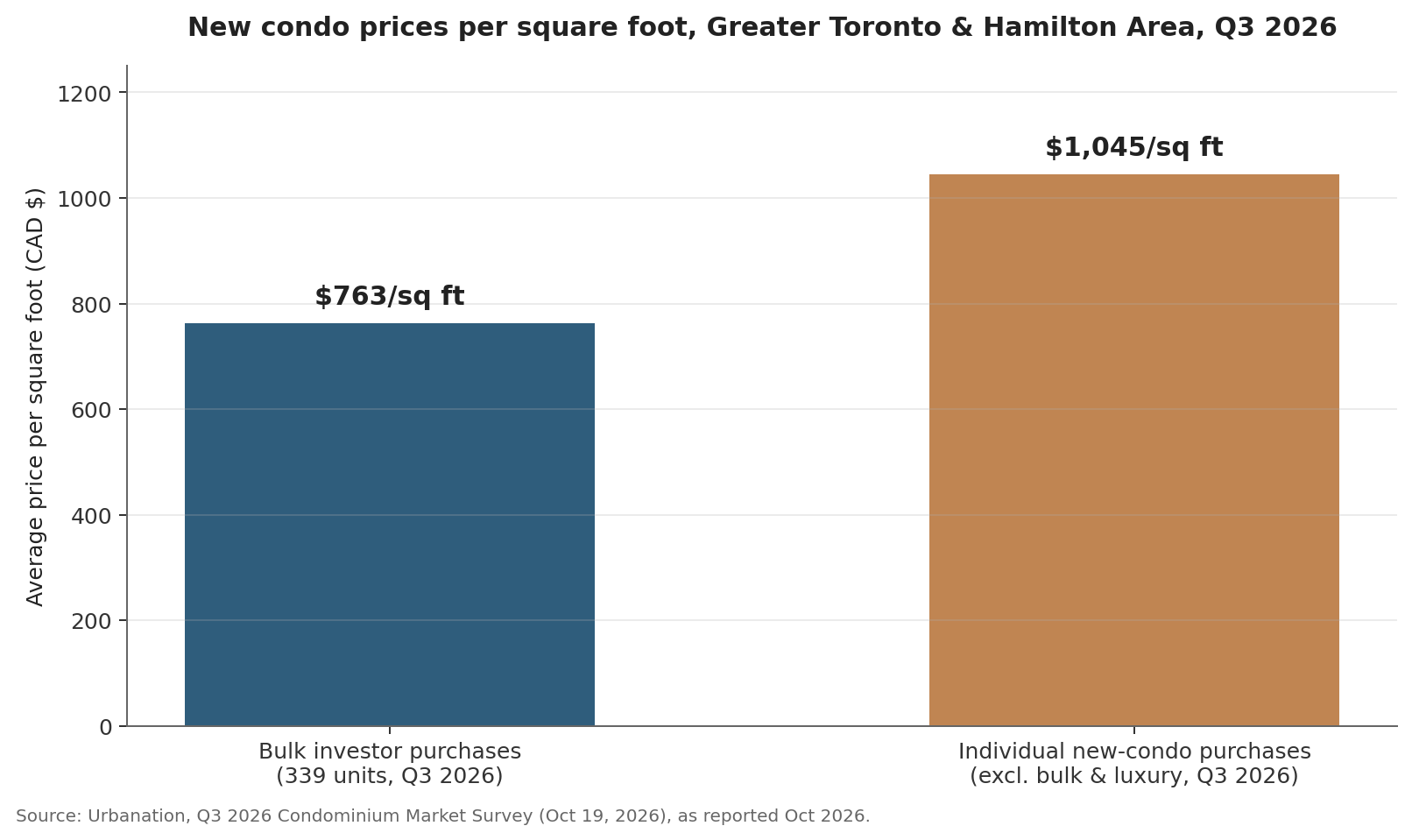
New condo prices per square foot, Greater Toronto & Hamilton Area, Q3 2026. Source: Urbanation, Q3 2026.
The practical result is that a large share of assignments in 2026 are being offered at the original purchase price or below it — the assignor's "profit" component is zero or negative, and the negotiation is really about how much of a loss the assignor will absorb to avoid closing.
Step 1: The builder's consent gate
Every assignment starts with the original agreement of purchase and sale, because the builder controls whether an assignment can happen at all. Builder contracts commonly restrict assignment in one of several ways:
- Prohibited outright. Some agreements ban assignment entirely. If yours does, there is no assignment to negotiate — the options narrow to closing, or negotiating with the builder, or default, each with its own consequences.
- Allowed only with the builder's written consent. This is the most common structure. Consent is not automatic: builders typically require information about the assignee, may require proof that the assignee can finance the closing, and charge an assignment fee.
- Allowed after a milestone. Some contracts permit assignment only after a date, a construction milestone, or a percentage of the project has been sold.
- Marketing restrictions. Many agreements prohibit advertising the unit on the public MLS or marketing it publicly before completion. That is one reason assignment listings circulate through private broker networks, which makes the buyer pool smaller and price discovery harder.
The builder's assignment fee is set by the original agreement — there is no published cap — and the builder's fee for approving an assignment is generally itself subject to GST/HST. Before marketing a contract, an assignor should have a real estate lawyer read the assignment clause, the fee, the advertising restrictions and the consent conditions, because those four items decide whether an assignment is possible, what it will cost, and how the unit can be offered.
Step 2: How an assignment price is built
An assignment price is not a single number in the way a resale price is. It has components, and both sides should itemise them in writing:
- The deposits already paid. The assignee reimburses the assignor for the deposits the assignor has already paid to the builder. On a typical pre-construction condo contract with 20% deposits, that is a large sum — $140,000 on a $700,000 purchase — and it is the assignor's own money coming back, not profit.
- The premium or the loss. On top of deposit reimbursement, the assignee pays a premium if the contract is worth more than its original price — or pays less than the full deposit reimbursement, in effect sharing a loss, if the contract is worth less. In the 2017–2021 boom, premiums were the point of the exercise. In 2026, the premium is frequently negative.
- The remaining obligations. After the assignment, the assignee owes the builder any deposits still to come under the original schedule, plus the balance of the original purchase price on final closing, plus closing adjustments, development charges and occupancy fees where they apply — all on the original contract's terms.
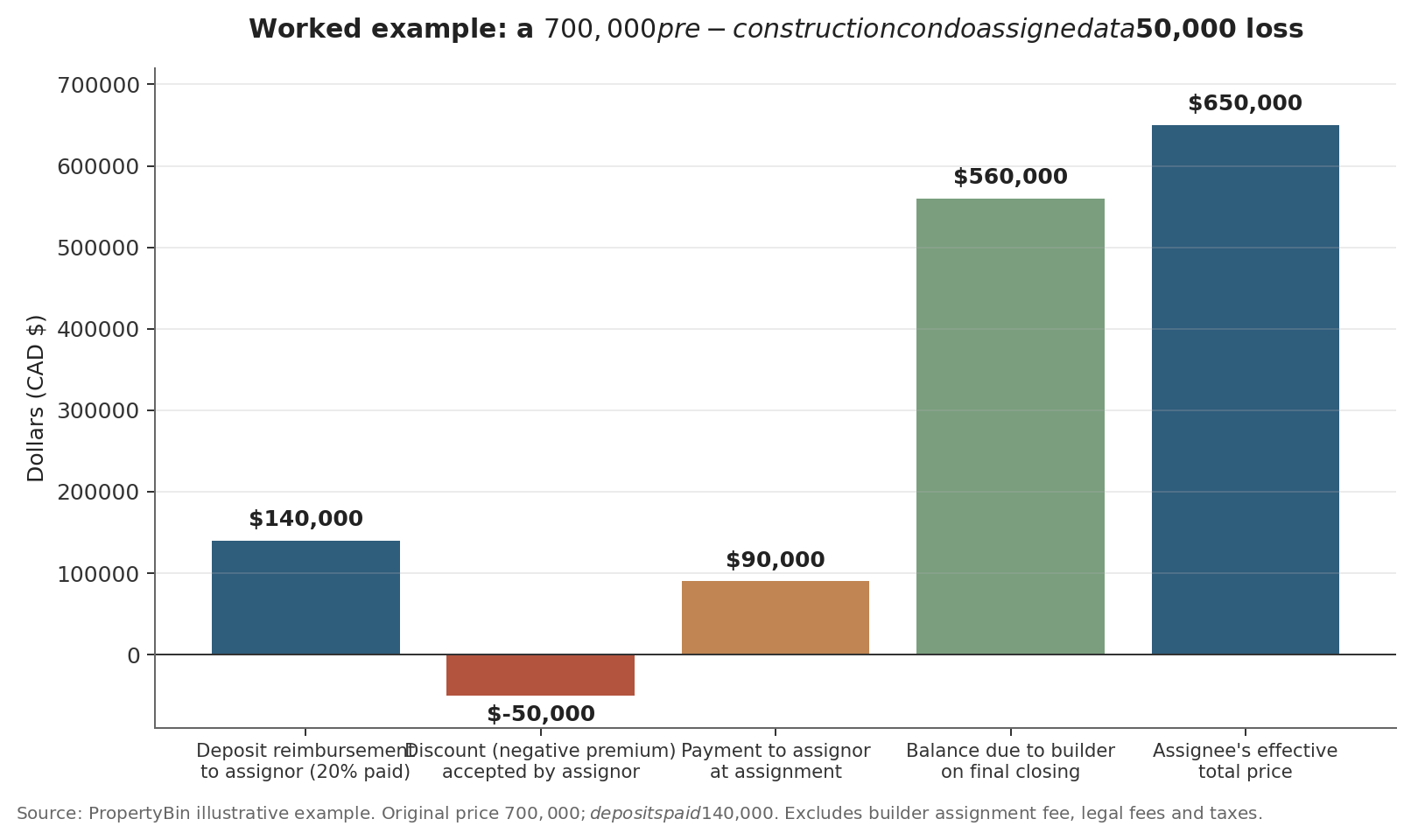
Worked example: a $700,000 pre-construction condo assigned at a $50,000 loss. Source: PropertyBin illustrative example.
The worked example in the chart shows the arithmetic of a loss assignment. A buyer who paid $140,000 in deposits on a $700,000 contract accepts a $50,000 loss: the assignee pays the assignor $90,000, then owes the builder the remaining $560,000 on closing, for an effective total price of $650,000. The assignor walks away having recovered $90,000 of $140,000 in deposits, and still has the builder's assignment fee, legal fees and any tax on the transaction to account for. Painful — but for an assignor who cannot obtain financing to close, or whose unit has appraised well below the contract price, a known $50,000 loss on assignment can be preferable to a default, which can mean forfeiting all deposits and facing a claim for the builder's additional damages.
Financing diligence belongs at this stage, not at closing. An assignment that collapses because the assignee cannot close leaves the original assignor exposed under most agreement structures, so builders and assignors commonly require the assignee's mortgage pre-approval or commitment before the assignment is treated as firm.
Step 3: GST/HST — the May 7, 2022 change
Before May 7, 2022, whether GST/HST applied to an assignment sale depended on the assignor's circumstances and intentions — in particular, whether the assignment was part of a business activity. Budget 2022 removed that ambiguity. Since May 7, 2022, under section 192.1 of the Excise Tax Act, every assignment sale of a newly built or substantially renovated home or condominium unit by a non-builder assignor is a taxable supply for GST/HST purposes, whatever the assignor's reason for buying. In Ontario, that means HST of 13%; in British Columbia, GST of 5% (with provincial rules to check separately).
One drafting detail decides tens of thousands of dollars. The taxable amount is the assignment price minus the portion that reimburses the assignor's deposits — but only if the assignment agreement states in writing which part of the price is deposit reimbursement. If the agreement does not say so in writing, the excluded amount is zero and tax applies to the whole price, including the assignor's own deposit money coming back. On the worked example above, that single sentence is the difference between HST on a small amount and 13% HST calculated on a $90,000 payment.
In most cases the assignor collects the GST/HST from the assignee and remits it to the Canada Revenue Agency (CRA); if the assignor is a non-resident, the assignee generally self-assesses and remits instead. The assignee's own tax picture continues at closing: the assignee pays GST/HST to the builder on the new home itself, and an individual assignee who meets the conditions may be eligible for the GST/HST new housing rebate — generally only one rebate application can be made for each new house, and the assignor, who never acquired the home as their primary place of residence, would generally not be the one eligible. Every party should confirm their position with the CRA's GST/HST Info Sheet GI-120 and their own tax adviser, because the mechanics are fact-specific.
A related timing point for 2026–2027: the temporary enhanced first-time buyers' GST/HST relief for new homes has its own agreement-date windows, and reporting on the enhanced rebate notes it is available after an assignment only where both the original agreement and the assignment agreement fall within the qualifying window (agreements signed between April 1, 2026 and March 31, 2027 for the enhanced measure). An older original contract does not become eligible merely because it is assigned during the window — assignees counting on the rebate should verify eligibility before pricing it into an offer.
Step 4: Income tax and the flipping rule
The second tax layer is income tax on the assignor's profit. The CRA's position is that profit from an assignment sale must be reported as business income in the year the rights were assigned — taxed in full, not as a capital gain at the 50% inclusion rate — and the principal residence exemption does not apply to assignment profits.
On top of that, the federal residential property flipping rule, in force since January 1, 2023 (subsections 12(12) to 12(14) of the Income Tax Act), deems a gain on a housing unit — including, in the CRA's guidance, rights to acquire one — owned for less than 365 consecutive days to be business income, denies the principal residence exemption, and denies losses outright. The rule has nine life-event exceptions (including death, disability, divorce or separation, job relocation and other specified events), but a low appraisal, a rise in interest rates, or a lender withdrawing financing are not among them. An assignor selling at a loss in 2026 should not assume the loss is deductible: whether it is depends on the holding period, the flipping rule, and how the transaction is characterised — another reason the tax conversation happens before the assignment agreement is signed, not at filing time.
Assignees should also remember the compliance layer that applies to them: assigning a pre-construction contract to a non-Canadian can engage the federal Prohibition on the Purchase of Residential Property by Non-Canadians Act, which has been extended to January 1, 2027, and knowingly assisting a prohibited purchase carries penalties. Status verification is part of a properly documented assignment.
What can go wrong — and the alternatives
Assignments fail in predictable ways. The builder refuses consent, or consents only on conditions the assignee will not meet. The assignee's financing falls through between the assignment and final closing, which can be a year or more later, leaving the assignor still liable. The appraisal at closing comes in below the contract price, and the assignee's lender funds against the lower value. Interim occupancy stretches out, adding months of occupancy fees before final closing. Each of these is a reason the assignment agreement itself — deposits held back until final closing, financing conditions, who bears which cost if closing fails — deserves the same care as the original purchase agreement.
If an assignment is not possible, the alternatives are limited but real: negotiate with the builder (some builders will discuss extensions, unit changes or, occasionally, a mutual release, particularly where they can resell the unit); arrange financing to close, including through alternative or private lenders, and then sell as a completed resale unit; or, as a last resort, understand the consequences of default before choosing it — forfeited deposits and potential liability for the difference if the builder resells for less, plus legal costs. None of these should be navigated without a lawyer who acts only for you.
A checklist for assignors and assignees
If you are assigning: read the assignment clause first; confirm the builder's fee and consent process in writing; itemise deposits, premium or loss, and the deposit-reimbursement wording for GST/HST in the assignment agreement; get tax advice on business-income treatment and the flipping rule before signing; and require proof of the assignee's financing.
If you are taking an assignment: have the original agreement, every amendment and the builder's disclosure reviewed as carefully as if you were signing it new; confirm the total effective price — assignment payment, remaining deposits, balance on closing, development charges, occupancy fees and GST/HST on the home — against resale alternatives in the same building and the builder's own unsold inventory; verify any rebate eligibility yourself; and make sure your financing will still be there at a closing date the builder, not you, controls.
The bottom line
An assignment sale is a contract sale with a gatekeeper (the builder), a price built from moving parts, and a tax profile that changed fundamentally in 2022 and 2023. In the 2026 market — national average price $678,584 and down 3.1% on the benchmark index year over year, only 60 presale condos sold in the GTHA in the third quarter, and bulk buyers acquiring new units at $763 per square foot against $1,045 for individual purchases — most assignments are loss-management exercises, not profit-taking ones. Handled early, with the contract read, the numbers itemised and the tax wording right, an assignment can still be the cleanest exit available. Handled late or casually, it can turn a difficult closing into a more expensive one.
This article is general information based on the public sources below, not legal, tax or financial advice. Assignment clauses, tax treatment and rebate eligibility are fact-specific; consult a real estate lawyer and a tax professional about your own transaction.
Sources: Canada Revenue Agency, GST/HST Info Sheet GI-120 (assignment of a purchase and sale agreement for a new house or condominium unit) and CRA guidance on reporting assignment profits as business income; Excise Tax Act s. 192.1 (in force May 7, 2022); Income Tax Act subsections 12(12)–12(14), the residential property flipping rule (in force January 1, 2023); Urbanation, Q3 2026 Condominium Market Survey (October 19, 2026); Canadian Real Estate Association, national statistics for October 2026 (released November 17, 2026); Bank of Canada policy rate decision, October 28, 2026 (policy rate raised to 2.50%).



Comments
No comments yet. Be the first to share your thoughts.