
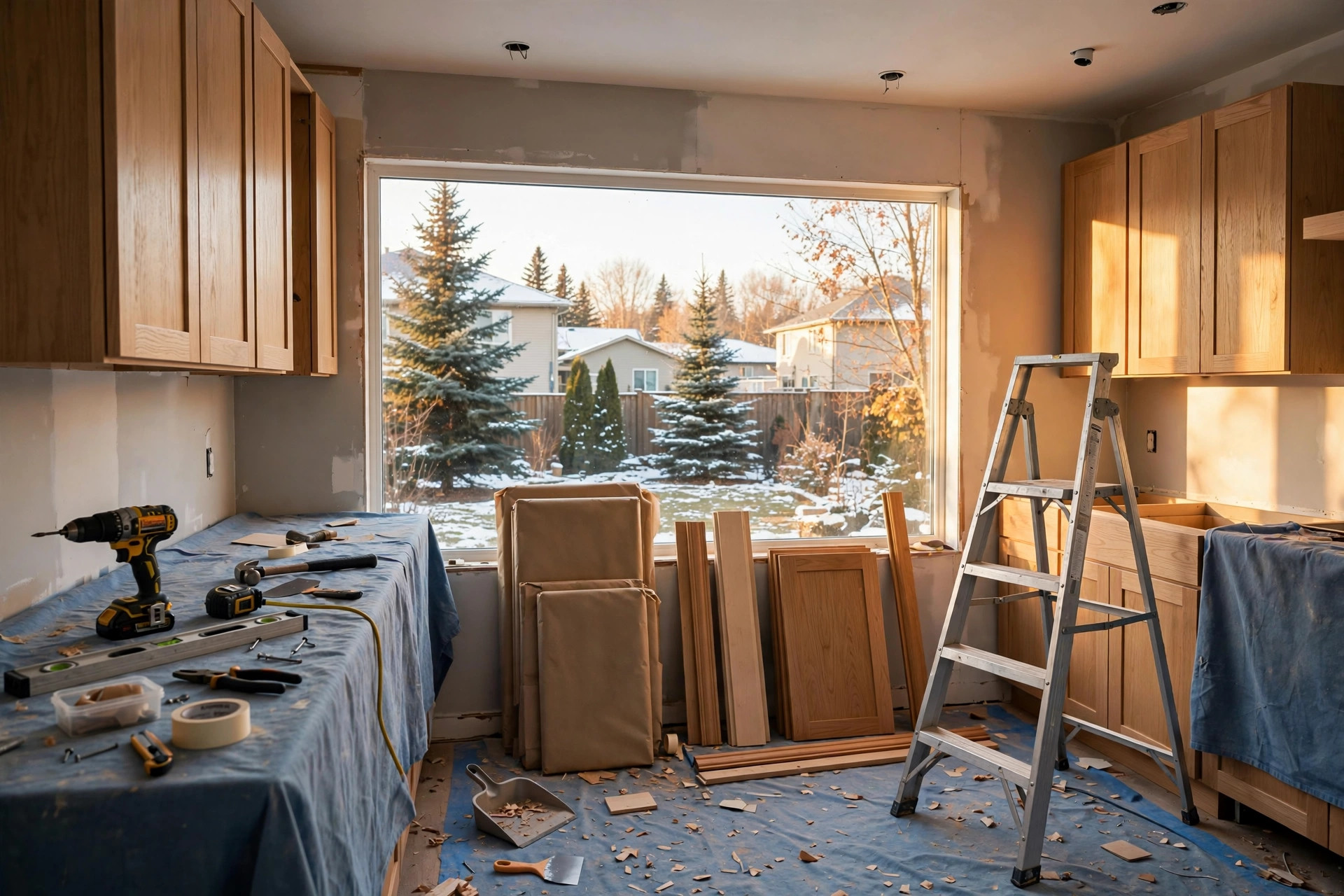
Canadians renovate a lot — and the pandemic era took that habit to a new level. A 2026 Re/Max Canada report on the Toronto and Vancouver markets estimated that national renovation spending increased by roughly $300 billion between 2019 and 2023, an 8% jump over the previous five-year period. The report called renovation and revitalization "one of the most underestimated factors behind escalating housing values," noting that older homes in established neighbourhoods are being bought and rebuilt into much higher-value properties.
But not every renovation dollar comes back when you sell. A $70,000 luxury kitchen in a $500,000 neighbourhood doesn't add $70,000 to the price — and a $2,500 paint job can sometimes add more value than a $25,000 one. The difference between money spent and money recovered is what the industry calls renovation ROI, or the "recoup rate."
This guide breaks down, with current Canadian data, which projects reliably pay back at resale in 2026, which ones pay back partially, and which ones you should only do if you want them for yourself. All figures below come from named industry sources — the Appraisal Institute of Canada, RE/MAX Canada's Renovation Investment Report, Royal LePage, and current cost guides — not from rules of thumb.
What "Renovation ROI" Actually Means
Renovation ROI (return on investment) measures how much of a project's cost a homeowner recovers in a higher resale price. A 75% ROI on a $20,000 bathroom renovation means the home sells for roughly $15,000 more than it would have without the work — you "recoup" 75 cents on the dollar.

A few things to keep straight:
- Recoup rate is not profit. Even the best projects rarely return more than 100% of their cost. You're usually recovering a share of what you spent, not making money on the renovation itself.
- Appraised value and buyer willingness can differ. A renovation can add genuine appraisal value (a legal second bathroom, for example) while still not being "worth it" if you overpaid for the work.
- Geography matters. A kitchen refresh in a Toronto suburb competes with dozens of updated homes; the same refresh in a market with older housing stock may recover more because buyers have fewer turnkey options.
- Timing matters. The Re/Max data shows renovated homes commanding premiums partly because buyers are increasingly hunting move-in-ready properties — and paying for the privilege of skipping the renovation themselves.
The Appraisal Institute of Canada publishes the most-cited recoup ranges in the industry, and they remain the standard reference in 2026:
| Renovation | Typical recoup rate (AIC) |
|---|---|
| Kitchen renovation | 75–100% |
| Bathroom renovation | 75–100% |
| New flooring | 50–75% |
| Energy upgrades (windows, insulation, furnace) | 50–75% |
| Finished basement | 50–85% |
| Exterior / paint | 50–100%+ |
These are ranges, not guarantees. Where your project lands in the range depends on how disciplined the spending was and how well the result matches what buyers in your price band actually want.
What the Industry Data Says: Kitchens First, Bathrooms Second
RE/MAX Canada's Renovation Investment Report, based on a survey of RE/MAX brokers across the country, ranks the projects that give sellers the biggest payouts:
- Kitchen — 93.5% of brokers named it the best-ROI renovation, covering new or updated cabinets, countertops, and appliances.
- Bathroom — 61.3% identified bathrooms as a great high-return renovation.
- Paint — 58% said a fresh coat of paint is the simplest and cheapest investment that pays off at resale.
- Flooring — 45.2% said new flooring is a popular, high-impact upgrade.
- Finished basement — 16.1% said adding liveable square footage below grade is a great selling feature.
The logic behind the top two is straightforward: kitchens and bathrooms are the most expensive, disruptive, and inconvenient rooms to renovate. A buyer who just sold their own home — possibly after living through a renovation of their own — will pay a premium for a house where that work is already done. As the report puts it, the "move-in ready" factor is significant.
The same report, built on a Leger survey of Canadian homeowners, found that most people don't renovate purely for resale: more than half renovated for personal or non-ROI reasons, with 29% citing non-essential lifestyle upgrades and 17% citing essential changes needed during lockdown. Only 16% renovated specifically to increase market value ahead of selling within one to three years. Still, 59% of Canadians said they always consider the return on investment a renovation will have on their home's value. Lifestyle is the driver; resale value is the backstop.
Kitchens: The Highest-Return Room in the House
Kitchen renovations are the most reliable value-add in Canadian real estate — and also the easiest to overspend on.
What the data says. The Appraisal Institute of Canada puts kitchen recoup rates at 75–100%. RE/MAX's research agrees, noting that kitchen renovations ranked among the top three ROI projects in 27 of the 31 housing markets studied. In other words, this isn't a regional quirk — it holds almost everywhere in Canada.
What kitchens cost in 2026. Current Canadian cost guides put a full kitchen renovation at roughly $25,000–$70,000 nationally (HomeStars), with mid-range averages around $35,000–$45,000 and high-end projects exceeding $70,000 (RenoQuotes). The biggest cost lever is whether plumbing and electrical stay where they are — moving a sink, stove, or island can add several thousand dollars on its own. A full gut renovation (back to the studs) typically costs 30–50% more than a standard renovation of the same room.
The smart play for resale. Minor kitchen remodels often beat major ones on ROI. The industry's consistent advice: reface or repaint cabinets rather than replacing them, upgrade to stone countertops (roughly $3,000 for a quality quartz or granite install), swap in matching stainless-steel appliances, and finish with a new tile backsplash and modern hardware. This "refresh" approach captures most of the buyer appeal at a fraction of the cost of a gut job. Neutral, functional kitchens with good storage and lighting sell; highly personalized designer kitchens in modest homes don't recover their premium.
Bathrooms: The Close Second
Bathrooms trail kitchens by a narrow margin in almost every dataset. AIC recoup rates: 75–100%. RE/MAX: bathrooms are a top-three ROI project in 17 housing markets including Toronto and Vancouver, with well-executed projects averaging around a 62% return on more conservative estimates.
What bathrooms cost in 2026. Full bathroom renovations typically run $15,000–$30,000 nationally (HomeStars), with mid-range projects landing in the $26,000–$35,000 range (RenoQuotes). Plumbing relocation is the budget-killer — a bathroom with plumbing moved to a new location can push past $55,000.
The smart play for resale. The highest-return bathroom work is the least glamorous: replacing a dated vanity ($1,000–$6,000 installed, or $200–$1,000 to refinish a solid existing one), updating fixtures and lighting, regrouting tile, and recaulking. If the home has only one bathroom, adding a second is one of the single most powerful value moves — it changes how the property compares against competing listings. Spa-like touches (frameless glass showers, calm tile, good ventilation) photograph well and read as "cared for" to buyers, which matters in a market where turnkey homes win bidding attention.
The Cheap Wins: Paint, Doors, and Flooring
If you're selling in the next year, the best returns often come from the smallest budgets:
- Interior paint ($4,000–$9,000 for a whole home). Recoup rates of 80–100% — among the highest of any project. Neutral, light colours make rooms feel larger and cleaner, which is exactly what stagers recommend. It's the single cheapest transformation in real estate.
- Exterior and curb appeal ($2,000–$15,000). Some estimates put landscaping and curb-appeal returns as high as 100–150%. Buyers form opinions before they enter; a painted exterior, tidy lawn, and clean entryway raise perceived value across the whole property.
- Front door and hardware. A solid wood or steel front door with a quality lockset is repeatedly cited as one of the highest-ROI single items (roughly $2,500 in value impact). Solid-core interior doors with updated hardware run about $250 per door.
- Flooring ($10,000–$25,000+ for a home). AIC recoup: 50–75%. Buyers strongly prefer hardwood or quality laminate/LVP over wall-to-wall carpet, which shows age and traps odours. In older homes, pulling up old carpet sometimes reveals original hardwood that just needs refinishing — the cheapest flooring upgrade there is.
Basements: Finishing vs. Legal Suites
Basement finishing is one of the most-requested renovations in Canada — and one of the most misunderstood on ROI. A cosmetic basement renovation typically recoups 50–85%, but the details change the math dramatically.
What basements cost in 2026. Expect $35–$55 per square foot for basic finishing (framing, insulation, drywall, flooring, lighting, paint — no plumbing), $55–$80 per square foot with a bathroom added, and $90–$150+ per square foot for a legal secondary suite with its own kitchen, entrance, and fire separation. For a typical 800–1,000 sq ft GTA basement, that means roughly $35,000–$85,000 for a finished rec room with bathroom — and $80,000–$140,000+ for a legal rental suite.
Two factors change everything, per Royal LePage's 2026 analysis of strategic renovations:
- Moisture mitigation comes first. Many Canadian foundations sit below the frost line, making freeze-thaw cycles a genuine water-infiltration risk. A finished basement without proper drainage, a sump pump, and corrected foundation grading is a liability, not an asset — and inspectors will flag it.
- Legal living space beats cosmetic space. Converting a basement into a legally recognized bedroom, full bathroom, or secondary suite adds official appraised square footage and, in the case of a suite, rental income potential. Compliant secondary suites are among the highest-yielding renovations in select Canadian markets.
A plain finished rec room adds comfort and helps a listing; a legal suite adds an income stream buyers can underwrite. Price the project accordingly.
Energy Upgrades: Solid ROI Plus Rebates
Energy retrofits — windows, insulation, heat pumps, air sealing — sit in the 50–75% recoup range on the Appraisal Institute of Canada's scale, but that understates their value in 2026 because government rebates can cover a large share of the cost, improving the effective ROI.
The federal landscape changed recently:
- The Canada Greener Homes Grant closed to new applicants on February 27, 2024, and the interest-free Greener Homes Loan closed on October 1, 2025.
- On October 8, 2026, the federal government announced the National Heat Pump Rebate — up to $10,000 for households below their province's median after-tax income, and $2,000 for other eligible households, for installing an eligible cold-climate air-source heat pump. No energy audit is required. The program is targeting an early-2027 launch, with details still being finalized.
- Provincial programs continue in parallel: Ontario's Home Renovation Savings program offers $2,000–$12,000 for cold-climate heat pumps and geothermal through participating contractors, and BC's CleanBC and utility programs offer $1,500–$4,000+ for heat pumps, insulation, and draft sealing. Federal and provincial rebates can generally be stacked.
The practical takeaway: get the energy audit or contractor quotes before signing anything, confirm which programs your project qualifies for, and don't count rebate money for a program that hasn't launched yet. A $15,000 heat pump installation with $7,000–$10,000 in stacked rebates changes the payback math completely — and buyers in 2026 are actively asking about heating systems and energy costs.
Where Renovation ROI Goes to Die
Not every project earns its keep. The consistent warnings from appraisers and brokers:
- Over-personalization. The $25,000 themed bathroom or the ultra-modern kitchen in a traditional neighbourhood narrows your buyer pool. Renovate to the neighbourhood standard, not above it.
- Luxury in modest homes. High-end finishes in a starter-home price band rarely recover their cost — buyers at that price can't pay for them. Match the renovation to the home's price tier.
- Swimming pools. In most Canadian markets, pools are the classic negative-ROI project: expensive to install, expensive to insure and maintain, and they shrink the buyer pool in a climate with a four-month swim season.
- Unpermitted work. Additions, structural changes, or electrical work done without permits can derail a sale entirely when the buyer's inspector or insurer asks questions. Budget permits separately and keep the paperwork.
- Ignoring the roof, foundation, and furnace. Buyers and inspectors care more about a 20-year-old roof and an aging furnace than about designer light fixtures. Deferred maintenance subtracts value; catching up on it protects value.
The Seller's Calculus vs. the Stayer's Calculus
How you renovate should depend on when you plan to sell:
Selling within 1–2 years: Spend on the cheap wins — paint, flooring refresh, curb appeal, minor kitchen and bathroom updates, and deferred maintenance. Don't undertake a major renovation; you won't enjoy it long enough to justify the spend, and buyers may have different taste. The industry rule of thumb: declutter, paint, and freshen the front yard first.
Staying 5+ years: Renovate for your own life — the kitchen layout you want, the basement for the kids, the energy retrofit that cuts your bills. The Leger data shows this is what most Canadians actually do, and it's the right instinct: you'll enjoy the benefit for years, and 59% of homeowners keep an eye on resale value anyway. Just avoid the negative-ROI traps above.
Investors and flippers: This is now a regulated lane. Canada's anti-flipping rule deems profits on properties sold within 12 months to be fully taxable business income (with limited exemptions), so the "buy, renovate, flip" math has to clear a higher bar than it did a decade ago.
Budgeting a 2026 Renovation: The Practical Checklist
- Define scope before pricing. Separate must-haves from nice-to-wants. The biggest cost lever in any room is whether plumbing and electrical stay put.
- Get three itemized written quotes. Compare scope, not just totals — the cheapest quote often omits the expensive parts.
- Add a 15–20% contingency. Older Canadian homes hide knob-and-tube wiring, asbestos, undersized plumbing, and irregular framing. Budget for surprises.
- Price permits and design separately. Permit costs for a bathroom alone can run $150–$1,500 depending on the municipality.
- Check rebates before you sign. Energy programs require pre-approval or pre-retrofit audits in many cases — work done before approval may not qualify.
- Plan financing against a ceiling. Whether it's savings, a HELOC, or a loan, know the maximum before the project starts.
- Hold back the final payment. Don't release the last cheque until the walkthrough is done and deficiencies are fixed.
The Bottom Line
The data tells a consistent story across every major Canadian source: kitchens and bathrooms pay back the most (75–100%), paint and curb appeal pay back the best per dollar spent, basement finishing pays back when it creates legal living space, and energy upgrades pay back better than their recoup rates suggest once rebates are stacked. Everything else should be done for your own enjoyment, not for resale.
With renovation spending having surged by an estimated $300 billion nationally between 2019 and 2023, renovated homes are setting the price bar in market after market — which means the cost of not updating, in the form of a longer sale and a lower offer, is rising too. The winning strategy in 2026 isn't the biggest renovation. It's the most disciplined one: fix what's broken, refresh what buyers see first, and let the data — not the showroom — decide where the money goes.
Sources: Appraisal Institute of Canada recoup ranges (via CIBC's home renovation guide); RE/MAX Canada 2021 Renovation Investment Report (Leger survey of Canadian homeowners and RE/MAX brokers); Re/Max Canada 2026 renovation and revitalization report (via Investment Executive); Royal LePage strategic renovations analysis (2026); HomeStars 2026 Home Renovation Cost Guide; RenoQuotes 2026 Home Renovation Price Guide; Natural Resources Canada and federal announcements on the National Heat Pump Rebate (October 2026).
Comments
No comments yet. Be the first to share your thoughts.