
The quietest revolution in Canadian housing
Canada's housing shortage is usually described as a supply problem: the country simply does not build enough homes. But behind that shortage sits a less visible cause — the zoning rules of the 20th century. For decades, most residential land in Canada's cities was reserved exclusively for single-detached homes. Apartments were confined to a few corridors, and anything in between — duplexes, triplexes, fourplexes — was effectively illegal on the vast majority of urban lots.
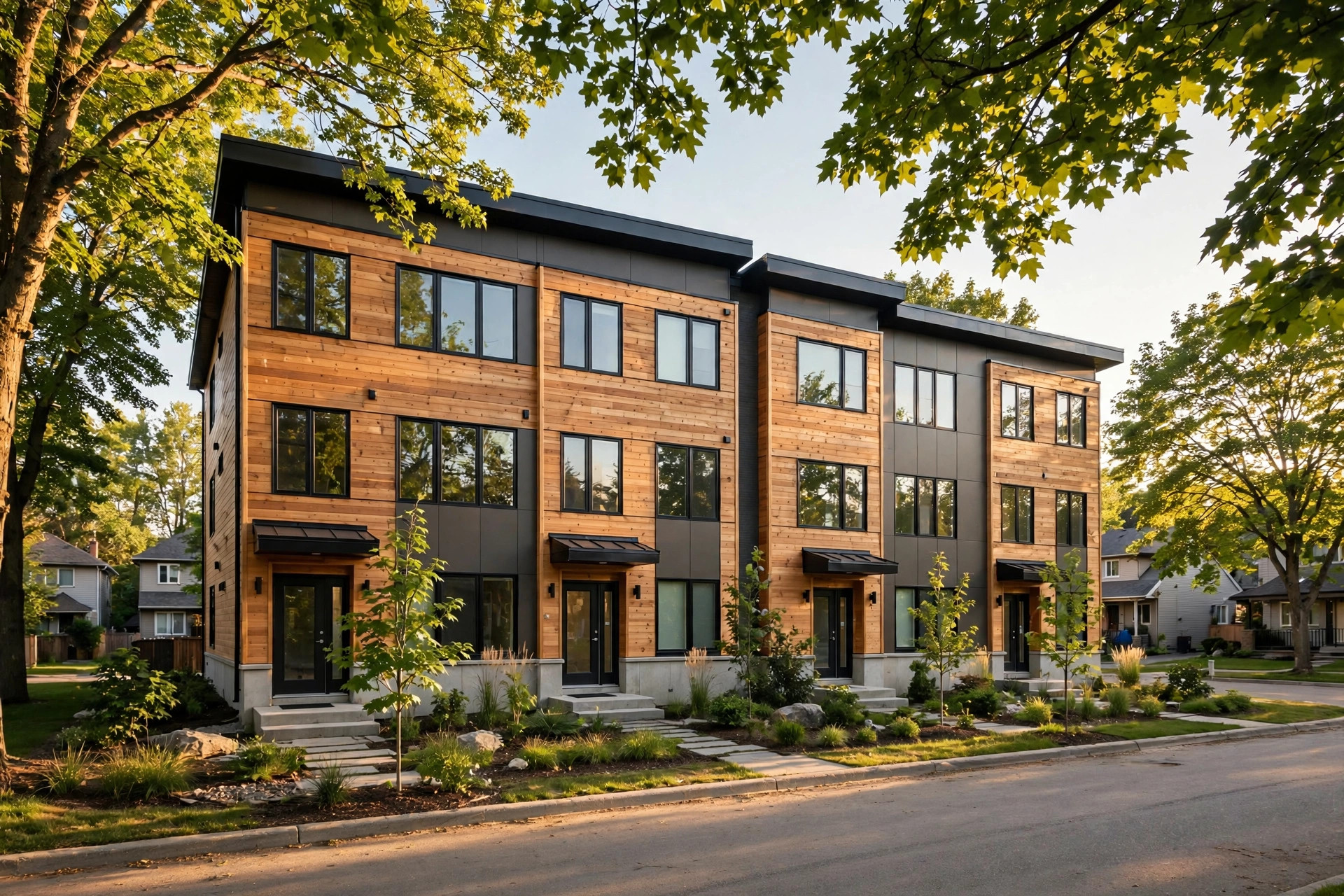
That is now changing, fast. In the span of about three years, the federal government, several provinces, and Canada's largest cities have moved — sometimes together, sometimes in open conflict — to legalize the homes that housing economists call the "missing middle": low-rise, ground-oriented homes that sit between a detached house and an apartment tower. What follows is a tour of what has actually been built and permitted so far, city by city, and what it means if you own, want to own, or invest in Canadian housing.
What is the "missing middle"?
The term describes housing forms that are denser than a single-family home but far smaller and more neighbourhood-friendly than a mid- or high-rise: duplexes, triplexes, fourplexes, stacked townhouses, row houses, laneway homes, and garden suites. These are the housing types that dominated Canadian cities before the Second World War — think of the multi-unit houses of Montreal's Plateau or Toronto's older avenues — and then were gradually outlawed by single-family zoning across most suburbs and inner-city neighbourhoods.
Why does the missing middle matter for the market? Because it is the cheapest form of new housing to build per unit after simple basement suites. It uses land that is already serviced — roads, sewers, transit, schools — and it can be built by the small builders and tradespeople who make up most of Canada's construction industry, not just the handful of large developers capable of financing condo towers. For buyers, it is the main realistic route back to ground-oriented homeownership in cities where detached prices have moved out of reach.
The federal lever: the Housing Accelerator Fund
The single biggest force behind the zoning changes has been money from Ottawa. Launched in March 2023 and administered by the Canada Mortgage and Housing Corporation (CMHC), the Housing Accelerator Fund (HAF) put $4 billion on the table — topped up with another $400 million in Budget 2024 — and handed it directly to municipalities. But there was a catch: to receive the money, cities had to commit to systemic land-use reforms drawn from a federal menu that included allowing as-of-right construction of multiplexes of up to four units in single-family neighbourhoods, reducing or eliminating minimum parking requirements, and digitizing permitting systems. The national target was to generate at least 100,000 net new housing units by October 2026, over and above what would have been built anyway.
The program was followed by an even more muscular federal move. The 2024 federal budget set aside $6 billion to accelerate new construction, with $5 billion of that as conditional infrastructure funding: provinces could only access it if they required municipalities to end single-family-only zoning and allow fourplexes, adopt updates to the national advisory building code, and enforce renter and homebuyer protections. As housing policy expert Carolyn Whitzman of the University of Ottawa put it, the policy was aimed at exactly the "missing middle" — townhomes and fourplexes that had until recently been illegal on most Canadian land.
The logic is blunt and unusual for Canada: because zoning is normally a purely municipal power, the federal government used cash, not law, to change the rules on the ground. Whether it works depends entirely on what cities do next.
British Columbia: the province that overrode its cities
If Ottawa's approach was cash incentives, British Columbia's was a legal override. In November 2023, the province introduced Bill 44, the Housing Statutes (Residential Development) Amendment Act, which rewrote the Local Government Act to force municipalities to allow three to four homes on lots currently zoned for single-family or duplex use — four units on most lots, and up to six units on larger lots near transit stops with frequent service. The mandate applied to municipalities with more than 5,000 residents, and cities had until June 30, 2024 to update their zoning bylaws. The province's own projection was that the change would produce over 130,000 new missing-middle homes over a decade.
The legislation also reformed the approval process itself, shifting planning and zoning work "up front" — meaning municipalities must update community plans and zoning bylaws on a regular schedule so that builders know what is allowed before they buy land, rather than gambling on a years-long rezoning fight. It is one of the most aggressive provincial interventions in local planning in Canadian history, and it is being watched closely by other provinces weighing similar moves.
Vancouver's R1-1 multiplex zone
Even before the province acted, Vancouver had moved on its own. In September 2023, Vancouver City Council adopted the R1-1 Residential Inclusive Zone, consolidating nine separate low-density residential zones into a single zone and introducing "multiplex" as a new housing option: three to six ownership units (strata tenure), or up to eight secured rental units, on a single lot.
The results have been striking. By the end of March 2025, the city had accepted approximately 370 multiplex applications representing about 1,500 new homes. In 2024, multiplex applications became the predominant development type in the R1-1 zone — roughly 50% of all application volume, compared with about 30% for duplexes and 20% for detached houses. The city is now streamlining further, with a concurrent development-and-building-permit process for multiplexes of up to four units expected to shorten timelines. Vancouver is the clearest proof of concept that when missing-middle housing becomes legal and predictable, the market responds.
Edmonton: the boldest experiment — and the backlash
Edmonton went further than any other Canadian city. On October 23, 2023, city council approved Zoning Bylaw 20001, ending what it called exclusionary zoning and replacing six low-density residential zones with a single Small Scale Residential (RS) Zone that permits up to eight units on any residential lot — with modest variations by lot size — in buildings up to three storeys. The bylaw took effect January 1, 2024, and the federal government committed $175 million from the Housing Accelerator Fund to fast-track more than 5,200 new homes in the city over three years.
The 2024 results, reported by city staff, showed the overhaul working as intended: 555 residential development permits were issued for missing-middle forms — 159 single-detached homes, 100 single-detached homes with secondary suites, 165 row houses, and 117 semi-detached homes. Small-scale homes were no longer a rounding error in Edmonton's housing production.
But Edmonton's experiment also produced the country's fiercest backlash. By the 2025 fall municipal election, infill had become a major campaign issue: long-time residents of established neighbourhoods raised concerns about property values, parking, developer practices, build quality, and whether the new homes were even affordable. Some homeowners took drastic steps — one resident bought his neighbour's property specifically to prevent it from becoming an infill project. The dispute even exposed the role of restrictive covenants: private agreements attached to some lots can restrict redevelopment regardless of what the zoning bylaw allows, adding a layer of legal complexity for buyers and builders alike.
In a dramatic escalation, the Alberta government ordered Edmonton to reverse its infill rules, citing property values — giving the city 18 months to review and consult on its land-use rules — and ordered Calgary to maintain its current zoning after that city's council backtracked on its own reforms earlier in 2026, pending a broader review expected to finish in 2027. Edmonton's story is the clearest warning that zoning reform is politically fragile: permission granted can be permission revoked.
Toronto: fourplexes as-of-right — and now sixplexes and free blueprints
Toronto's journey has been steadier. In 2023, the city passed By-law 474–2023 permitting up to four dwelling units — duplex, triplex, or fourplex — as-of-right on residential lots across the entire city, with built-form standards similar to those for detached houses. In December 2023, Toronto signed a Housing Accelerator Fund agreement with CMHC worth $471.1 million tied to creating 11,780 new homes — the federal lever that then pushed the city further.
On June 26, 2025, council went beyond fourplexes, adopting Official Plan Amendment 818 and By-law 654-2025 to permit five- and six-unit multiplexes — but only as a pilot in about nine wards, not citywide. The city also waives development charges for multiplex projects, a saving worth tens of thousands to well over $100,000 per project, and in June 2026 secured $1.5 billion in combined federal and provincial funding intended to keep those exemptions in place. A city bulletin estimates the full Expanding Housing Options in Neighbourhoods (EHON) program could generate up to 54,600 new homes by 2031 and nearly 164,000 by 2051.
Most recently, in October 2026, Toronto launched free pre-approved building plans for fourplexes and sixplexes — four new designs suited to both narrow and wide lots, compliant with the Ontario Building Code and developed with accessibility, climate resilience, and construction cost in mind. The designs complement CMHC's national Housing Design Catalogue. If a multiplex meets the zoning requirements, an owner can apply directly for a building permit without going to the Committee of Adjustment — removing both design costs and months of process. Toronto is betting that the missing middle's real obstacle was never just zoning; it was the cost and complexity of everything around it.
Ottawa: fourplexes plus the end of parking minimums
Ottawa's new zoning bylaw, finalized in 2025, enables fourplexes on all serviced residential lots citywide — a commitment the city made under the Housing Accelerator Fund — and pairs it with the elimination of minimum parking requirements, a classic hidden tax on housing construction. New maximum parking rules apply near rapid transit stations, 25% of spaces in mid- and high-rise developments must be electric-vehicle-ready, and new surface parking lots are banned downtown entirely.
Ottawa's package shows how missing-middle reform works best as a bundle: fourplex permission means little if every unit must still come with an expensive parking stall, and gentle density only pencils out when the soft costs come down alongside the zoning.
What it means for you
If you are a homeowner
Your lot may now be worth more than you think — and your street may look different in five years. In Toronto, a bungalow lot can legally become a fourplex as-of-right; in Edmonton, more. Before paying an architect or a contractor, check the current rules for your exact address: Toronto's sixplex permission covers only certain wards, Alberta's orders have forced reviews in Edmonton and Calgary, and restrictive covenants or heritage rules can still override zoning. A quick pre-application meeting with your city's planning department is worth far more than internet advice.
If you are a buyer
Missing-middle homes — legal duplexes, triplexes, and garden-suites-to-be — are the new entry tier in expensive cities. They trade the prestige of a detached house for something more practical: a lower price, a mortgage you can actually carry, and in many cases a rental unit that subsidizes the payments. When comparing options, ask whether the units are strata-titled (Vancouver's model) or rental-only, since that determines what you can buy and what your lender will finance.
If you are an investor or small developer
The economics of small multiplexes have improved on paper — as-of-right permission, development charge waivers, pre-approved designs — but execution is everything. Budget realistically: current GTA conversion costs run roughly $100,000–$250,000 for a basement legalization or duplex conversion, $250,000–$500,000 for a triplex, and $500,000–$1,000,000 for a fourplex with structural work or an addition, with hard construction running about $250–$425 per square foot of renovated area. Verify servicing (water, sewer, electrical capacity), financing (small-scale projects sit in an awkward gap between residential mortgages and commercial construction loans), and — the Edmonton lesson — political risk: confirm the rules will still be the rules when your permit application lands.
What to watch
Zoning reform has moved faster in three years than in the previous fifty, but permission is not production. The honest open questions: whether BC's 130,000-unit projection materializes or stalls on financing and construction capacity; whether Edmonton's reversal survives its 18-month review or becomes the template for rolling back reforms elsewhere; whether Toronto's free plans and fee waivers convert permits into actual occupied homes; and whether the federal government's October 2026 HAF target of 100,000 incremental units is met. Real estate cycles are measured in years, and the missing middle is still in the early innings.
One thing is no longer in doubt, though: the single-family neighbourhood as a legally protected category is over in Canada's major cities. The only remaining question is how fast the market builds the homes that replaced it.
Related reading: Vacant Home Taxes in Canada: Toronto, Vancouver, and Ottawa Rules for 2026
Sources: City of Toronto news release (October 2, 2026); City of Toronto / CMHC Housing Accelerator Fund agreement; Toronto City Council By-law 474–2023, By-law 654-2025 and Official Plan Amendment 818; Government of British Columbia Bill 44 (Housing Statutes (Residential Development) Amendment Act, 2023); City of Vancouver memorandum on the R1-1 Residential Inclusive Zone (May 2025); City of Edmonton Zoning Bylaw 20001 and 2024 development permit data; City of Ottawa new zoning bylaw; Government of Canada 2024 federal budget and CMHC Housing Accelerator Fund materials.
Comments
No comments yet. Be the first to share your thoughts.