

Introduction: The Move Half of Retiring Canada Is Planning — and Half Is Not
Downsizing used to be treated as an automatic chapter of retirement: the kids leave, the house feels too big, and you trade it for something smaller and simpler. The data says modern Canada is far more divided. A Royal LePage survey conducted by Leger in May 2025 (1,626 Canadian adults) found that 46 per cent of Canadians approaching retirement plan to downsize within two years of leaving work — and 47 per cent say they will not. It is as close to an even split as a national survey gets.
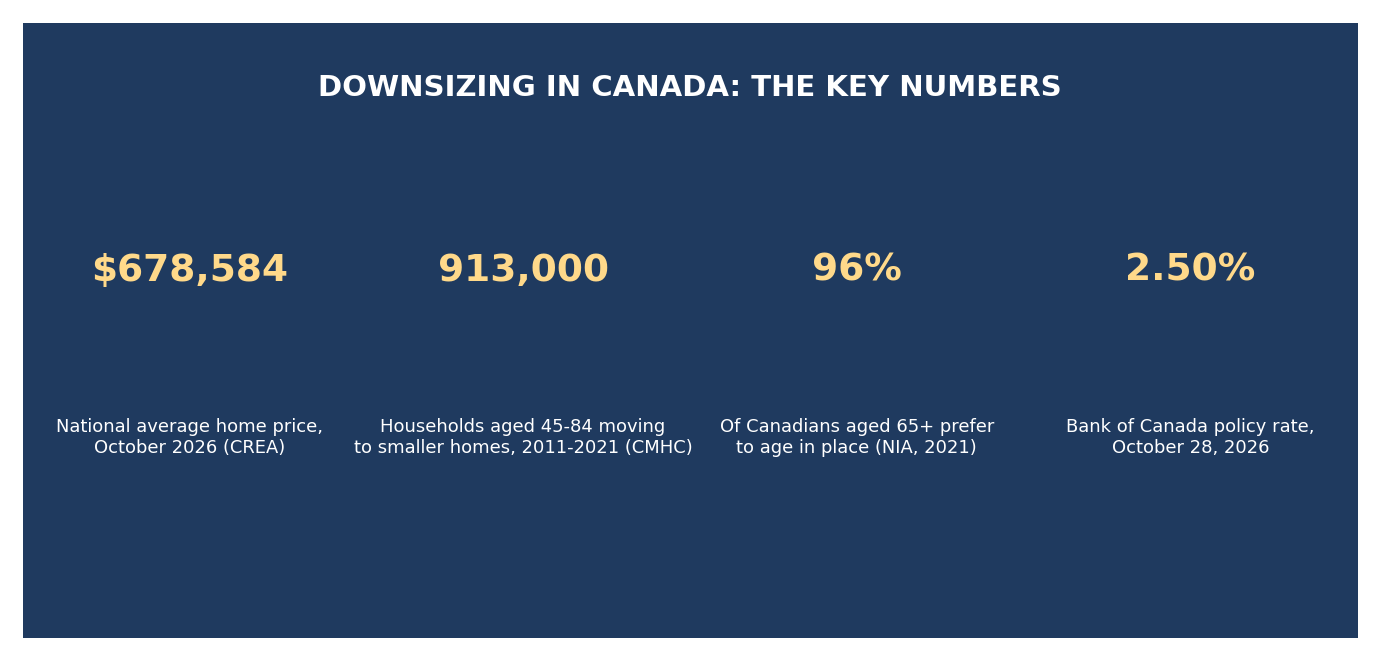
The same survey explains part of the hesitation: 29 per cent of those planning to retire in 2025 or 2026 expect to still be making mortgage payments in retirement, while 45 per cent are already mortgage-free and another 6 per cent expect to be by the time they retire. And Canada Mortgage and Housing Corporation (CMHC) research adds a longer view: about 913,000 households aged 45 to 84 moved from larger homes to smaller ones between 2011 and 2021 — a real stream of moves, but one CMHC describes as confined to a minority of older households. The share of owners aged 75 and over who sell in a given period has actually been drifting down for decades, from 38.6 per cent between 1996 and 2001 to 36 per cent between 2016 and 2021.
Meanwhile, the backdrop has shifted. CREA reported a national average home price of $678,584 in October 2026, down 1.6 per cent year over year, with the MLS Home Price Index down 3.1 per cent year over year. CREA's revised forecast expects about 463,336 sales in 2026 and a national average price of $686,710, rising modestly in 2027. The Bank of Canada raised its policy rate to 2.50 per cent on October 28, 2026 — its first increase since July 2023 — with the next decision scheduled for December 9, 2026. For a downsizer, that combination matters: prices are softer than the 2022 peak, borrowing is no longer getting cheaper, and the gap between what you sell for and what you buy is where your retirement money is made or lost.
This guide works through the whole decision: who downsizes and why, what the move actually costs (with a full worked example), the tax rules that protect — or tax — your gain, the main alternatives if you would rather stay, how to choose the next home, and a step-by-step plan for doing it in the right order.
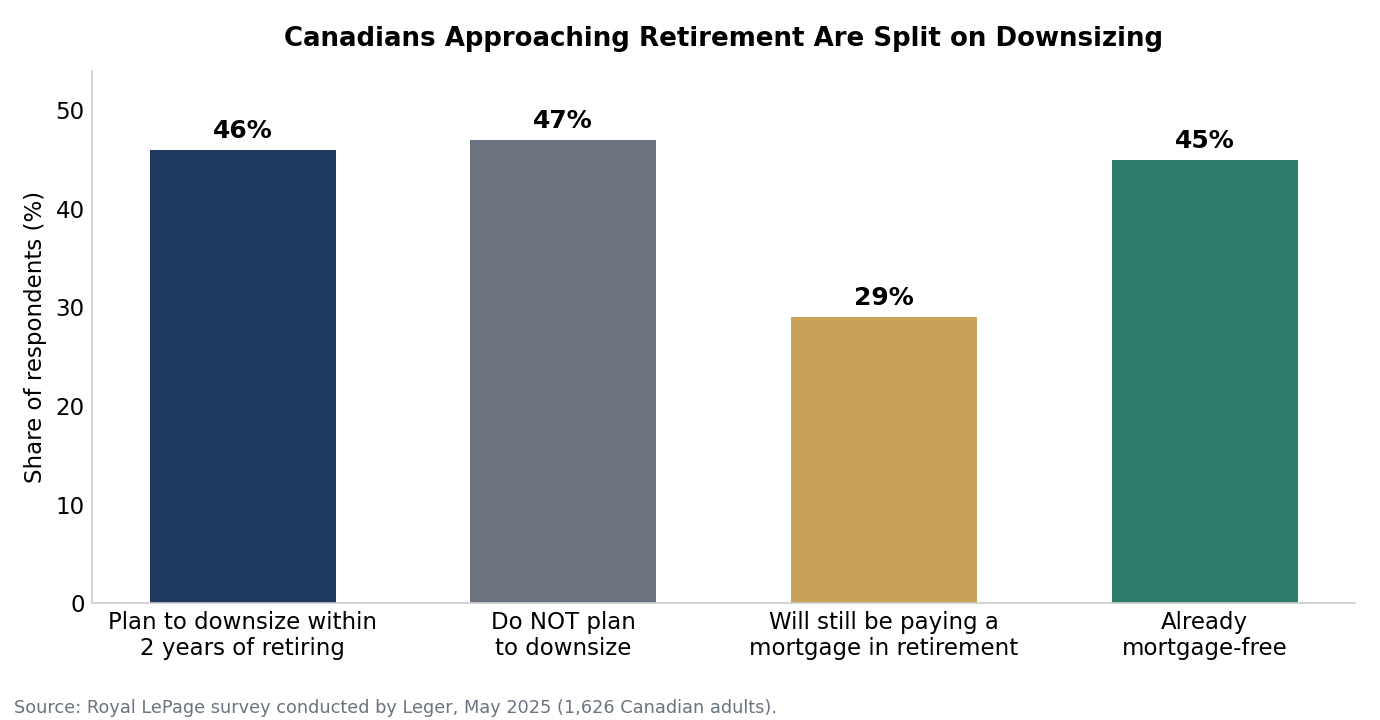
Canadians approaching retirement are split on downsizing. Source: Royal LePage survey conducted by Leger, May 2025.
Downsizing vs. Right-Sizing: What the Words Actually Mean
CMHC draws a useful distinction. Downsizing means moving to a smaller home. Right-sizing means moving to a home that better fits your life now — which might be smaller, but might instead be the same size on one level, closer to family, or simply cheaper to run. The distinction matters because many "downsizers" discover the goal was never fewer square feet; it was no stairs, no snow shovelling, no furnace anxiety, and lower monthly costs.

The preference data is lopsided in one respect: the National Institute on Ageing (2021) found 96 per cent of Canadians aged 65 and over would prefer to age in place — to stay in their home or community as long as possible. CMHC also notes that more than five million Canadian households aged 45 to 84 live in homes with three or more bedrooms, so the theoretical supply of "downsizable" family homes is enormous; the constraint is that most owners do not want to leave them, and the sell rate only rises meaningfully at advanced ages. Statistics Canada projects the population aged 75 and older will grow by roughly 53 per cent between 2021 and 2031, which is why this slow-moving decision still shapes the whole housing market: every family home a senior releases is a home a younger family can buy.
Where do downsizers actually go? Among Royal LePage professionals who reported a majority of clients downsizing, standard condominiums were the top choice at 43 per cent nationally (59 per cent in Ontario), followed by adult lifestyle communities at 25 per cent and smaller detached homes at 16 per cent. CMHC found regional flavours too: Toronto and Vancouver seniors are the most likely to transition to condominiums, while Montreal shows a stronger preference for rental housing.
The Real Math: What a Downsizing Move Actually Costs
The most common downsizing mistake is mental arithmetic that stops at "sell high, buy lower, pocket the difference." The difference is real — but two rounds of transaction costs stand between you and it. Consider a representative Ontario move in late 2026: you sell a detached home for $850,000 (mortgage-free) and buy a condominium for $550,000 outside Toronto.
On the selling side, the largest cost is commission. A typical total commission of 5 per cent of the sale price, plus 13 per cent HST in Ontario, comes to $48,025 on an $850,000 sale — which is why understanding how real estate commissions work and what is negotiable is worth real money to a downsizer. Add roughly $2,000 in legal fees and disbursements to sell. On the buying side, Ontario land transfer tax on a $550,000 purchase is $7,475 (0.5 per cent on the first $55,000, 1 per cent on the next $195,000, 1.5 per cent on the next $150,000 and 2 per cent on the remaining $150,000), plus about $2,500 in legal fees. Moving, short-term storage, utility connections and the small army of transition expenses add roughly $5,000 for a typical move. Our full guide to closing costs in Canada breaks down every line a buyer should expect.
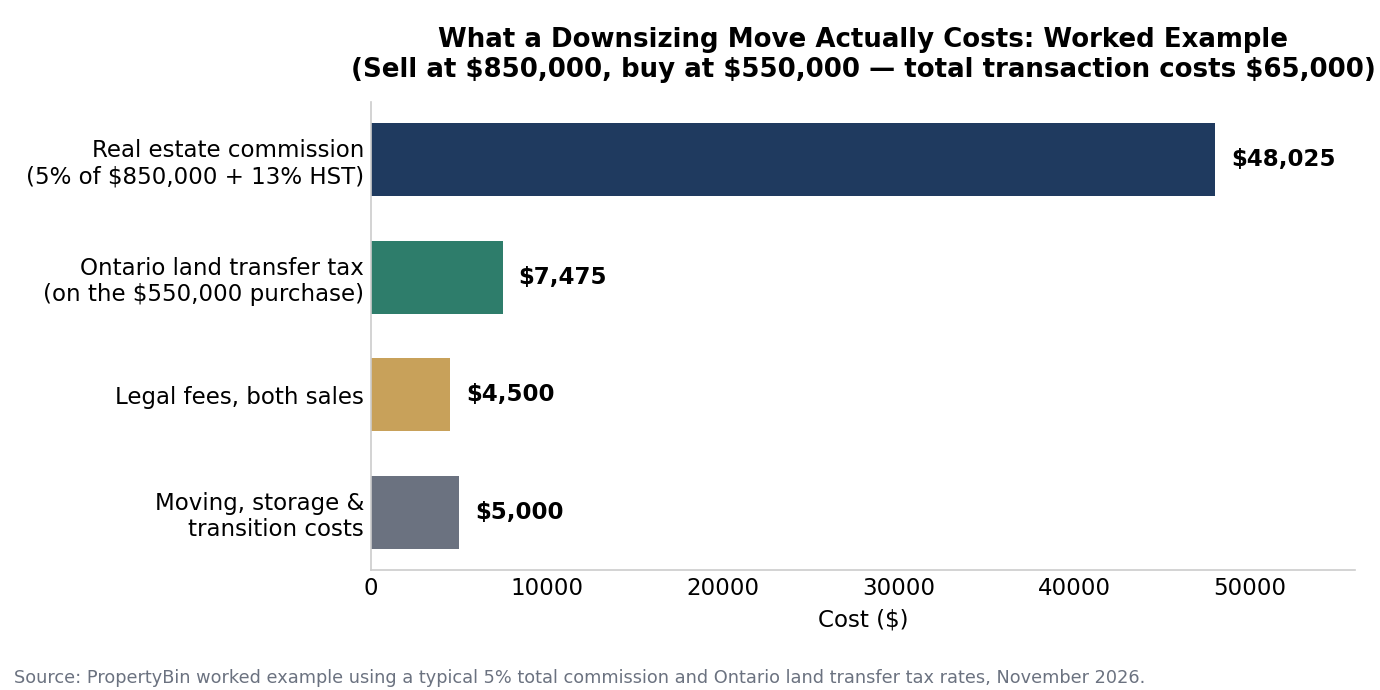
What a downsizing move actually costs: worked example. Source: PropertyBin worked example using a typical 5% total commission and Ontario land transfer tax rates, November 2026.
Total transaction costs: about $65,000. Equity released: $850,000 − $550,000 − $65,000 = $235,000. That is still a meaningful sum — but it is $65,000 less than the headline price gap, and the gap shrinks fast if the new home is closer in price to the old one. A move from an $850,000 house to a $700,000 bungalow in the same city can release barely $85,000 after costs, which may not compensate for leaving a neighbourhood you love. The rule of thumb: the move has to be decisively smaller, decisively cheaper, or decisively better located for the finances to sing.
Two more costs hide below the waterline. First, if the smaller home is a condominium, monthly condo fees replace the (lumpy, deferrable) costs of house maintenance with a fixed monthly bill that rises over time — and a building with a thin reserve fund can levy special assessments, so read how condo reserve funds and status certificates work before you buy. Second, if you still carry a mortgage, breaking it early can trigger a penalty; and if you are buying before your sale closes, you may need short-term financing to bridge the gap.
The Tax Picture: The Principal Residence Exemption Is Your Best Friend
For most downsizers, the tax news is good. When you sell your principal residence, the capital gain is generally fully exempt from tax in Canada under the principal residence exemption — whether you gained $50,000 or $1 million. The exemption applies for each year the property was your principal residence and you (or your spouse) ordinarily inhabited it. Since 2016, you must report the sale on your tax return and designate the property as your principal residence for the exemption to apply; the Canada Revenue Agency (CRA) can assess penalties for late designations, so the paperwork matters even though no tax is due.
Watch three traps. First, the one-property rule: a family unit can designate only one principal residence per year, so couples who own both a house and a cottage must choose which property absorbs the exemption for overlapping years — often a reason to keep the cottage's cost records meticulously. Second, partial use: if part of the home was rented or used for business, a portion of the gain may be taxable, and claiming capital cost allowance on a rental portion can complicate the exemption. Third, the anti-flipping rule: a home owned for less than 12 months that is sold (with exceptions for life events such as death, disability, divorce or job relocation) is treated as business income, not a capital gain — rarely an issue for genuine downsizers, but relevant if a quick resale follows the move. If you are selling an investment property rather than your home as part of the same life transition, the rules are entirely different and a tax professional is essential.
After the sale, where the released equity sits has tax consequences too. Money inside a TFSA grows and withdraws tax-free; non-registered interest and dividends are taxed annually; and drawing on home equity through a home equity line of credit instead of selling is borrowing, not income — but it carries interest cost and rate risk, especially with the Bank of Canada's policy rate back up to 2.50 per cent.
If You Would Rather Stay: The Alternatives to Weigh Honestly
Downsizing is one way to convert housing wealth into an easier life. It is not the only one, and for the 96 per cent who would prefer to age in place, the alternatives deserve a fair hearing:
- Age in place with support. Stay, and spend some of what a move would have cost on the things that make staying work: a main-floor bathroom renovation, stair lift, snow and lawn contracts, and paid home care as needed. The honest test is whether the house can be made safe and affordable on one level of living.
- A reverse mortgage. Canadians 55 and over can borrow against home equity with no required payments until the home is sold or the borrower dies or moves out. It preserves the home and the neighbourhood, at the cost of steadily compounding interest that reduces the estate. Our detailed guide to how reverse mortgages work, what they cost, and when they make sense lays out the trade-offs.
- Add a suite instead of leaving. Converting a basement or garage, or adding a garden suite, can bring rental income — or family — into the home you already own, and it is one of the ways CMHC suggests senior supply can be unlocked without anyone moving.
- Sell and rent. Renting after selling converts all of your equity into investable capital and eliminates maintenance, property tax and repair risk entirely. The trade-off is rent inflation and less control: a landlord can sell, and in most provinces a tenancy can end for a buyer's own use with proper notice and compensation.
Timing the Move in the 2026 Market
Downsizers are both sellers and buyers, which makes market timing a two-sided question. CREA's October 2026 figures — national average price $678,584, down 1.6 per cent year over year, with the benchmark index down 3.1 per cent — describe a market that has cooled from the 2022 peak but, on CREA's forecast, stabilizes through 2027 with average prices rising about 1.1 per cent in both 2026 and 2027. Desjardins' October 2026 analysis adds an important nuance: because seniors tend to hold their homes until advanced ages, resale supply from downsizers arrives slowly regardless of price signals — which is one reason family-sized homes in established neighbourhoods remain scarce even in soft markets.
Practically, three timing rules serve downsizers well. Sell the family home into the spring market if you can: detached homes with yards show best and attract the deepest buyer pool from March through June. Buy the smaller home in the same market conditions you sell into — if prices have softened 5 per cent, they have softened on your purchase too, and because your purchase is cheaper, a balanced percentage move actually favours the downsizer in dollar terms on the buy side while costing on the sell side; what matters is the gap, not either price alone. Sequence the transactions safely: buying first risks carrying two homes if your sale stalls; selling first risks a rushed purchase. Bridge financing exists precisely for the overlap when dates do not line up, and a longer closing on one side is often cheaper than a bridge loan.
Interest rates frame the decision for the 29 per cent who still carry a mortgage. With the policy rate at 2.50 per cent after the October 28, 2026 increase — and the Bank signalling it will proceed carefully — anyone renewing or taking a new mortgage on the smaller home should compare fixed and variable terms freshly rather than assuming the falling-rate environment of 2024–2025 still applies.
Choosing the Next Home: A Downsizer's Checklist
The best downsizing moves are pulled by a better life, not pushed by a worse one. Research on downsizer wellbeing points the same way: people who move toward something report better outcomes than people who move merely away from a problem. Use this checklist on every candidate home:
- One-level living: bedroom, full bathroom, kitchen and laundry on the entry level — or an elevator-served building.
- Healthcare proximity: your actual doctors, pharmacy and hospital, not just "amenities nearby."
- The people map: distance to children, grandchildren and friends is the amenity retirees consistently rank first — the Royal LePage survey found proximity to family among the top priorities for downsizers.
- Total monthly cost, honestly: mortgage (if any) + property tax + condo fees + utilities + insurance, compared against your current all-in cost. A cheaper purchase price with $700 monthly condo fees can cost more per month than the house did.
- Condo documents: for condominiums, the status certificate, reserve fund study and any special-assessment history — before your offer is firm, not after.
- Guest and hobby space: downsizers who give up the room where grandchildren sleep or the workbench they use daily often regret the move even when the finances work.
- Exit flexibility: a mainstream home type in a mainstream location resells to the widest future pool — including, one day, your own estate.
Step by Step: How to Downsize Without the Chaos
The six-step downsizing plan
- Run your numbers first. Estimate your sale price, subtract commission, legal and moving costs, subtract your target purchase price plus its land transfer tax and legal costs. The remainder is your released equity — decide if it justifies the move.
- Declutter a decade at a time. Start 6–12 months out: sell, gift and donate in passes. Measure the new home's closets before deciding what furniture survives.
- Prepare and price the family home. Small repairs, deep clean, honest pricing for current market conditions — overpricing is the costliest error in a balanced market.
- Secure the next home. Buy with a closing date that works with your sale (or arrange bridge financing), and review condo documents or inspection results before going firm.
- Close, move, and settle the paperwork. Report the sale on your tax return with the principal residence designation; redirect pensions, licences, health cards and insurance.
- Put the released equity to work deliberately. Top up TFSAs, set aside a cash reserve for the new home's first-year surprises, and review your estate plan and will — the move changes both.
Emotionally, give the process more time than feels necessary. The family home holds decades of memory, and the downsizers who fare best treat the sorting of belongings as part of the move rather than an obstacle to it — photographing rooms, passing meaningful items to family while you can enjoy giving them, and keeping a short list of what absolutely comes along before the first box is packed.
The Bottom Line
Downsizing in 2026 is neither the automatic step it once was nor a mistake to avoid — it is a financial transaction wrapped around a life decision, and it rewards people who run the full numbers. In a market where the national average price is $678,584 and roughly flat on CREA's forecast, where the policy rate has turned back up to 2.50 per cent, and where nearly half of near-retirees plan to move while half plan to stay, there is no herd to follow. There is only your arithmetic: the equity a move actually releases after roughly $65,000 of transaction costs on a typical Ontario example, the monthly costs of the next home against the one you have, the tax shelter of the principal residence exemption, and the honest question of whether the smaller home is a life you are moving toward. Get those four things right, and downsizing does exactly what it promises — it turns bricks you no longer need into freedom you will actually use.
Sources: CREA national statistics and forecast, October 2026; Bank of Canada policy rate announcement, October 28, 2026; CMHC, "What do we know about elderly people's behaviour on the Canadian real estate market?", Housing Market Insight, 2023; Royal LePage survey conducted by Leger, May 2025; National Institute on Ageing, 2021; Desjardins Economic Studies, "Why Aren't Canadians Moving Like They Used To?", October 2, 2026; Statistics Canada population projections. Commission, legal and moving figures in the worked example are typical Ontario values used for illustration, not quotes.



Comments
No comments yet. Be the first to share your thoughts.