
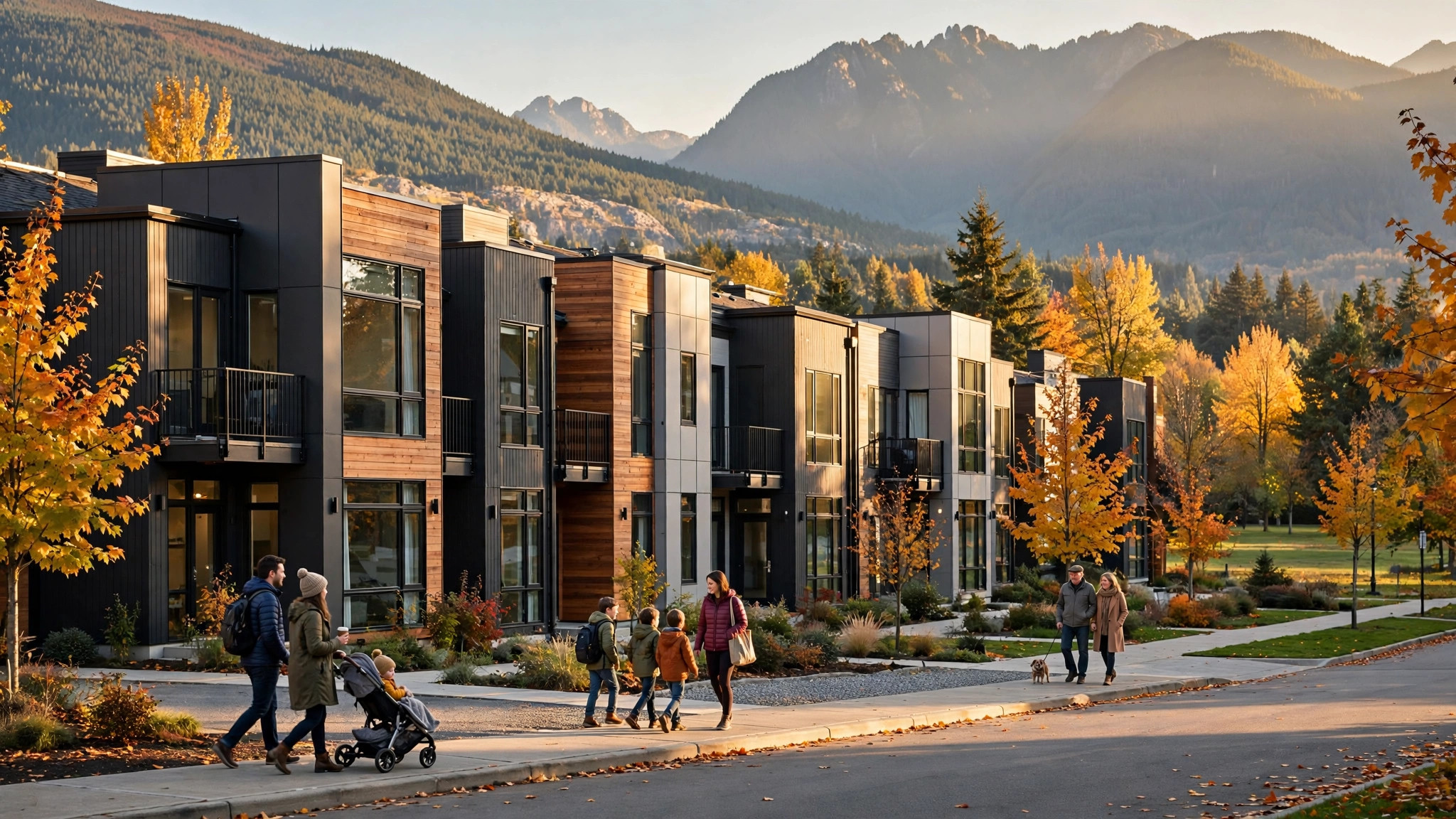
What leasehold actually means
With freehold — also called fee simple — you own the home and the land underneath it, indefinitely. With leasehold, you own the home and a registered right to occupy the land for the remaining term of a lease. Someone else owns the land: a city, a university, the province or federal government, a First Nation, or in some cases a private or institutional landlord.

Day to day, a leasehold home feels ordinary. You can live in it, renovate within the usual strata or municipal rules, sell it, mortgage it, rent it out if the lease and bylaws allow, and leave it to your heirs. Your interest is registered on title, just as a freehold interest is. The difference is the clock. Every year, the remaining term gets one year shorter, and what you are really buying and selling is those remaining years.
That single fact explains almost everything else in this guide: why leasehold homes are often cheaper, why lenders are more cautious, why two otherwise identical homes can have very different values, and why the lease document itself — not the listing — is where the real answers live. Buyers who compare leasehold only on price per square foot miss the point. Buyers who read the lease, count the years remaining, and understand what happens at renewal or expiry can sometimes find genuine value in exactly the neighbourhoods where freehold is out of reach.
Leasehold is not common across most of Canada, which is why it confuses people. It is concentrated in specific places where land was never meant to be sold: university endowment lands, city-owned redevelopment land from the 1970s, First Nations land, national park townsites such as Jasper and Banff, Crown land communities, and newer master-planned developments built on leased land in Alberta and elsewhere. If you are house-hunting in Vancouver, parts of Calgary, Jasper, or in Ontario land-lease communities, you will run into it. Everywhere else, you may never see it — until a listing that looks surprisingly affordable turns out to be leasehold.
Prepaid vs rent-paying: the most important distinction
Not all leaseholds cost the same to carry. The first question to ask about any leasehold home is whether the lease is prepaid or rent-paying.
In a prepaid lease, the developer paid the ground rent for the entire term up front, and that cost was built into the original purchase price. Owners after that pay no monthly ground rent to the landowner. Most modern 99-year leases work this way, including the familiar model on University of British Columbia land, where homes are sold on 99-year prepaid leases. A prepaid lease with 80 or 90 years remaining behaves, for most owners, very much like freehold during their time in the home.
In a rent-paying lease, you pay ground rent on an ongoing basis, often monthly, and that rent can be reviewed and reset on dates set out in the lease, using a formula the lease specifies — frequently tied to the market value of the land at the review date. That reset risk is the central financial risk in a rent-paying lease. A modest ground rent today can become a much larger one after a review if land values have risen sharply, and the history of some long-standing leasehold enclaves in Canada includes difficult, well-publicized rent resets. This is not a reason to avoid every rent-paying lease, but it is a reason never to buy one without knowing the review dates, the reset formula, and what the rent could plausibly become.
Between those two poles are variations: leases with fixed scheduled increases, leases tied to inflation, and older city leases approaching expiry where the question is no longer rent but renewal. The head lease — the master document between the landowner and the original developer or strata — controls all of it. Get it, read it, and have a lawyer who has actually done leasehold work explain it. A general summary from a listing is not a substitute.
Where you will find leasehold homes in Canada
In Metro Vancouver, leasehold clusters in a few well-known areas. On UBC campus neighbourhoods and the University Endowment Lands, homes sit on 99-year prepaid leases from the university. In False Creek South, a large waterfront neighbourhood built largely in the 1970s and 1980s, homes sit on City of Vancouver land. One widely cited count puts 1,849 homes in False Creek South on City land, with most leases ending between 2036 and 2046 — which is why that neighbourhood is now the centre of a live policy discussion about what happens as leases run down. In the West End and Champlain Heights, selected buildings also sit on leased land, with terms and landlords that vary building by building.
On First Nations land, leasehold is the structure that makes market housing possible on land that is not sold. Examples buyers encounter in British Columbia include long prepaid leases on Tsawwassen First Nation land, developments on Musqueam and other Nations' lands around Metro Vancouver, and in Alberta, new communities such as Taza on Tsuut'ina Nation land west of Calgary and Redwood Meadows. The legal framework differs by Nation and by whether the land is designated land, land under a land code, or treaty land, and lender requirements differ accordingly. The practical point for buyers is the same: the identity and stability of the landowner, the remaining term, and the rent structure matter more than the word leasehold itself.
In Alberta's mountain towns, leasehold is simply how the towns were built. Most residential property in Jasper is held under Parks Canada leasehold rather than fee simple, because the townsite sits inside Jasper National Park. Banff has a similar structure. Prices there reflect scarcity inside a finite townsite as much as tenure — leasehold does not automatically mean cheap when almost everything available is leasehold.
In Ontario, leasehold appears in a different form: land-lease communities, where you own a manufactured or modular home and lease the lot, and scattered leasehold condominiums in Toronto on institutional or hospital lands with very long terms. If you are comparing that kind of purchase with a conventional lot purchase, our guide to buying vacant land in Canada covers the servicing and zoning questions that still apply when you do own the dirt — and it is a useful contrast for understanding exactly what a land lease replaces.
The price discount: real, but not uniform
Leasehold homes are often priced below comparable freehold homes because the buyer is purchasing a time-limited interest rather than permanent land ownership. How large that discount is depends entirely on the lease.
Vancouver-focused leasehold guides in 2025 and 2026 commonly report leasehold condos selling about 15 to 30 percent below comparable freehold units. An Alberta legal guide aimed at buyers reports a narrower 10 to 20 percent range in that market, where many leaseholds are newer, prepaid, and long. Another British Columbia analysis reports discounts in the 20 to 40 percent range for some Indigenous-land leaseholds compared with similar freehold homes, reflecting financing friction and a smaller buyer pool as much as the tenure itself. Treat all of these as reported ranges from practitioner guides, not as a national statistic — Canada does not publish a single official leasehold discount, and any article that gives you one precise number for the whole country is inventing it.
The pattern behind the ranges is consistent. A new, prepaid, 99-year lease in a desirable master-planned community may trade close to freehold, because the buyer gives up very little during any realistic holding period. EstateBlock listing data cited in November 2026 put the median asking price for UBC-area condos at $1,099 per square foot, slightly above a Kitsilano condo figure of $1,024 and a city-wide median of $1,022 in the same snapshot — asking prices, not sale prices, but a reminder that long prepaid leasehold in a prime location does not automatically come cheap. Where the discount showed up in that same snapshot was in time on market: a median of 75 days for UBC-area listings, compared with 51 days across Vancouver and 43 in Kitsilano. Financing friction and buyer hesitation can show up as slower sales even when asking prices hold.
At the other end, a rent-paying lease with only a few decades remaining, a rent review coming, or no clear renewal path will trade at a deep discount — and should. As the remaining term shortens, the value of the leasehold interest tends to decline, a point the BC government itself makes plainly in its guidance: the relative value of a lease tends to fall as its termination date approaches. The discount is not a bargain by itself. It is the market pricing the years, the rent, and the uncertainty you are taking on.
To make the discount concrete: on a home that would sell for $800,000 freehold, a 15 percent discount is $680,000, a 20 percent discount is $640,000, and a 30 percent discount is $560,000. Whether any of those is a good buy depends on what you pay in ground rent over your holding period, what you can borrow, and what the home will be worth — with fewer years remaining — when you sell.
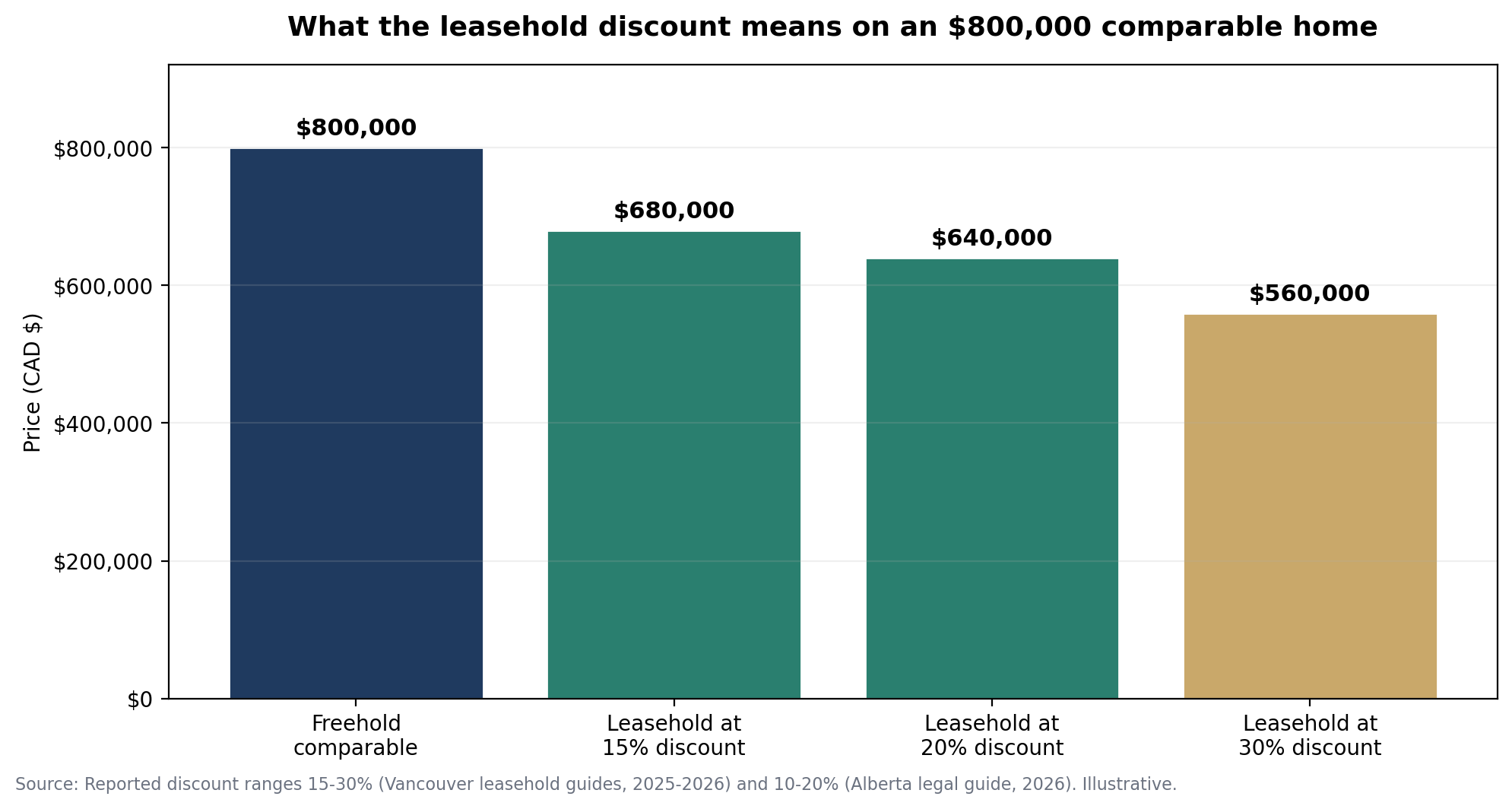
What the leasehold discount means on an $800,000 comparable home. Source: Reported discount ranges, Vancouver and Alberta guides, 2025-2026.
Ground rent: the carrying cost freehold does not have
Where a lease is not prepaid, ground rent is a real monthly cost on top of mortgage payments, strata or condo fees, property tax, heat, and insurance. Vancouver leasehold guides report typical ground rent ranges of about $200 to $600 per month in False Creek South, $200 to $500 per month around UBC and the University Endowment Lands, and $150 to $400 per month in selected West End buildings. Those are reported ranges for those areas in 2025–2026 guides, not quotes for a specific home — the actual figure is in the lease and on the strata's information certificate, and you should verify it there before you offer.
Ground rent matters twice. First, it is money out every month that builds no equity. Four hundred dollars a month is $4,800 a year, and $48,000 over a ten-year hold before any increase at a review. Second, lenders count it against you. In debt-service calculations, ground rent is treated as a recurring housing obligation in much the same way strata fees are, so it reduces the mortgage you qualify for. One Vancouver guide puts it vividly: $400 a month in ground rent has roughly the same effect on qualification as about $80,000 more mortgage. Even if you treat that equivalence as approximate, the direction is right — a cheaper purchase price paired with ground rent does not leave your monthly budget as far ahead as the listing price suggests.
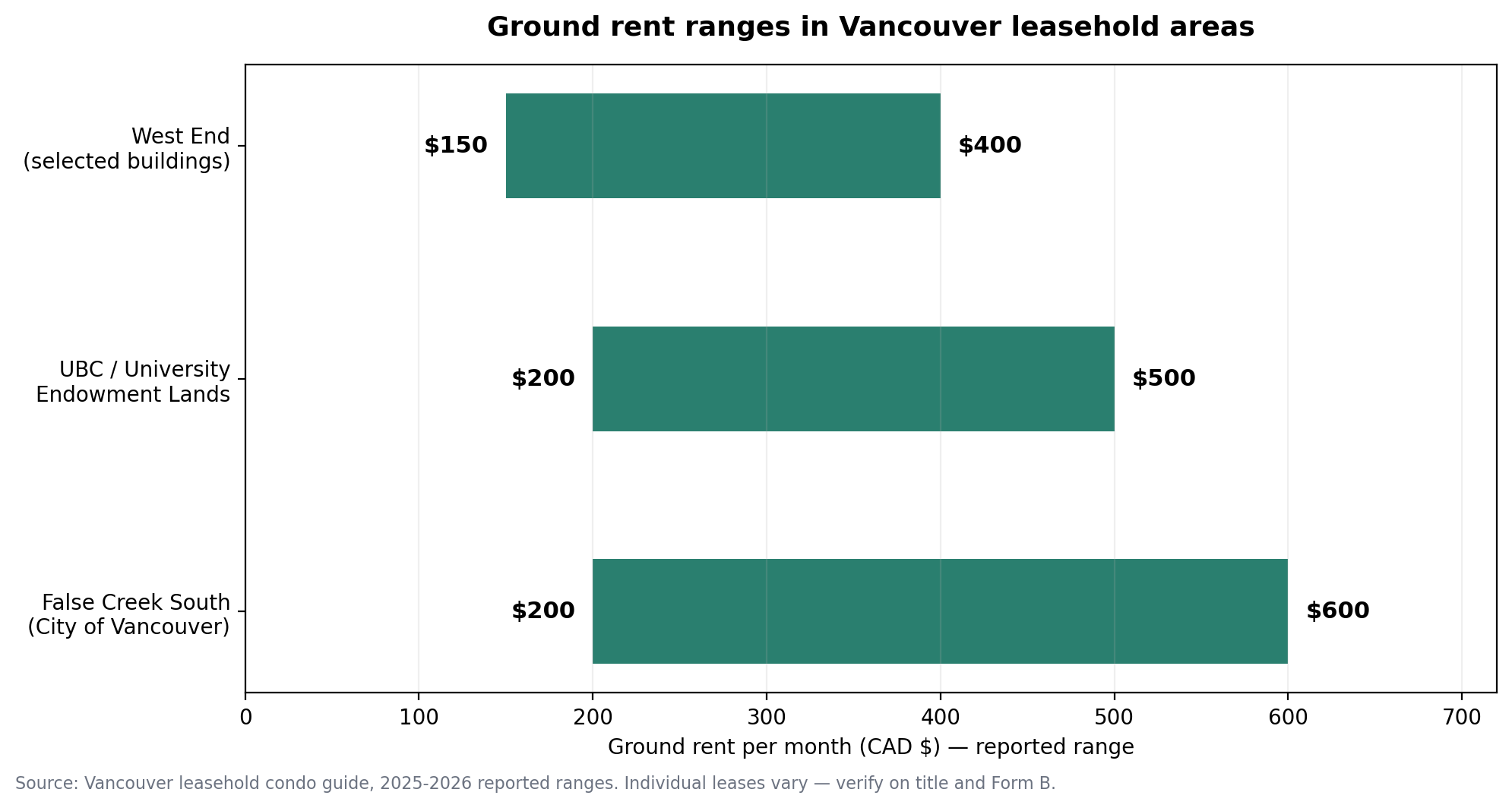
Ground rent ranges in Vancouver leasehold areas. Source: Vancouver leasehold condo guide, 2025-2026 reported ranges.
For prepaid leases, do the opposite check. Confirm in writing that the lease really is fully prepaid for the whole term, that there is no separate land rent, licence fee, or community fee doing the same job under a different name, and whether any amount becomes payable if the lease is extended or renewed. In newer master-planned leasehold communities, also look for community or amenities fees that a freehold buyer in a conventional subdivision would not pay in the same form.
Mortgages and insurance: tighter, and it varies by lease type
Most Canadian lenders will finance at least some leasehold homes, but on tighter terms than freehold, and the details vary more than buyers expect. Three rules of thumb appear again and again in lender and broker guidance.
First, the remaining lease term must outlast your mortgage. Standard mortgage instructions used across Canada ask that the remaining term exceed the amortization period by at least five years, and many lender guides use a buffer of five to ten years — so for a 25-year amortization, a lender may want 30 to 35 years or more remaining. As the remaining term falls toward that threshold, the pool of willing lenders shrinks, amortizations shorten, and eventually a home becomes effectively cash-only, which is one reason values can fall faster late in a lease.
Second, down payments are often larger. This is where blanket statements mislead. For many Vancouver leasehold condos on city or institutional land, practitioner guides report that mortgage default insurers do not insure the loans and that buyers should expect to need a large down payment — one widely used guide puts the figure at 35 percent for those condos. For Parks Canada leasehold in Jasper, broker guidance puts the minimum at 20 percent, on the basis that CMHC insurance is generally not available there. For housing on First Nations land, the picture is different again: CMHC operates a specific leasehold lending on-reserve program under which insured homeowner loans can reach high loan-to-value ratios where the lease and land framework meet CMHC's requirements, and some guides report insurers covering qualifying First Nations leasehold mortgages subject to strict criteria. The honest summary is not that leasehold always needs 35 percent down — it is that insured financing is unavailable for many common leasehold types, available under specific programs for others, and always lease-specific. Get a pre-approval from a lender or broker who has financed that exact leasehold community before, in writing, before you rely on any down-payment assumption. Our guide to down payment rules in Canada explains the freehold minimums this is being compared against, and the contrast is the point: leasehold starts where those insured minimums often stop.
Third, qualification still uses the federal stress test where it applies — qualifying at the higher of your contract rate plus two percentage points or the benchmark floor — and ground rent, strata fees, tax, and heat all sit inside the debt-service ratios that decide how much you can borrow. If you are also dealing with the boundary and title side of a property — what is actually registered, where the lot lines run, and what rights others hold over the land — our guide to easements, surveys and boundary disputes walks through the title checks that matter for freehold and leasehold alike.
CMHC's role deserves one more sentence, because it is the source of much confusion. CMHC does not have a single yes-or-no answer to leasehold. It has specific programs, including on-reserve leasehold lending, each with its own eligibility rules for the lease, the land framework, loan-to-value, and amortization. A statement that CMHC never insures leasehold is wrong. A statement that you can get a standard insured mortgage on any leasehold condo is also wrong. The program, the land, and the lease decide.
Taxes and legal quirks buyers miss
In British Columbia, property transfer tax treatment turns on the length of the lease you are registering. A lease that gives you the right to occupy for more than 30 years is a taxable transaction, so you pay property transfer tax on a long leasehold purchase much as you would on freehold. Once 30 years or less remain at registration, counting extensions and renewal options, the transfer is exempt. That threshold creates an odd late-lease dynamic: the tax saving arrives at roughly the same stage of a lease's life when financing is getting hardest.
Also in BC, the three-business-day home buyer rescission period does not apply to a leasehold interest in residential property or to residential property on leased land. Buyers used to counting on that cooling-off window should know it is not there for these purchases — your subjects and conditions in the contract are your protection, so use them properly, including a financing condition long enough for a leasehold lender to actually review the lease. Fourteen to twenty-one days for financing is a figure some First Nations leasehold guides suggest, and the principle — do not use a freehold timeline for a leasehold file — applies broadly.
Property tax itself is usually not the saving people expect. In most arrangements the leasehold owner pays tax on the home, and the land tax is either borne by the landowner and reflected in rent, or passed through under the lease. Either way, budget for tax as a normal carrying cost and confirm who pays what under the specific lease rather than assuming leasehold means lower tax.
Title insurance can be especially relevant on older leasehold and boundary-sensitive purchases, because it addresses certain title and survey risks that a fresh survey or legal opinion might otherwise be needed for. Our guide to title insurance in Canada explains what it does and does not cover — read it alongside the lease, not instead of it.
What happens when the lease ends
This is the question every leasehold buyer should ask on day one, and the answer is always in the lease. The main possibilities are renewal or extension on terms set out in the document or negotiated later, purchase of the land or conversion to another tenure if the landowner offers it, compensation for the building or improvements under a formula in the lease, or surrender — the home and land revert to the landowner at the end of the term, in some leases with an obligation to remove structures or leave them, depending on the surrender clause.
False Creek South shows why this cannot be left vague. With most of its City leases ending between 2036 and 2046, owners there hold homes whose remaining terms are now short enough to affect financing and resale today, while the renewal framework is a matter of public policy and negotiation rather than a private certainty each owner already holds. That does not make those homes unbuyable — many are well-located and have traded for years with the end dates known — but it means price must reflect a shortening, uncertain tail, and buyers need current information on the City's position, not a decade-old assumption.
Contrast that with a new 99-year prepaid lease. No owner buying today will personally face its expiry, and neither will their children in any practical financing sense. The end-of-lease clause still matters for long-run value, but the risk is remote and heavily discounted. The mistake is treating these two situations as the same product because both are called leasehold. They are not. Years remaining is the product.
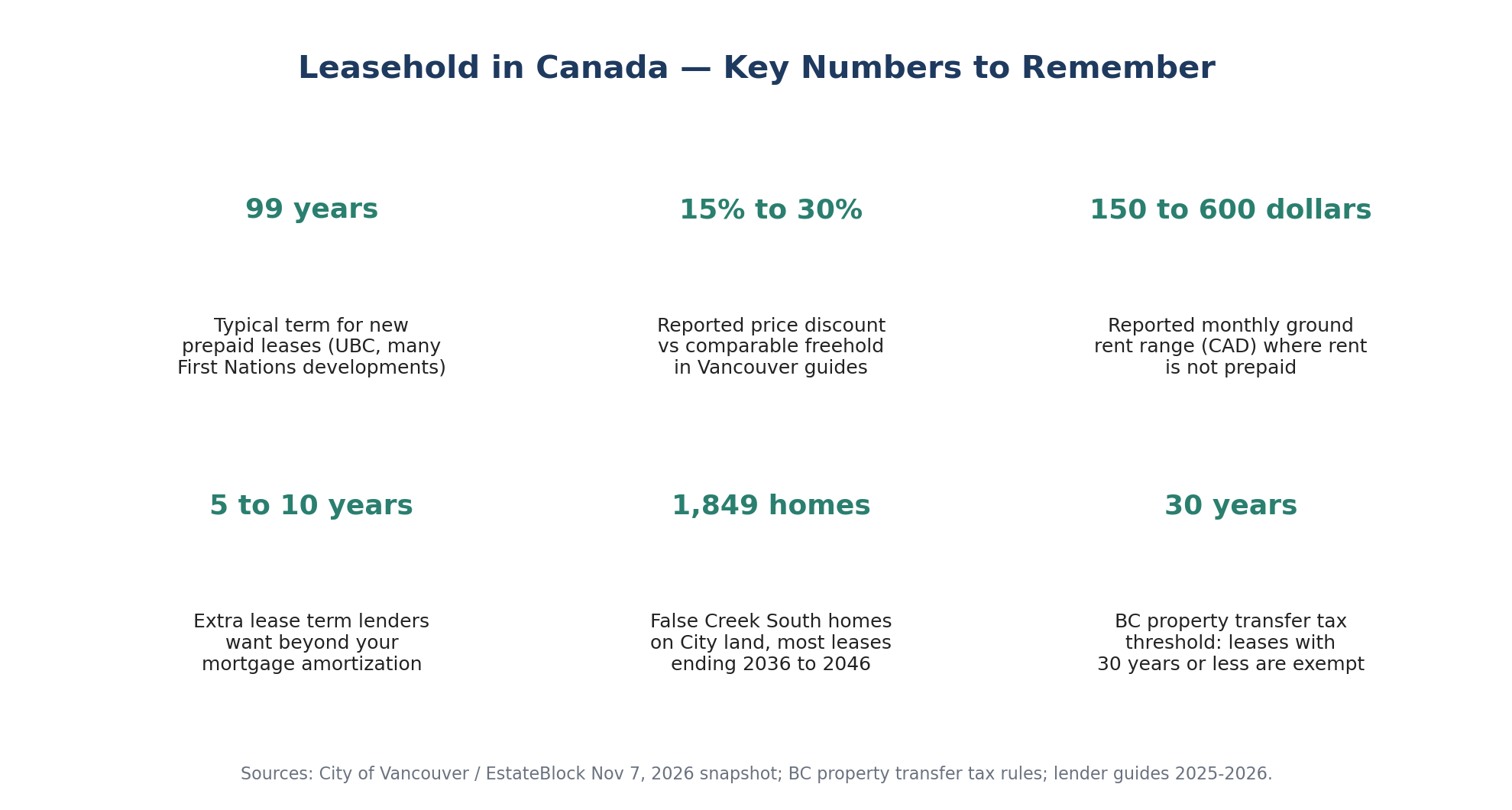
Leasehold in Canada — Key Numbers to Remember. Sources: City of Vancouver / EstateBlock Nov 7, 2026; BC property transfer tax rules; lender guides 2025-2026.
A due-diligence checklist that actually protects you
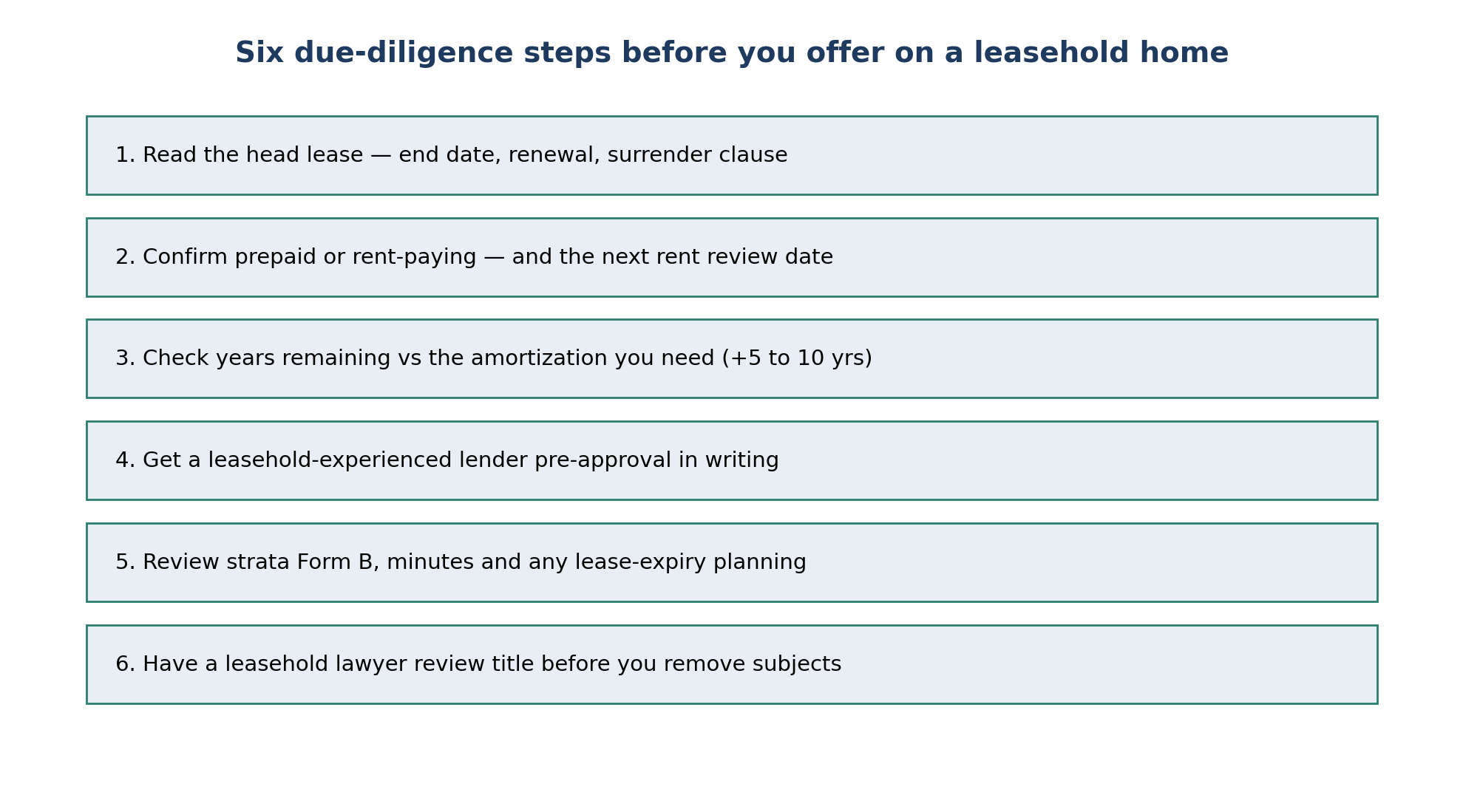
Start with the lease, not the listing. Obtain the head lease and any sublease or strata leasehold documents, the title search, and, for a strata, the Form B Information Certificate and recent minutes. Confirm the exact expiry date, whether the term includes any renewal or extension already granted, and whether further renewal is a right, an option, or merely a hope.
Confirm the money. Is the lease prepaid in full, or is ground rent payable? If rent is payable, how much is it now, when is the next review, what formula sets the new rent, and is there any cap? Are there separate community, amenities, or land-related fees? Who pays property tax on the land and on the home?
Count the years against your financing. Take the years remaining, subtract the amortization you want, and check the buffer your lender requires — at least five years under standard instructions, often five to ten in lender guidance. If the math is tight, get the lender's answer on that specific property before you write, not after.
Use leasehold-experienced help. A mortgage broker or lender who has closed in that community, a real estate lawyer who reads these leases regularly, and, for a strata, careful attention to whether the strata is planning for lease expiry, renewal costs, or major building work that owners will be asked to fund late in a lease. If the building also needs major capital work, the reserve fund and special assessment picture matters just as much as it does for freehold condos — the analysis in our guide to condo reserve funds and status certificates applies here with the lease layered on top.
Finally, price your exit, not just your entry. Ask who will buy this home from you in seven or ten years, with that many fewer years on the lease, and which lenders will finance them. If the honest answer is a much smaller pool, the discount you demand today should be larger.
When leasehold makes sense — and when it does not
Leasehold tends to make sense when the lease is long and prepaid, the landowner is stable and identifiable — a university, a municipality, a First Nation with a clear land framework, or Parks Canada — the price genuinely reflects the tenure, you have the down payment and lender the purchase requires, and your holding period sits comfortably inside the remaining term. For buyers shut out of a freehold neighbourhood they love — near a university, on the waterfront in False Creek, in a new master-planned community on leased land, or in a park town where leasehold is the norm — it can be a rational way to buy the home and location, while knowingly not buying the land.
It tends not to make sense when the remaining term is short relative to your mortgage needs, when a rent review is coming with no cap and no clear formula you can model, when renewal at expiry is pure speculation, when you are stretching to a small down payment that leasehold financing will not allow, or when the supposed discount disappears once ground rent, fees, and a weaker resale are counted. It is also a poor fit for buyers who need maximum flexibility to sell quickly to the widest possible pool — leasehold homes can take longer to sell, as the November 2026 UBC-area days-on-market figures illustrate.
None of this makes leasehold a trick or a trap. It makes it a different bundle of rights with a price that should reflect those rights. Canadians buy leasehold homes every week and live in them happily for decades. The buyers who regret it are usually the ones who discovered the lease terms after they fell in love with the kitchen. Read the lease first, count the years, price the rent and the exit, and let the discount — if it is really there — be the reward for doing the work, not the reason you skipped it.
Sources
- Vancouver leasehold condo guides, 2025–2026: reported 15–30% price discount range, ground rent ranges by area ($150–$600 per month), down payment and remaining-term guidance for Vancouver leasehold condos.
- Integrity Legal Solutions, Alberta leasehold buyer guide, 2026: 10–20% reported discount range in Alberta, 99-year prepaid lease structure, Taza and University District examples.
- EstateBlock listing snapshot via Dan Marusin, November 7, 2026: UBC-area condo median asking $1,099 per square foot, median 75 days on market vs 51 city-wide; False Creek South 1,849 homes on City land, most leases ending 2036–2046; UBC 99-year leases.
- Government of British Columbia, strata leasehold and property transfer tax guidance: value tends to decline as termination approaches; property transfer tax applies to leases over 30 years and is exempt at 30 years or less remaining; home buyer rescission period exemption for leasehold interests.
- CMHC, Leasehold Lending On-Reserve fact sheet: program eligibility for homeowner and small rental loans on leased lands on-reserve, including loan-to-value and land-framework requirements.
- Parks Canada leasehold broker guidance for Jasper, 2026: 20% minimum down payment reported for Jasper leasehold, remaining term must exceed amortization by 5–10 years, CMHC insurance generally not available in that context.



Comments
No comments yet. Be the first to share your thoughts.