
Why older homes deserve a second look
Canada's older housing stock is some of its most desirable: solid construction, mature streets, larger lots, and locations that new subdivisions cannot replicate. But every era of building left its own materials behind the walls, in the attic, under the floors, and sometimes buried in the yard. Most of those materials are harmless while they sit undisturbed. The problems start when nobody knows they are there — and a renovation, a furnace replacement, or a simple child's bedroom repaint disturbs them, or a buried tank quietly leaks for years.
This guide walks through the five hazards that come up again and again in Canadian transactions: radon gas, asbestos (including vermiculite insulation), lead in paint and water pipes, urea formaldehyde foam insulation (UFFI), and buried or aging heating-oil tanks. For each one you will find what it is, which homes are most likely to have it, the verified numbers behind the risk, what testing involves, and what fixing it typically involves. None of this is a reason to walk away from an older home automatically. It is a reason to test before you buy, budget honestly, and put what you learn in writing — the same discipline that applies to any careful purchase, as our guide to home inspections in Canada explains in detail.
A note on sources and certainty: the figures below come from Health Canada, the 2024 Cross-Canada Survey of Radon, and published Canadian contractor and regulator guidance, and each is attributed where it appears. Where costs are given, they are planning ranges drawn from published Canadian sources, not quotations — your home, your soil, and your province will move the real number.
Radon: the hazard you cannot see, smell, or negotiate away
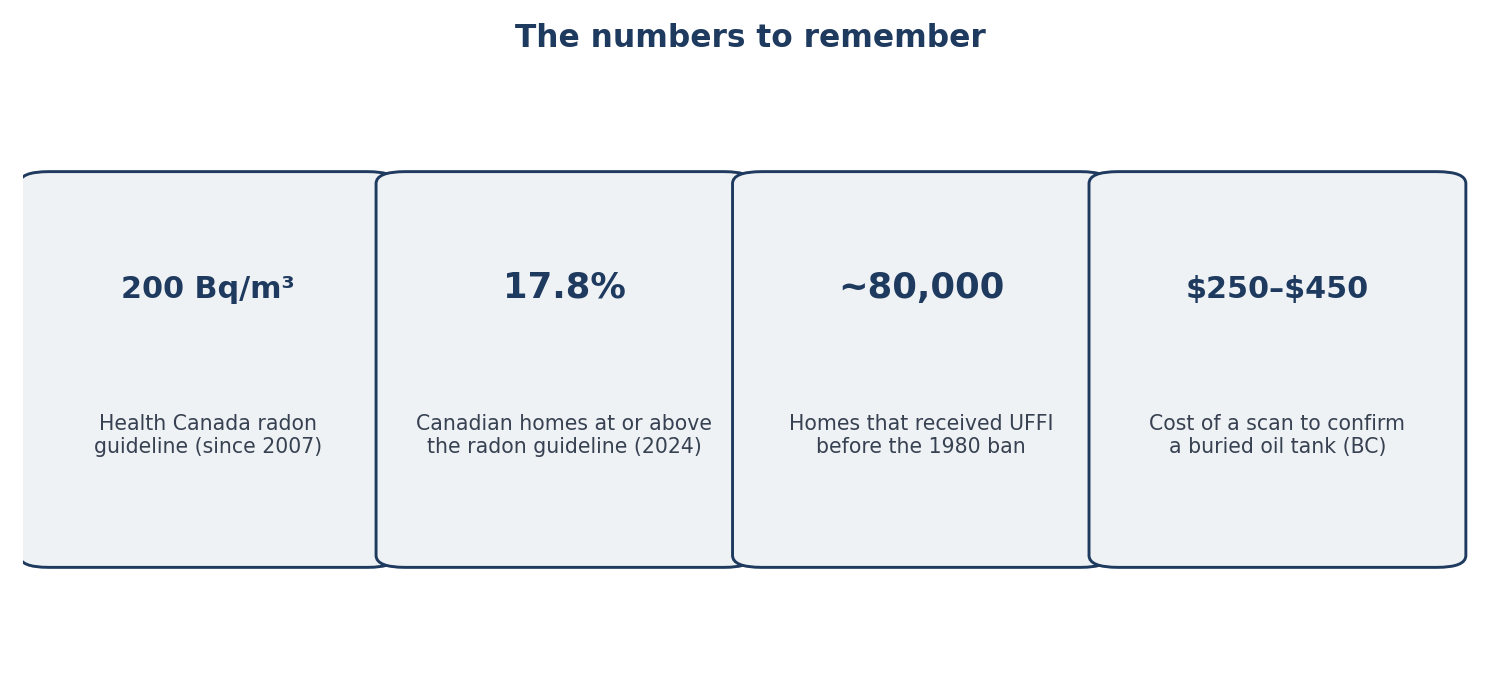
Radon is a radioactive gas produced by the natural breakdown of uranium in soil and rock. It seeps into homes through foundation cracks, construction joints, gaps around pipes, sump pits, and drains, and it accumulates in the lowest lived-in levels of a house. Health Canada's guideline for radon in indoor air is 200 becquerels per cubic metre (200 Bq/m³) — a level the federal government lowered from 800 Bq/m³ in June 2007 as the evidence on long-term exposure strengthened. Health Canada notes that non-smokers exposed to radon at 200 Bq/m³ face roughly a 2% lifetime chance of developing lung cancer, and that no level of exposure is considered completely free of risk; the guideline is an action threshold, not a safety boundary.
The most important recent development is how common elevated radon turns out to be. The 2024 Cross-Canada Survey of Radon — produced by the Evict Radon National Study team with Health Canada, CAREX Canada, and the BC Centre for Disease Control, from 69,478 long-term tests — found that approximately 1 in 5 Canadian houses (17.8%) have radon levels at or above the 200 Bq/m³ guideline. That is more than double the 6.9% found by Health Canada's earlier national survey published in 2012. The 2024 survey estimates that about 10.3 million Canadians live in homes at or above the guideline.
The regional picture matters for buyers, because radon is geology-driven:
- Atlantic Canada: 33.3% of houses at or above the guideline
- Pacific interior and the Yukon: 31.6%
- Prairies and the Northwest Territories: 20.0%
- Central Canada (Ontario and Quebec): 16.4%
- Pacific coast: 1.3%
Within those regions the variation is just as sharp — the 2024 survey puts Nova Scotia at 36.8% and Ontario at 12.4% — which is exactly why Health Canada warns that survey results should not be used to decide whether a specific home needs testing. A low-risk region still contains high-radon houses, and the only way to know a home's level is to test that home.
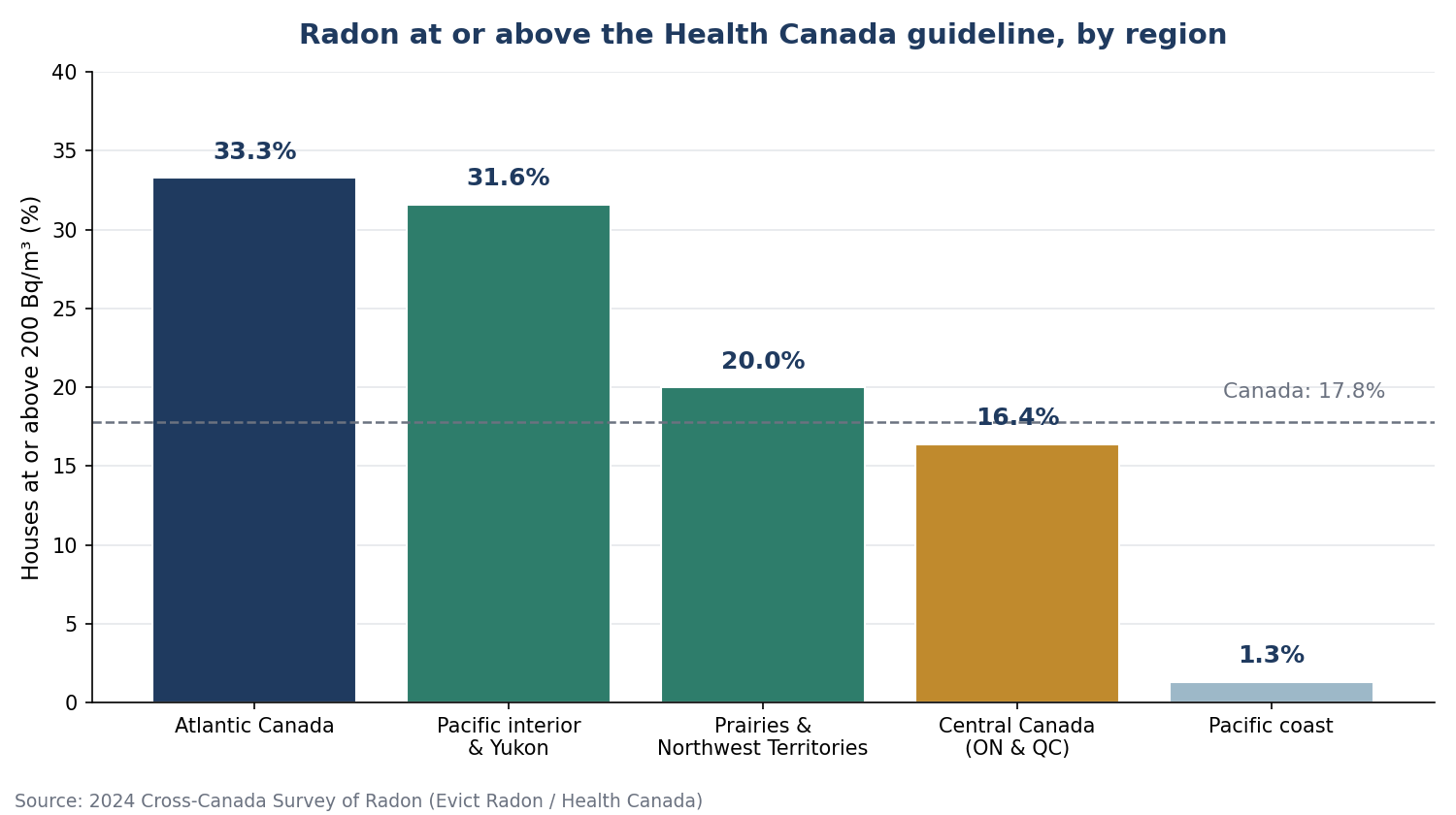
Radon at or above the Health Canada guideline, by region. Source: 2024 Cross-Canada Survey of Radon (Evict Radon / Health Canada).
Testing and fixing. A proper radon test is a long-term test: Health Canada's survey methodology uses tests of three months or longer, because radon levels swing with season, weather, and how a house is being used. Short weekend tests can mislead in either direction. If a long-term test comes back at or above 200 Bq/m³, Health Canada recommends mitigation, most commonly a sub-slab depressurization system installed by a certified professional, which vents soil gas from beneath the foundation to outside. For buyers, the practical moves are simple: ask whether the home has ever been tested and get the result in writing, budget for a long-term test kit early in your ownership if it has not, and treat a known high result as a fixable, priceable item — not a mystery. If you are buying in a rural area, radon testing belongs on the same checklist as the septic and well checks described in our guide to buying a rural property in Canada.
Asbestos and vermiculite: dangerous when disturbed, manageable when left alone
Before 1990, asbestos was widely used in Canadian homes for insulation, fireproofing, and soundproofing, according to Health Canada. It can turn up in house siding, cement and plaster, floor and ceiling tiles, textured coatings, roofing products, drywall joint compound, putty and caulking, and insulation around pipes, furnaces, and hot water tanks. Canada prohibited the manufacture, import, sale, and use of asbestos and asbestos products under regulations that came into force at the end of 2018 — but that ban governs new products. It does not remove what is already inside millions of older homes, and nothing requires a homeowner to remove asbestos that is already in place.
Health Canada's position is the one every buyer should internalize: there are no significant health risks from asbestos materials in a home when they are left undisturbed, isolated in an attic, sealed behind walls and floorboards, or tightly bound in products that are in good condition. The danger is inhaling fibres released when materials are cut, drilled, sanded, or torn out. That is why asbestos is primarily a renovation problem: the risk moment is demolition day, not moving day.
Vermiculite deserves its own paragraph. This pebble-like, silver-gold or grey-brown loose-fill insulation was poured into attics and wall cavities for decades. Health Canada advises that vermiculite ore produced from the Libby Mine in Montana from the 1920s to 1990 — sold mostly under the brand name Zonolite — may contain asbestos, and that it is prudent to assume pre-1990 vermiculite may contain some. Health Canada's advice for homes with vermiculite is specific: do not use the attic for storage, keep children out of it, do not disturb it or try to remove it yourself, seal gaps around the attic hatch, light fixtures, and baseboards, and hire professionals trained to handle asbestos if renovation work will touch it.
What buyers should do. You cannot identify asbestos by looking at a material — only laboratory testing of a sample confirms it. Before buying a pre-1990 home you plan to renovate, ask what the seller knows, look for vermiculite in the attic during your inspection (without disturbing it), and budget for a designated-substance survey before demolition. If a renovation is part of your plan, factor testing and possible abatement into the same budget conversation as the upgrades themselves — our analysis of renovation ROI in Canada shows how quickly unplanned costs erode the payback on a project.
Lead: paint in pre-1960 homes, and pipes in even older ones
Lead shows up in older Canadian homes in two places: paint and plumbing. Health Canada's guidance, reflected in Canadian inspection practice, is that a home built before 1960 probably contains lead-based paint, inside and out. Homes built between 1960 and 1990 may have lead in exterior paint and smaller amounts in interior paint. Intact lead paint sealed under newer coats is a different situation from peeling, chipping, or friction-worn paint on windows and doors — and a very different situation from dry-sanding or heat-stripping it during a renovation, which is how lead dust gets created. Families with young children should treat deteriorating paint in a pre-1960 home as a prompt for professional advice, not a DIY weekend project.
On the plumbing side, homes built before the mid-1950s may have a lead water service pipe — the underground line connecting the house to the municipal main. A house can have modern copper plumbing inside and still be fed by a lead service line outside, which is why this is a question to ask the seller and, where the municipality offers it, to check against city records or replacement programs. Several Canadian cities run lead service line replacement programs, sometimes with cost-sharing; what applies to a specific address is a municipal question worth asking before closing, alongside the other closing-day items in our complete guide to closing costs in Canada.
UFFI: the 1970s foam that still shapes transactions
Urea formaldehyde foam insulation — UFFI — was pumped into wall cavities as a retrofit insulation, widely during the 1970s. The concern, as Health Canada describes it, is that the resin can release formaldehyde gas during and after curing, and that moist foam can support mould growth. UFFI has been prohibited from advertising, sale, and importation in Canada since December 1980 under the Hazardous Products Act. The National Research Council estimated that UFFI had been installed in roughly 80,000 Canadian homes before the ban.
Four decades later, UFFI's practical significance is mostly transactional rather than day-to-day: it remains a standard disclosure question on seller forms, some insurers ask about it, and standard Ontario purchase paperwork has long included UFFI warranties. If a seller knows a home has UFFI, that is a material fact to disclose; if you are buying a 1970s home, ask the question directly, have your inspector look for the tell-tale patched holes in exterior walls, and confirm with your insurer in writing during the condition period whether it affects coverage on that address. Surprises after closing are the enemy — on UFFI as on everything else in this guide.
Buried and aging oil tanks: the hazard with the widest cost range
Homes that heat — or once heated — with oil carry a different kind of risk, and it is the one with the most extreme cost spread in this entire guide. An above-ground tank that needs removal or replacement is a manageable, budgetable job. A buried tank that has been leaking into soil and groundwater for years is an environmental remediation, and liability generally follows the property: buyers can inherit cleanup responsibility for contamination they did not cause.
Published British Columbia figures illustrate the ladder of costs. A geophysical scan to confirm whether a buried tank exists typically runs $250 to $450. Removing a buried tank when no leak is found typically runs $3,500 to $8,500, including excavation and reporting. Light remediation — removing up to about 10 cubic metres of impacted soil — can add $8,000 to $22,000. Significant contamination, with a larger plume or groundwater work, can add $30,000 to $100,000 or more. Sources in other provinces tell the same story at similar scale: underground removal in New Brunswick is quoted at $5,000 to $15,000 or more, with remediation at $10,000 to $100,000 or more, and Ontario guidance puts clean underground removals at $2,000 to $5,000 with remediation reaching $10,000 to $30,000 or beyond. The exact numbers vary by province and site, but the shape of the risk does not: the scan costs hundreds, the clean removal costs thousands, and the leak costs tens of thousands.
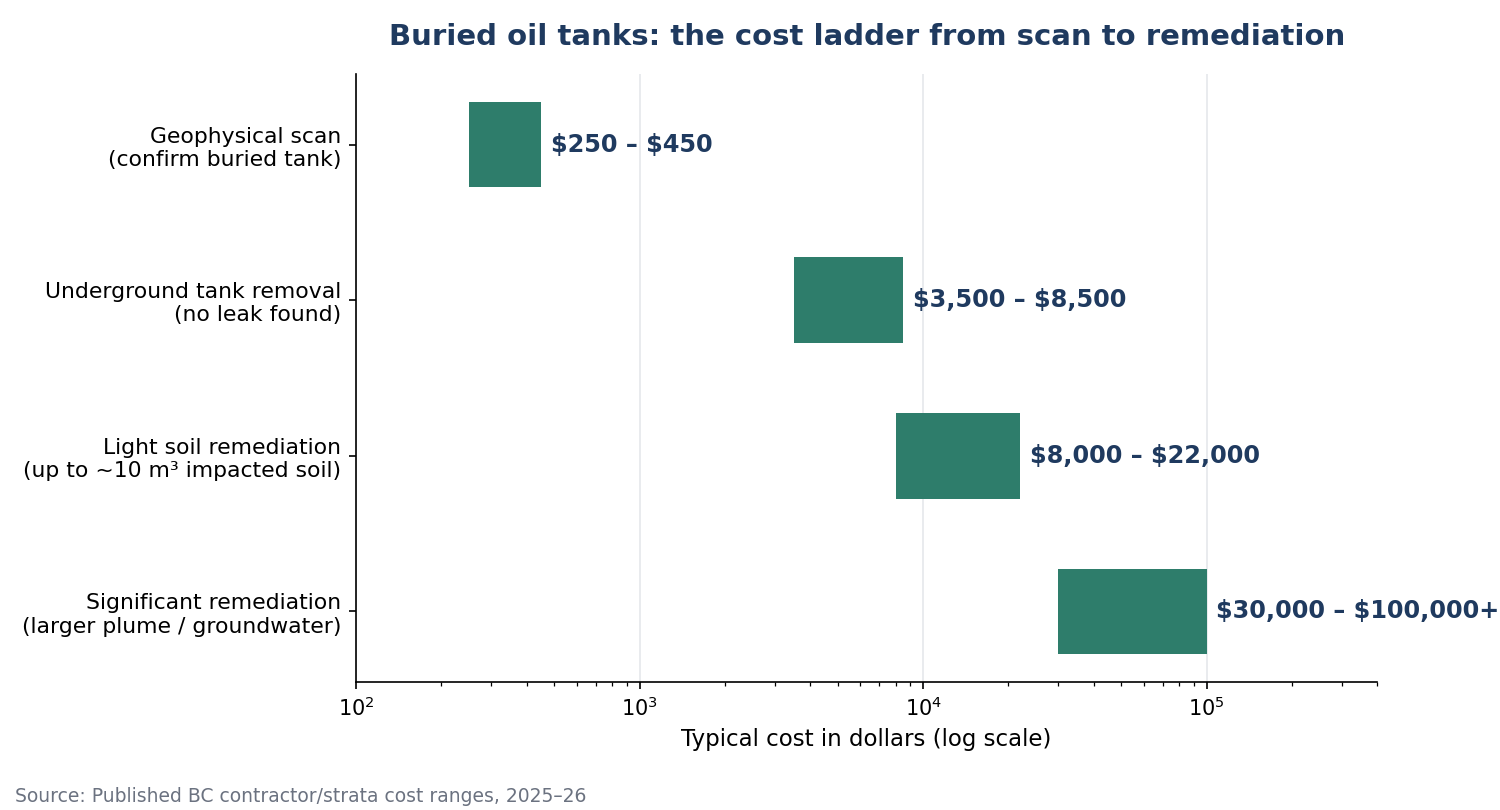
Buried oil tanks: the cost ladder from scan to remediation. Source: Published BC contractor/strata cost ranges, 2025–26.
That asymmetry is why the due diligence is so cheap relative to the risk. If a home has ever heated with oil — look for a fill pipe, a vent pipe, an old furnace, or a seller who cannot quite say when the tank came out — spend the few hundred dollars on a scan before you firm up, and ask for removal paperwork and soil-test reports where a tank was previously removed. In Ontario, only a TSSA-registered petroleum contractor may remove a buried fuel oil tank, and an unused underground tank must be removed unless the TSSA approves leaving it in place, with an environmental assessment required. Insurers also care: oil-heated homes face extra questions at renewal, which connects this topic to the broader picture in our guide to home insurance and climate risk in Canada.
Putting it together: a testing checklist by decade
The year a home was built is the single best predictor of which hazards deserve a test:
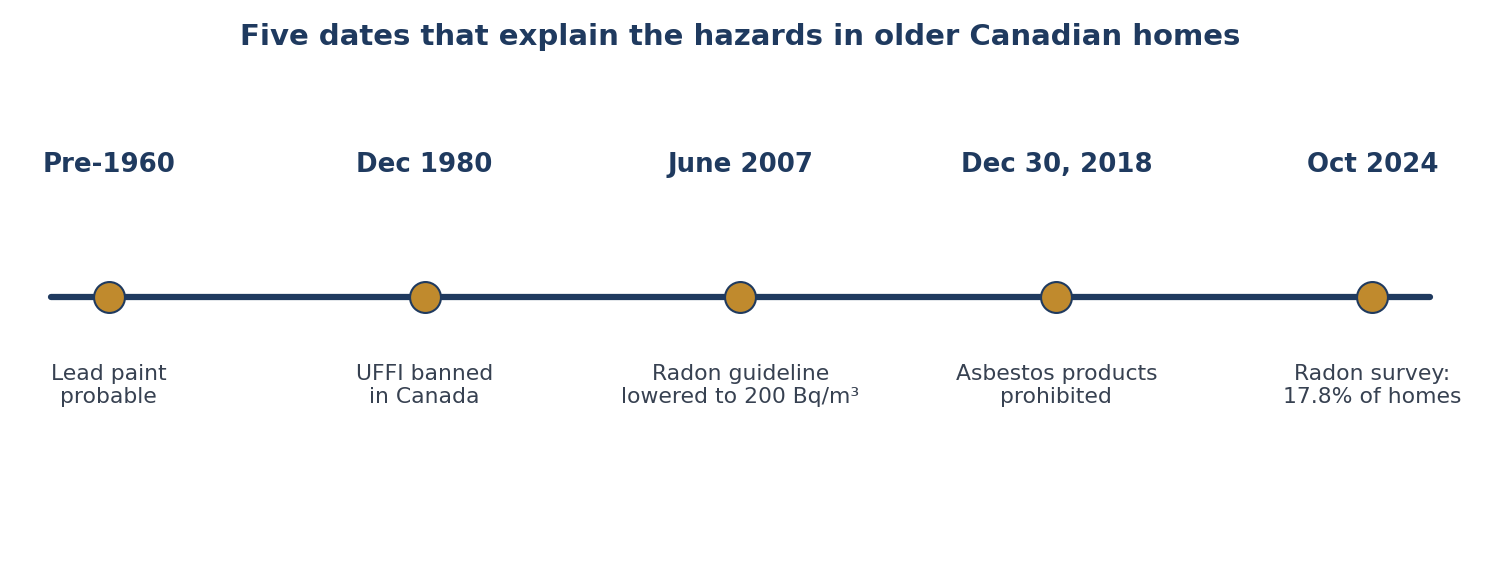
Five dates that explain the hazards in older Canadian homes.
- Built before 1950: lead paint is likely; check for a lead water service line; knob-and-tube wiring and buried oil tanks are also common finds of the era.
- 1950s–1960s: lead paint remains likely on pre-1960 surfaces; asbestos appears in flooring, ceilings, and pipe wrap; check the heating history for oil tanks.
- 1970s: the full house — asbestos in flooring, textured ceilings, and joint compound; vermiculite in attics; UFFI in retrofitted walls; aluminum wiring as an insurance question.
- 1980s–1990: asbestos declines but does not vanish until products were phased out (the full prohibition only arrived in 2018); vermiculite installed before 1990 should be treated as suspect; lead is possible in exterior paint.
- Any age, any decade: test for radon. It is the one hazard on this list that has nothing to do with when the home was built.
Disclosure, conditions, and your offer
Most of these hazards share a legal thread: a defect a buyer cannot discover through ordinary visual inspection, which the seller knows about, is exactly the kind of material latent defect Canadian disclosure practice is built around. Sellers in BC and Alberta complete a Property Disclosure Statement; Ontario sellers commonly complete a Seller Property Information Statement, and known asbestos, UFFI, and oil-tank issues are standard disclosure territory everywhere. As a buyer, your protections are boring and effective: ask specific questions in writing, keep your inspection condition, add testing conditions where the home's age and heating history warrant them, confirm insurability in writing during the condition period, and get any seller representations about tanks, UFFI, and prior testing into the paperwork rather than the driveway conversation.
None of these hazards needs to kill a good purchase. Radon can be mitigated, asbestos can be managed or professionally removed, lead lines can be replaced, UFFI can be disclosed and priced, and even an oil tank is a known, quotable job when the soil is clean. What turns a manageable item into a financial disaster is discovering it after closing, with no condition, no paperwork, and no budget. Test first, price what you find, and let the charm of the older home be the reason you bought it — not the reason you skipped the questions.
Sources: Health Canada, radon guideline and Cross-Canada Survey of Radon Concentrations in Homes (2024 survey by the Evict Radon National Study with Health Canada, CAREX Canada, and the BC Centre for Disease Control; 2012 survey); Health Canada, "Asbestos and your health" and vermiculite insulation advisory; Prohibition of Asbestos and Products Containing Asbestos Regulations (in force December 30, 2018); Health Canada UFFI notice (prohibited December 1980, Hazardous Products Act); National Research Council estimate of UFFI installations; Ontario Technical Standards and Safety Authority (TSSA) guidance on buried fuel oil tanks; published BC, Ontario, and New Brunswick oil-tank removal and remediation cost ranges (2025–2026). Cost figures are planning ranges, not quotations. This article is general information, not medical, legal, or environmental advice — consult certified professionals for testing and remediation.




Comments
No comments yet. Be the first to share your thoughts.