
Introduction
A century house with original wood sash windows, a wraparound porch and plaster mouldings can be the most characterful purchase on a street — and the most rule-bound. Heritage protection in Canada is mostly municipal and provincial, not federal, and the single most important fact for a buyer is this: designation travels with the land, not the owner. The obligations you accept at closing follow the property for as long as the designation stands. That does not mean a designated house is frozen in time. It means named features — the heritage attributes written into a by-law — sit behind a consent step, and a buyer who reads that by-law before writing an offer will have a very different experience from one who discovers it after planning a teardown or a vinyl-window swap.
This guide uses Ontario as the detailed example because the Ontario Heritage Act is the framework most Canadian buyers will meet in the country's largest housing market, then places it beside British Columbia practice and the national programs. Every figure below is traceable to a named source: the Ontario Heritage Act itself, the City of Toronto, Parks Canada, and published municipal program pages, all checked in November 2026.
Three words that mean three different things: listed, designated, and district
Buyers, agents and even listing descriptions use "heritage" loosely. Legally, in Ontario there are three distinct states, and confusing them is expensive.
Listed (on the municipal register, not designated). Under section 27 of the Ontario Heritage Act, a municipality keeps a register of properties it considers to be of cultural heritage value or interest. Listing alone does not require permission to alter a property. Its one hard consequence is demolition timing: an owner may not demolish or remove a building on a listed property unless they give council at least 60 days' written notice. That window lets council decide whether to move toward designation instead.
There is also a deadline hanging over every listed property in Ontario. Section 27(16) requires council to remove a property that was on the register as of December 31, 2022 if council has not given a notice of intention to designate it on or before January 1, 2027. Where a property is removed that way, section 27(18) stops council from putting it back on the register for five years. For a buyer in late 2026, that means a merely listed house may quietly lose even its 60-day demolition-notice status in the new year — or may be designated in a rush before the deadline. Ask which way your municipality is heading.
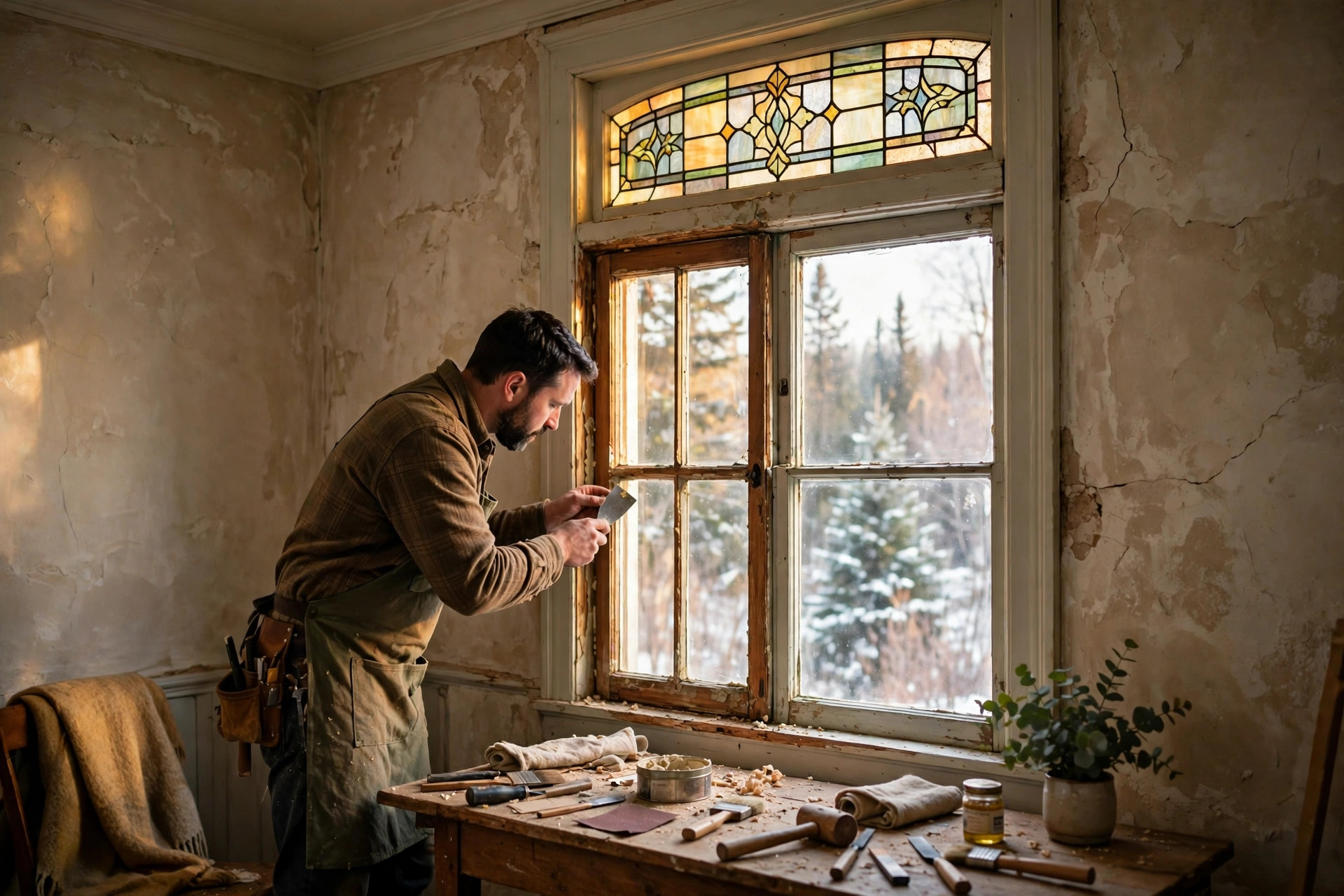
Designated — Part IV (individual property). Under section 29, council can designate a single property by by-law where it meets the prescribed criteria. The by-law must carry a statement of the property's cultural heritage value and a description of its heritage attributes. Those named attributes — perhaps the brick facade, the roofline, a stained-glass transom, a stone foundation — are what the rest of the Act protects. Two designated houses on the same street can carry quite different restrictions because their by-laws describe different things.
Designated — Part V (heritage conservation district). Under section 41, a whole area can be designated and governed by a district plan. In a district, the plan — not an individual by-law — defines what is protected, and a house described as "contributing" is treated differently from a non-contributing one. Toronto publishes a Heritage Register Map and a Heritage Register Tool so owners can check whether a property is designated individually under Part IV, sits inside a Part V district, or is only listed. Do that check yourself; do not rely on a listing summary.
British Columbia works in a recognizably similar way at the municipal level: a property can be on a community heritage register, formally designated by bylaw, or bound by a covenant or a Heritage Revitalization Agreement, and only the formal tools are legally binding in the same way. The vocabulary differs by province; the buyer's job is identical — find the exact legal status, then read the exact document that creates it.
If your purchase also involves land questions — a shared driveway, a right-of-way, a fence on the wrong side of a line — work through easements, surveys and boundary disputes in Canada before closing, because heritage lots are often old lots, and old lots carry old paper.
What designation actually stops you doing — and what it does not
Designation does not prohibit alterations, does not require an owner to restore a building to its original condition, and does not require opening the home to the public. Municipal guidance in Ontario is explicit on all three points. What it does is put a consent step in front of two kinds of work.
First, alterations that affect a heritage attribute. Section 33(1) provides that no owner of a designated property shall alter it — or permit its alteration — where the alteration is likely to affect the heritage attributes set out in the designating by-law, unless the owner applies to council and receives consent in writing. Work that does not touch a named attribute sits outside that provision. Interior renovations are usually unrestricted unless the by-law explicitly covers interior features. Routine maintenance and like-for-like repair — replacing rotted wood with matching wood — is normally the least contentious category of all.
Second, demolition, which is treated more widely than most buyers expect. Section 34 requires consent to demolish or remove any of the attributes described in the by-law, and separately to demolish or remove a building or structure on the property whether or not the demolition would affect the heritage attributes. A rear garage or an old shed is therefore not automatically yours to remove.
The process, as Ontario municipalities such as Oshawa describe it, is consistent: talk to planning or heritage staff first (strongly recommended before you apply), apply for a heritage permit — Oshawa charges no fee for the application — have staff review whether the heritage attributes are affected and consult the municipal heritage committee, and receive a council decision that can approve, approve with conditions, or refuse. Council has 90 days to answer an alteration application; an owner who disagrees with a decision may appeal to the Ontario Land Tribunal within 30 days. If council does not serve notice of its decision within the time the Act allows, it is deemed to have consented. Those clocks matter to a renovation schedule, which is why they are charted below.
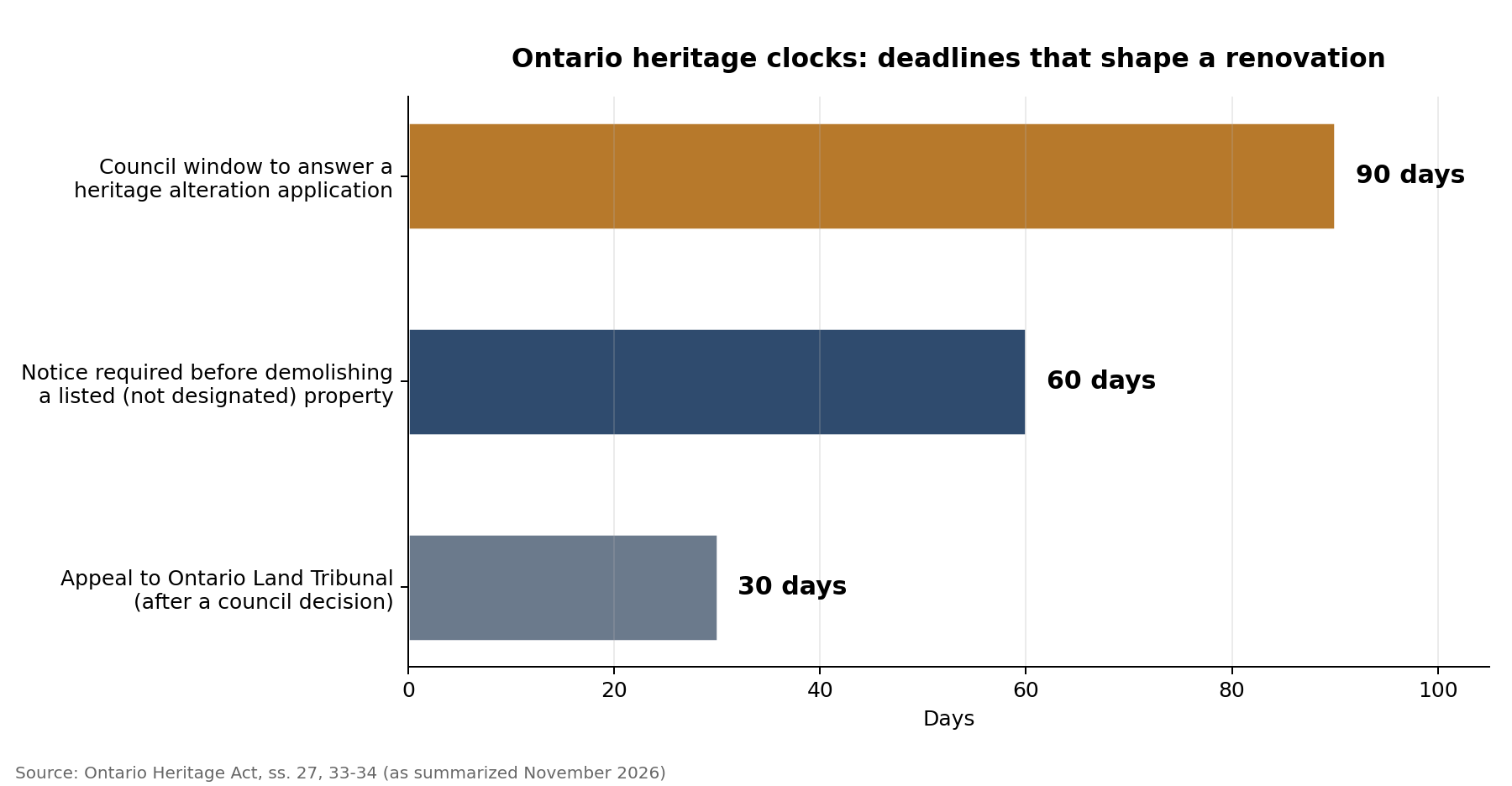
Ontario heritage clocks: deadlines that shape a renovation. Source: Ontario Heritage Act, November 2026.
The practical translation: a designated house rewards repair-over-replace thinking. Replacing original wood sash windows with vinyl substitutes is exactly the kind of change a by-law is written to stop; restoring the same sash with new putty and weatherstripping is exactly the kind it is written to encourage. Additions are not banned either — the pattern that succeeds is an addition that is architecturally compatible and set back so it does not obscure the heritage facade. Before you fall in love with a transformation, read which renovations actually pay back at resale in Canada alongside the by-law, so the work you are allowed to do is also the work worth paying for.
The money: grants, tax rebates, and cost-sharing
Heritage ownership costs more to do properly, and three layers of public money exist to narrow the gap. None of them is automatic, all of them are capped, and a private single-family house qualifies for fewer of them than headlines suggest — so verify eligibility for your exact property class before you budget a dollar of help.
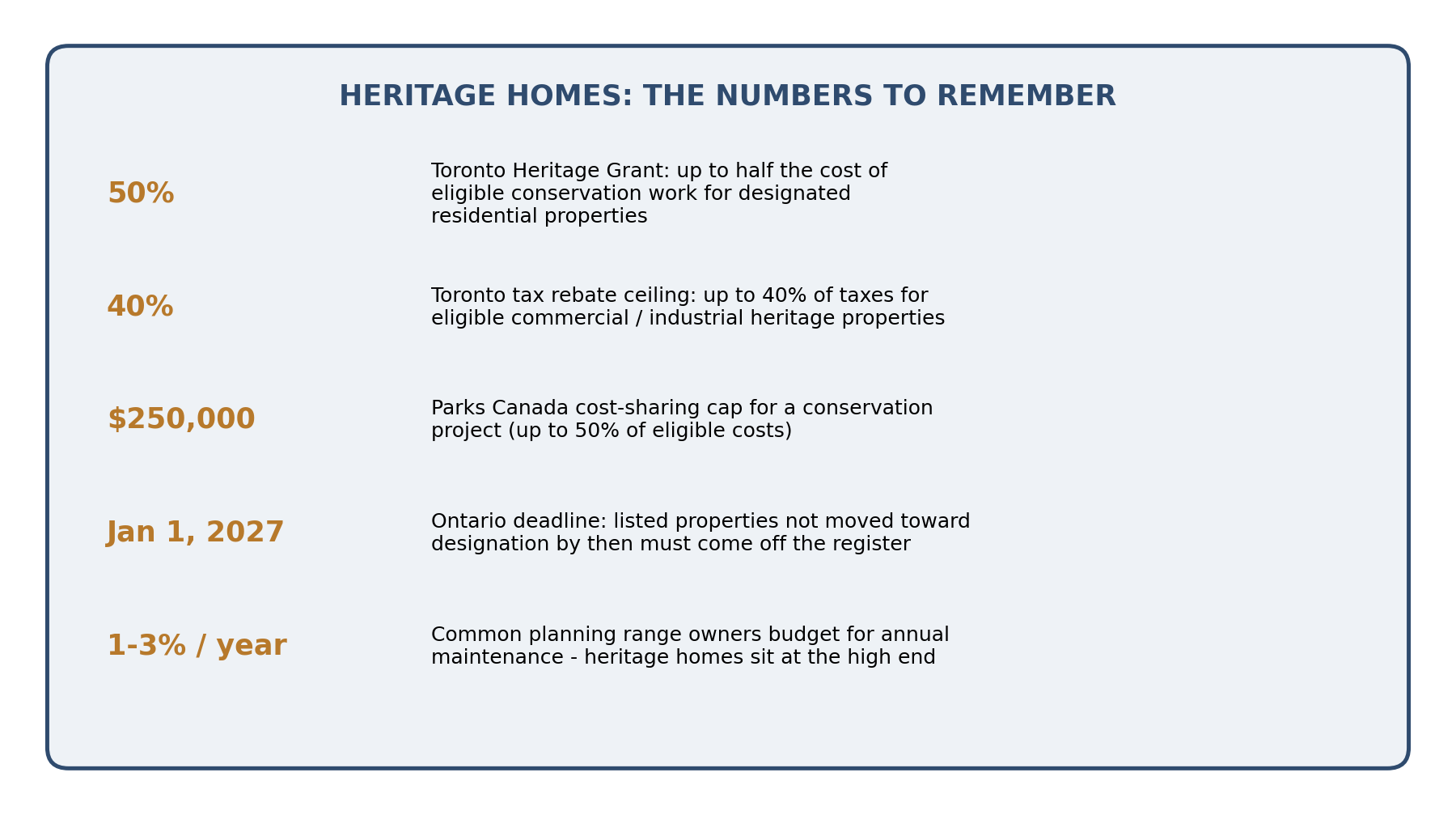
Municipal grants. The Toronto Heritage Grant Program provides funds of up to 50 per cent of the estimated cost of eligible heritage conservation work to designated residential or tax-exempt heritage properties, for properties designated under Part IV or Part V of the Ontario Heritage Act. For a Toronto house buyer, that is the most directly relevant program in this article: half the cost of eligible work on the protected fabric, matched by the owner.
Municipal tax rebates. Ontario lets municipalities set heritage tax relief between 10 and 40 per cent. Toronto's Heritage Property Tax Rebate Program is at the top of that range — a rebate of up to 40 per cent of annual taxes — but note the eligibility shape in the current by-law: the Toronto rebate is aimed at commercial and industrial heritage properties, requires a heritage easement or maintenance and conservation agreement, and is capped at 50 per cent of the cost of eligible maintenance and conservation work, with an annual cap of $500,000 for a Part IV property and $50,000 for a Part V property. Other GTA municipalities run their own versions — Whitby at 40 per cent, Markham at 30 per cent, Ajax at 10 per cent in published Toronto Real Estate Board guidance — and many municipalities offer no program at all. A residential buyer should treat a tax rebate as a question to ask the municipality, never as an assumption.
Federal cost-sharing — with a hard eligibility wall. Parks Canada's National Cost-Sharing Program for Heritage Places can reimburse up to 50 per cent of eligible costs, up to $250,000 for a conservation project and up to $25,000 for preparatory or presentation work. For 2027–28 the program has up to $2 million available nationally, with applications closing December 8, 2026; in 2026–27 it awarded $2.9 million across 21 projects. The wall is this: eligible applicants are not-for-profit organizations, Indigenous organizations, and governments that own or long-term-lease a federally recognized heritage place — national historic sites, heritage lighthouses and heritage railway stations. Private homeowners and for-profit owners are excluded. It belongs in this guide so a buyer does not mistake a national headline for a personal entitlement — and because a heritage house beside, or converted within, an eligible institutional property sometimes participates through its owner organization.
The order of operations matters for every program: work generally must follow the Standards and Guidelines for the Conservation of Heritage Places in Canada, use historically appropriate materials, and — critically — must not begin before grant approval. A roof replaced in a hurry in October is a roof you funded alone.
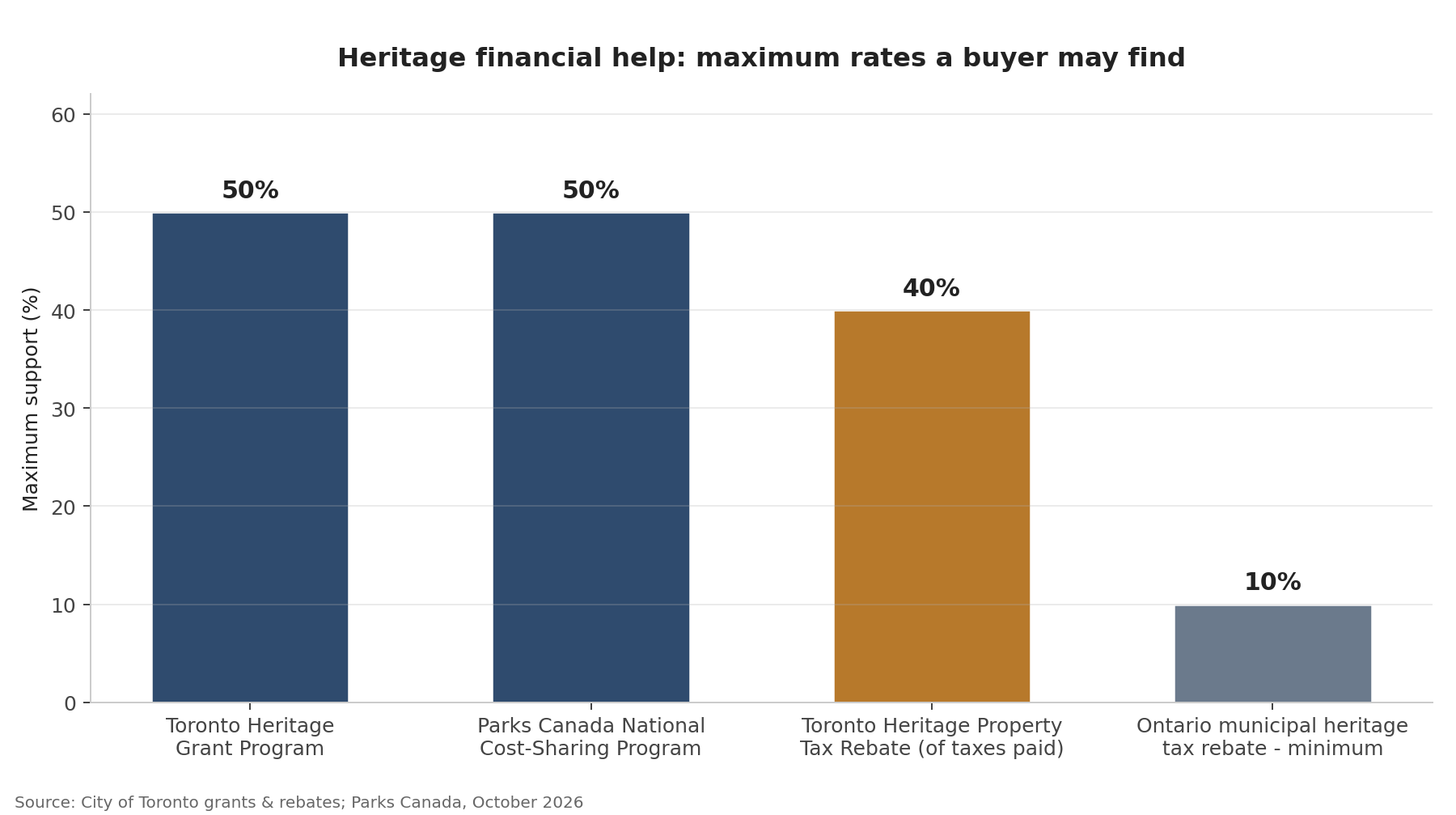
Heritage financial help: maximum rates a buyer may find. Source: City of Toronto; Parks Canada, October 2026.
Insurance: the second approval you did not expect
A heritage house is harder and often more expensive to insure than a standard house of the same size, for reasons that compound. The construction is unique, the materials are specialized, repairs may need municipal approval after a loss, and many standard insurers restrict or decline the risk, pushing owners toward specialty policies with higher premiums and more detailed applications. Insurers will want to understand the current state of wiring, plumbing and heating in particular: knob-and-tube or early cloth-insulated wiring, galvanized supply lines and older boilers are common in vintage houses and can affect both insurability and a lender's comfort.
Two questions decide most heritage insurance outcomes. The first is the rebuilding term: will the policy pay to rebuild with like materials and craftsmanship — which is what a designation may effectively require — or does it cap, exclude or cash-settle parts of that cost? The second is exclusions, which on older properties can include risks such as overland flooding. Price the insurance during your condition period, not after closing, and read home insurance and climate risk in Canada for the flood and premium questions that apply to any older house, designated or not.
The house itself: systems, hazards, and the 1–3 per cent rule
Designation protects the visible fabric; it does nothing about the invisible systems. A heritage purchase therefore needs two inspections in one visit's clothing: a conservation eye for the protected attributes, and a hard-nosed systems check of everything behind the walls. Roofs and flashing around chimneys, wood cladding and verandahs needing paint, caulking and localized rot repair, original windows that can usually be restored rather than replaced, foundations, structure and moisture control first — the sequencing rule experienced owners use is moisture, structure, roof and mechanical systems before finishes.
Older Canadian houses also carry a specific hazard list that has nothing to do with heritage status and everything to do with age: radon, asbestos in old insulation and tiles, lead paint and pipes, urea-formaldehyde foam insulation, and buried oil tanks. Our dedicated guide to hidden hazards in older Canadian homes — radon, asbestos, lead, UFFI and buried oil tanks sets out what to test for and in what order, and a general home inspection in Canada explains what an inspector will and will not catch. On a heritage purchase, waiving inspection to win a bidding war risks buying both a protected facade and an unprotected five-figure remediation bill.
For budgeting, a common planning guideline is 1 to 3 per cent of the purchase price per year for maintenance, with heritage houses at the higher end — especially where work has been deferred. That range is a planning rule of thumb from published buyer guidance, not a quote: get trade estimates for the specific deferred items your inspection names, and remember that a heritage-appropriate repair can cost more than its modern substitute because the materials and the skills are scarcer.
A worked way to decide: is the discount — or the premium — fair?
Heritage houses do not price like-for-like with their neighbours, and both directions occur. A designation can support value: protected streetscapes cannot be casually demolished around you, original fabric that survives is genuinely scarce, and some buyers will pay for character that cannot be built new at any reasonable cost. It can also narrow the buyer pool at resale: the next owner must accept the same permit step, the same insurance conversation and the same maintenance discipline, and a buyer whose plan depends on a large addition over the heritage facade is a buyer who will walk away.
Price the specific house, not the category. Start with comparable sales on the same street or district, then adjust honestly for the three heritage deltas: the cost of deferred conservation work your inspection found (net of any grant you have confirmed, in writing, that the property can receive), the value of the plans the by-law rules out (a teardown, a facade-altering addition, a window package), and the scarcity value of intact attributes in your market. If the asking price assumes none of the costs and all of the charm, negotiate. If it already carries a discount larger than the confirmed work, a patient buyer who actually likes the rules can do well.
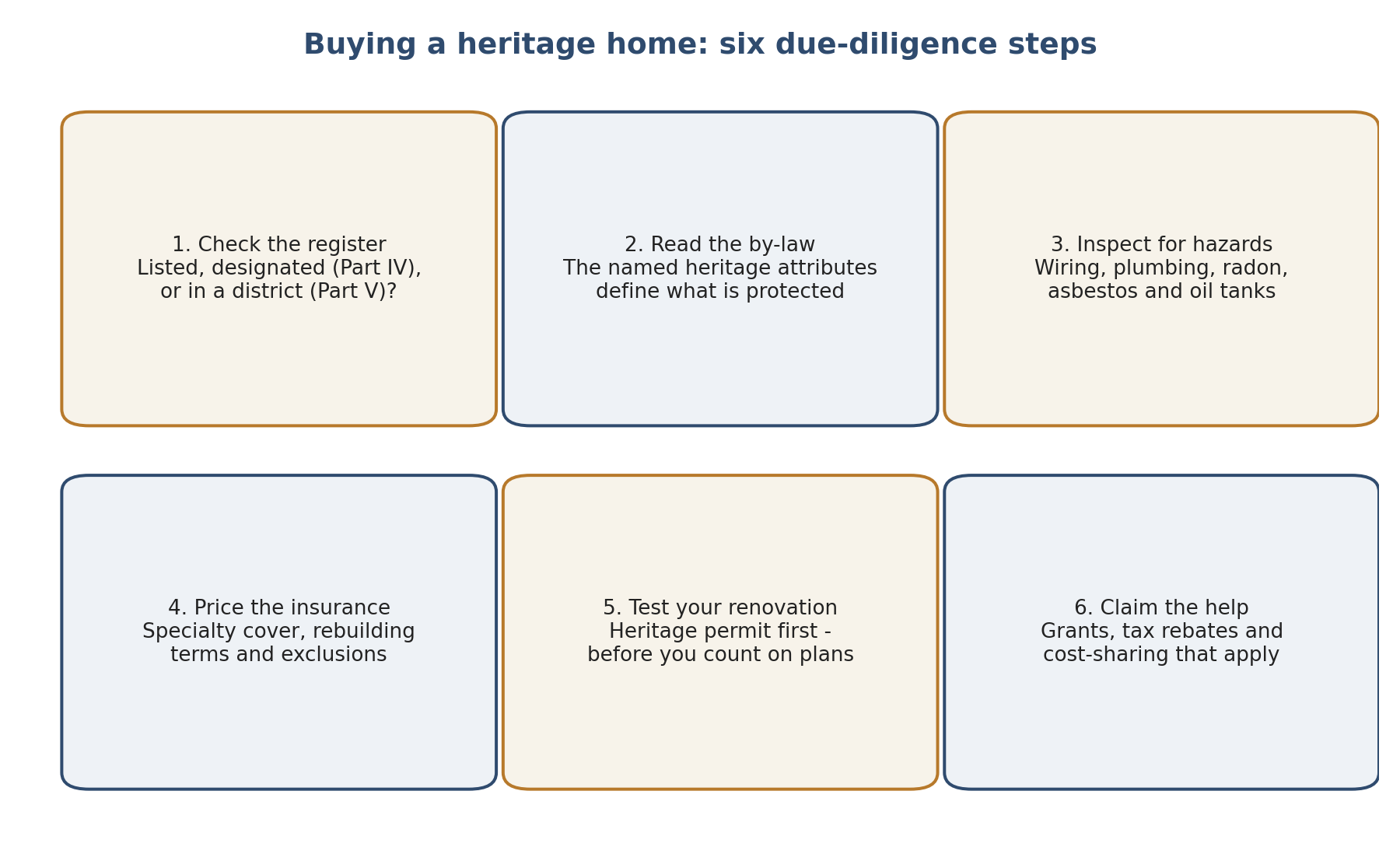
Six due-diligence steps before you write the offer
- Check the register yourself — listed, Part IV designated, Part V district, or none of the three — using the municipal register or Toronto's Heritage Register Tool.
- Read the designation by-law or district plan and list the named heritage attributes. That list, not the home's age, defines your obligations.
- Inspect twice over: protected fabric plus systems and hazards, with estimates for deferred work.
- Bind the insurance early: a specialty quote with rebuilding terms you have actually read, obtained inside your condition period.
- Test your renovation against the permit process with municipal heritage staff before the offer firms up — including the 90-day decision clock in your schedule.
- Confirm every dollar of help in writing: grant eligibility, any tax rebate for your property class, and the rule that approved work must not start before approval.
The bottom line
A heritage home is not a loophole, a trap, or a museum. It is a house with a public document attached that names the features a community has decided are worth keeping — and a set of grants, clocks and permit steps that reward an owner who reads that document first. Buyers who check the register, read the by-law, price the insurance, test their renovation plans with staff, and confirm their grants before closing routinely find designation a manageable condition of owning an irreplaceable house. Buyers who skip those steps are the ones who call it a nightmare. The difference is about a week of homework.
Sources: Ontario Heritage Act, ss. 27, 29, 33, 34 and 41 (summaries checked November 2026); City of Toronto — Heritage Property Tax Rebate Program by-laws 1043-2005 and 263-2019, and Grants, Incentives & Rebates program pages; City of Oshawa — designated properties, alterations and demolition guidance; Parks Canada / Government of Canada — National Cost-Sharing Program for Heritage Places, October 2026 call (up to $2 million for 2027–28, applications close December 8, 2026; $2.9 million awarded to 21 projects in 2026–27); Toronto Real Estate Board heritage rebate municipal summary. Program terms change — confirm eligibility with your municipality before relying on any figure.



Comments
No comments yet. Be the first to share your thoughts.